



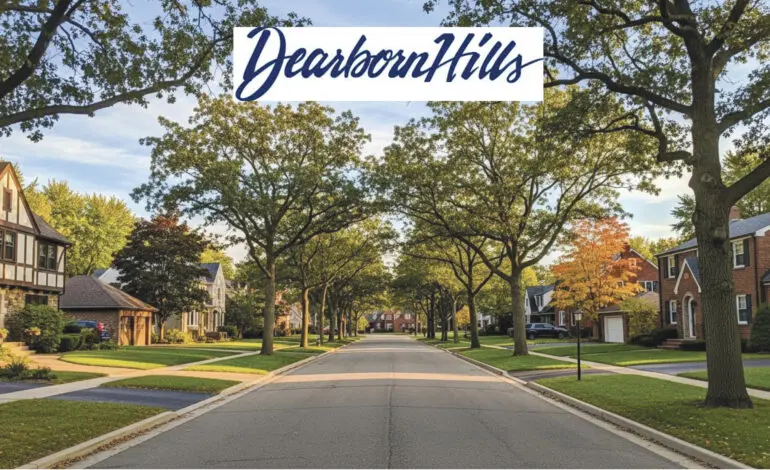

DEARBORN — Dearborn Hills is one of Dearborn’s most established and appealing neighborhoods for families, known for its historic character, tree-lined streets and proximity to west downtown. But a growing number of property owners in this quiet neighborhood are expressing deep frustration with what they describe as the neighborhood association’s “hostile” and “exclusionary” policies, particularly toward nonmembers, amid accusations of anti-Arab racism among association officials.
In a neighborhood of 1,260 homes, the Dearborn Hills Civic Association has just 138 members, according to its treasurer. Those members control the restrictions and rules enforced on all properties, regardless of whether their owners belong to the association. Some property owners accuse association officials of monopolizing the organization and failing to welcome new members.
Tensions between the association and several Dearborn Hills residents spilled into public view on Tuesday evening, October 6, when several nonmembers were barred from attending the association’s 101st annual meeting, prompting Dearborn Police to respond.
What happened at the meeting entrance exposed a complex dispute involving the association’s rules, membership policies and regulations, amid lawsuits against several neighborhood property owners.
Some homeowners say disagreements with the association over alterations to their properties quickly escalated into litigation. While some Arab Americans describe discriminatory treatment targeting them because of their ethnicity, those objecting to the association’s conduct also include White property owners, who make up the majority of residents in the neighborhood bordering the Dearborn Hills Golf Course.
Association officials deny allegations of racial discrimination and targeting Arab property owners. They maintain that enforcing the neighborhood’s regulations is “necessary to preserve Dearborn Hills’ historic character.”
Like other neighborhoods in west Dearborn, Dearborn Hills has seen steady growth in its Arab population in recent years as families purchase and renovate properties.
Who participates in the association?
An association official told The Arab American News that membership stands at 138, with annual dues of $25.
Figures presented at the meeting showed that the association received 107 membership payments during the year, along with 46 advance payments for future years. Adding those figures does not establish the current membership total, but it raises questions about participation in an association whose members elect its leadership while its deed restrictions apply to properties belonging to residents who are not necessarily members.
Membership is voluntary, but the restrictions are attached to the property itself. The association explains that some exterior projects homeowners submit to the city of Dearborn may also require its review, and that Dearborn Hills’ restrictions may be stricter than city regulations. It also says it has two volunteers who review plans and that the review process typically takes up to 30 days.
The association maintains that the restrictions “run with the land” and that neighborhood residents voted in 1999 to extend them through 2049. A homeowner may therefore choose not to join the association while remaining subject to the restrictions it decides to enforce.
Paying at the meeting entrance
The annual meeting took place in the Memorial Parlor, inside the Cherry Hill United Presbyterian Church Offices in Dearborn. The association had announced the meeting on its website and through signs posted along neighborhood streets.
A sign photographed by The Arab American News read “Annual Meeting — Tuesday — 7 p.m.” alongside the association’s name and a reference directing residents to its website. It did not display the words “members only.” The official website, however, described the event as the “101st Annual Member Meeting.” When several residents arrived, nonmembers were not permitted to enter.
Joe Corso, who has lived in Dearborn Hills for 33 years, was among the most vocal objectors. He said he understood restricting voting to association members, but strongly objected to being prevented from attending and listening.
“Why should I have to pay $25 to hear what is happening in my neighborhood?” he asked.
As the exchange intensified, Corso said he was told police might be called to remove him.
“Call the police,” he responded. “I want them to remove me.”
Corso left before police arrived, but the dispute continued with others who were denied entry. Dearborn Police officers later arrived and spoke with both sides.
Corso’s experience shows that the objections are not limited to Arab American residents. His complaint centered on his right, after 33 years of living in the area, to listen to the proceedings of an association bearing his neighborhood’s name.
In the courts
For Abdul Beydoun, the dispute went beyond membership to involve his home and the courts.
Beydoun said his problems began in May 2024, when he submitted plans through his contractor to landscape his yard and install a circular driveway. He explained that his family has five vehicles and that difficulty parking on the street was one reason for the project.
According to his account, someone from the association came to inspect the project about two weeks later, but he received neither approval nor a denial within 30 days. He therefore began work after the 31st day. He said the disagreement subsequently developed into several legal disputes involving the driveway, paving, shed, porch and garage.
“All I’m doing with my home is trying to make it beautiful,” he said. “My house was built in 1954. It needs updating.”
Beydoun described what he has experienced as “harassment” and accused the association of being particularly strict with some Arab residents. He called for greater Arab American representation on the board and a more effective way to resolve disagreements before they reach the courts. The association denies that race, national origin or religion plays any role in its dealings with residents.
Steve Hamade said his disagreements with the association had led, according to his account, to four lawsuits. He said a case involving his porch remains pending, while other disputes ended in his favor.
He summed up his objection with a question: “Before you sue your neighbor, why don’t you reach out to him? Why don’t you go and meet with them first? Why don’t you have a conversation with them first?”
That raises a fundamental question: What happens before litigation, and who decides to file a lawsuit?
Margot Cleveland’s position within the association is significant here. She serves as board secretary, and the Michigan Court of Appeals previously described her as both a board member and the association’s legal counsel. No information establishes that she alone decides whether to sue homeowners. However, her combined administrative position and legal role make her an important figure in understanding how disputes that reach the courts are managed.
Threat of a defamation lawsuit
The Arab American News’ contact with Cleveland did not begin by email. It began face-to-face on the night of the annual meeting, when Cleveland asked how the newspaper had learned about the meeting. The Arab American News explained that the date had been posted on the association’s website and on signs throughout Dearborn Hills, and that covering local community affairs is part of its journalistic work.
During the conversation, Cleveland asked The Arab American News to email its questions to her, which the newspaper did. Her subsequent written responses varied in tone depending on the subject.
Arab American News: What are the main challenges facing the Dearborn Hills Civic Association today, especially as the community and its demographics continue to change?
Cleveland: “In recent years, Dearborn Hills has been blessed to see an influx of young growing families, which is reinvigorating. And tonight the DHCA was thrilled to connect with some young moms who are excited to volunteer with the Board to organize some fun new events for the kids.”
Arab American News: We’ve heard concerns from residents that certain households have had difficulty joining the association. Some Arab American residents have also raised concerns about being treated differently. How do you respond to these concerns?
Cleveland:” Any statement that suggests the DHCA has improperly barred residents from joining the DHCA or that suggests the DHCA treats residents differently based on race, national origin, sex, religion or any other characteristic is false and defamatory and if you publish any such statement, you personally and your newspaper can expect a defamation lawsuit —something we will succeed with as we have when such falsehoods were previously peddled. See DHCA v. Scripps.”
Arab American News: I also wanted to follow up about what happened during today’s meeting between you and some of the people who were there. I want to give you the opportunity to share your side and explain what happened from your perspective. If there is anything you would like to clarify or add about the situation, please feel free to share it with me.
Cleveland: The DHCA is a voluntary civic association that holds an annual meeting for its members. Any statement that suggests the DHCA improperly barred individuals from attending the civic association’s meeting is false and, if defamatory, and you publish any such statement, you personally and your newspaper can expect a defamation lawsuit — something we will succeed with as we have when such falsehoods were previously peddled. See DHCA v. Scripps.
But when the newspaper’s questions addressed membership and some residents’ allegations of unequal treatment, her response took a sharper legal tone. She said any statement suggesting that the association had improperly prevented residents from joining, or that it treated residents differently based on race, national origin, sex, religion or any other characteristic, was, in her words, “false and defamatory.”
Her response went beyond denying the allegations. She added that The Arab American News and its reporter could expect a defamation lawsuit if the newspaper published such statements. She said the association would prevail in such a lawsuit, as it had, according to her, when “similar lies” were raised previously, and referred the newspaper to the case of Dearborn Hills Civic Association v. Scripps Media Inc.
However, Michigan Court of Appeals records from 2022 show that the trial court had granted summary disposition to the defendants after concluding that the statements at issue were not defamatory. The Appeals Court subsequently affirmed the decision in part and reversed it in part, meaning the published court proceedings cannot be reduced to a complete “victory” for the association.
In another question, The Arab American News asked for her position on people who reside in the subdivision and own their homes being barred from attending the annual meeting of the subdivision association. Cleveland responded that the Dearborn Hills Civic Association is “a voluntary civic association that holds an annual meeting for its members.” She then said any statement suggesting that the association had improperly prevented individuals from attending the meeting was “false.” She repeated that if the published material was defamatory, the newspaper and its reporter could expect a defamation lawsuit, again citing the Scripps case. This was indeed the wording she used in her two written responses concerning unequal treatment and the annual meeting.
Following the meeting and her emailed responses, The Arab American News contacted Cleveland again, giving her an additional opportunity to explain what happened at the meeting entrance, the reasons for the disagreement over admitting nonmembers and to provide any other comments she wished to include in the report. The newspaper received no further response from her by the time this report was prepared and published.
Discrimination allegations
Some Arab American residents accuse the association of treating them differently, allegations the association and Cleveland categorically deny. One resident and homeowner told The Arab American News that he wanted to see the neighborhood’s diversity better reflected in the association and its board, adding, “I just want diversity.”
Association representatives, meanwhile, defend the restrictions as a way to preserve Dearborn Hills’ character. John Matthews, the association’s vice president, said anyone buying a home in the neighborhood should know the conditions attached to the property, while acknowledging that some restrictions may need to be amended.
Alice Thornton Lopez, who has lived in the neighborhood since 1988, said she had not experienced problems with the association. However, she acknowledged that some rules had become “old-fashioned” and might need to change. She also expressed understanding of newer residents’ desire to improve their homes.
“I am open and welcoming to everyone,” she said. “I am open to change.”
A separate lawsuit against the city of Dearborn
In a case legally separate from the homeowners’ disputes, Cleveland filed a federal lawsuit in September against the city of Dearborn and Mayor Abdullah Hammoud, accusing the city of religious favoritism. The suit concerns what she considers the use of public funds and property to celebrate Ramadan without providing Christian and Jewish observances with comparable treatment, according to her allegations. The city rejected those accusations, maintaining that its practices involve neither religious discrimination nor favoritism toward one religion over another.
That lawsuit does not establish whether the residents’ allegations against the association are true or false. But it places Cleveland’s position on equality in a striking context: In her lawsuit against the city, she demands equal treatment, while denying allegations by some Dearborn Hills residents that the association, in which she holds an administrative position and serves a legal role, treats some of them differently.
A crisis of trust
What the October 6 meeting revealed goes beyond a disagreement over who enters the room and who remains outside. The issue concerns the relationship between a civic association with voluntary membership and homeowners affected by decisions tied to their properties even when they are not members.
The association has the right to defend restrictions it says protect Dearborn Hills’ character, and residents have the right to ask how those restrictions are enforced and to challenge decisions affecting their homes. The association categorically denies allegations of unequal treatment, while objections from residents such as Corso show that the crisis of trust extends beyond race alone.
Hamade’s question remains one of the clearest expressions of the dispute:
“Before you sue your neighbor, why don’t you talk to him?”
The test facing the Dearborn Hills Civic Association is not only its ability to enforce restrictions, but also its ability to convince residents that its decisions are clear and consistent, that standards are applied to everyone in the same way, and that a path to dialogue and objections exists before a disagreement becomes a court case.



Leave a Reply