



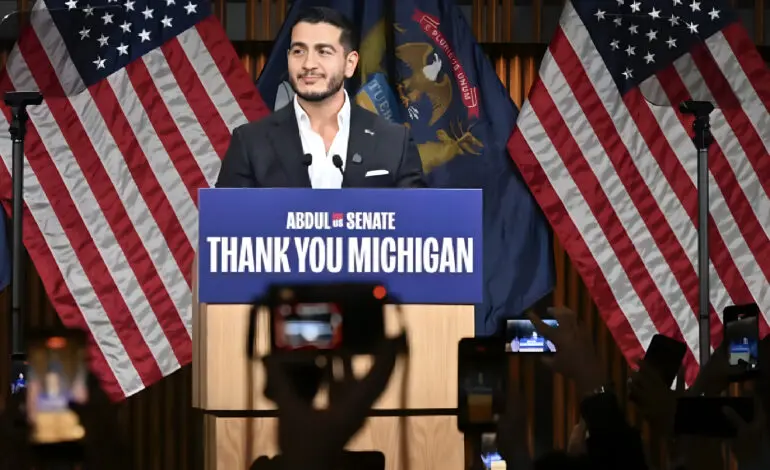

Arab American Abdul (Abdulrahman) El-Sayed made U.S. political history Tuesday, becoming the first Muslim elected to the U.S. Senate after defeating Republican Mike Rogers in a fierce campaign during which Republicans targeted the Democratic candidate’s religious and ethnic background.
El-Sayed won the statewide Michigan race by approximately 335,000 votes, overcoming relentless waves of coordinated smear campaigns and incitement, unprecedented spending and a late reversal by his Democratic primary opponent, U.S. Rep. Haley Stevens, who endorsed Rogers in the closing days of the race.
Unofficial results underscored El-Sayed’s substantial victory. With approximately 98 percent of the vote counted, he received 2,507,906 votes, or 52.5 percent, compared with Rogers’ 2,173,595 votes, or 45.5 percent.
El-Sayed’s victory, at age 42, was the crowning achievement of the blue tsunami that swept the midterm elections, securing Democrats a commanding U.S. Senate majority of at least 54 seats, pending final results in Mississippi and Alaska. Democratic candidates scored decisive victories in Iowa, Carolina, Ohio and Texas.
The shift in control marks a pivotal change in the balance of power on Capitol Hill, giving Democrats greater leverage and stronger oversight authority to constrain Republican President Trump’s administration during the remaining two years of his term.
Victory speech
Addressing a large crowd of supporters early Wednesday at Hudson’s Tower in downtown Detroit, El-Sayed opened his victory speech by introducing himself by his full name, Abdulrahman Mohamed El-Sayed — a direct response to months of attacks questioning his faith, identity and loyalty to the United States.
The former director of Wayne County’s Department of Health, Human and Veterans Services repeated his campaign’s central themes amid an enthusiastic reception: getting money out of politics, putting money in people’s pockets and Medicare for All.
“Michigan, we did it,” he said. “I am proud and honored to stand here before you as senator-elect from the great state of Michigan.”
El-Sayed praised the grassroots supporters who stood by him throughout the campaign and voters who took a chance on “the unlikeliest of candidates.”
“This success belongs to you, the people of Michigan,” he said. “I cannot wait to serve you with the same big hearts, open minds and determination you have shown me. You welcomed me into your homes, churches, synagogues and places of worship, veterans’ halls and union halls. You shared your moments of frustration and grief with me, and you gave me compassion and strength at my lowest moments, and the hope and inspiration that fuel my best. I love you all, and I hope to take all of that with me to Washington in your service.”
The senator-elect reflected on the fierce campaign and personal attacks against him.
“The past month revealed the true stakes of this election,” he said. “This beautiful movement was built over a year and a half, across Michigan’s biggest cities and smallest towns, to talk to you about a brighter future.”
He contrasted that effort with corporate-funded media campaigns designed to mislead and distract voters.
“Our opponents decided to divide us by pointing to my name and my faith,” he said. “When that did not work, they threw their full weight behind one of the ugliest campaigns we have seen in our lifetimes. But we all know that my name and my faith are not the reason you cannot afford gas, groceries or a visit to the doctor.”
Explaining why he did not respond in kind to the vicious attacks, El-Sayed emphasized that he had not run for personal gain.
“The truth is, they were not targeting me. They were targeting you, and the very idea of America,” he said. “They hate the idea of an America big enough for someone who looks a little different, prays differently or whose family comes from a different part of the world.”
“They turned this into a simple choice,” he continued. “They want an America too small for some of us, while we know America is big enough for all of us and big enough to confront the crises we face, even as Trump’s insults grow uglier and cruder by the day.”
El-Sayed delivered pointed, mocking messages to his opponents and other Republican leaders.
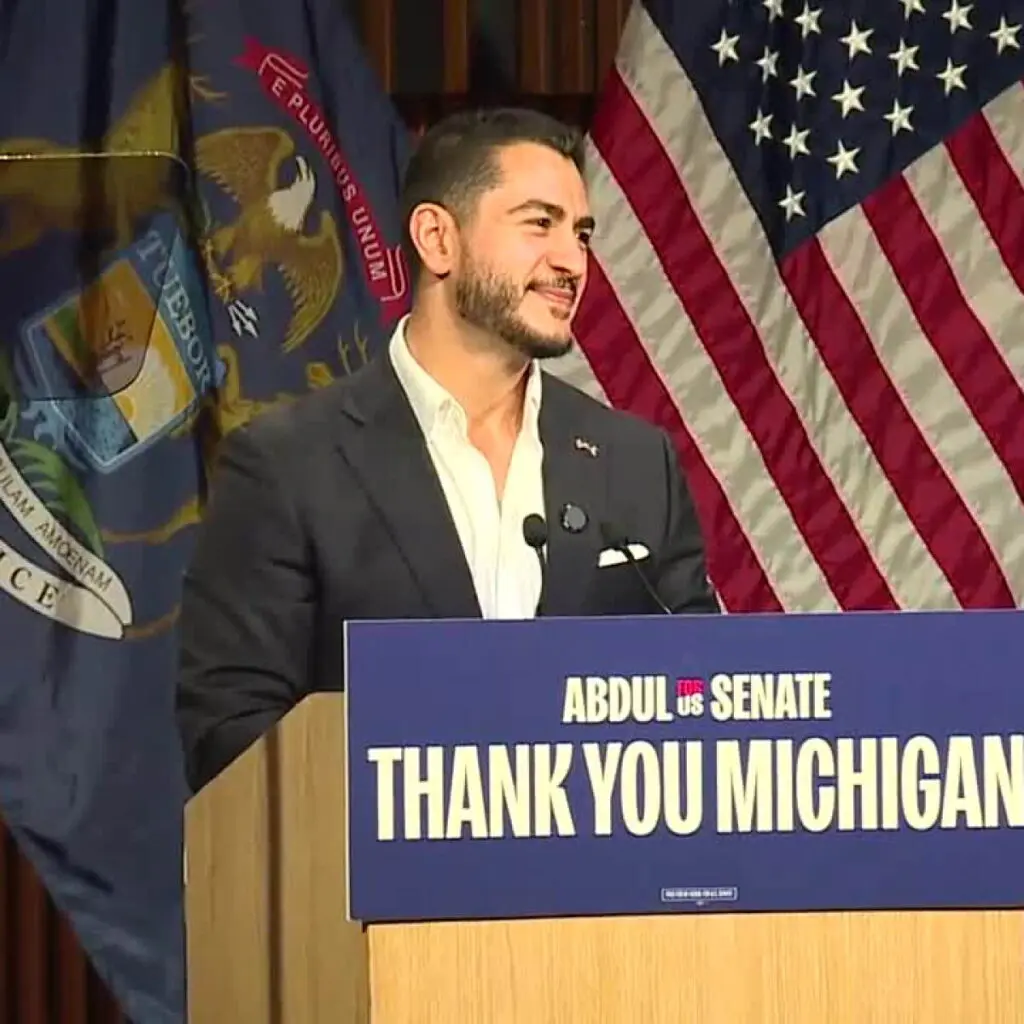
Abdul El-Sayed delivers his historic victory speech at the Hudson’s in Detroit early Wednesday, November 4. – Video grab
“Throughout our primary and general election campaigns, they spent more than $350 million trying to defeat us — a record here in Michigan,” he said. “But we built something bigger than bank accounts. We built a movement for government of the people, by the people and for the people, and we proved that in a fight between money and the people, the people win.
“To all the children and parents who watched the public mockery of our names and the way we pray, tell them the bad guys lost, and together we won,” he added. “So, Mike, enjoy your retirement in Florida. You chose hate, and Michigan chose hope. I hope we never see the likes of you here again.”
He then turned to Vice President JD Vance with a quip that drew widespread attention from news outlets and social media.
“JD, habibi, there is a delicious irony in the fact that you are constitutionally obligated to swear me in next January,” he said. “Do you know what that means? It means Wolverines 1, Buckeyes 0.”
The remark referred to the fierce college football rivalry between El-Sayed’s alma mater, the University of Michigan, and Vance’s alma mater, Ohio State University.
El-Sayed also addressed Trump, recalling the president’s deliberate, mocking difficulty pronouncing his name. After his January swearing-in, he said, Trump could “simply go ahead and call me senator.”
The senator-elect reaffirmed his positions on foreign policy and political lobbying money, taking aim at the American Israel Public Affairs Committee, or AIPAC, which spent more than $42 million against him.
“Thank you for giving me the opportunity to beat you twice,” he said, referring to his victories over Stevens in the August primary election and Rogers in the November 3 general election.
“When we demand that Palestinian children live peacefully in their ancestral homeland without being killed with our tax dollars, and when we believe in dignity, rights and equality, that is not hate,” he added. “That is love.
“Michiganders want their tax dollars spent here, on schools, health care and infrastructure, not on apartheid, genocide and wars,” he continued. “They told us there was no way to beat the money, that a Muslim with my name and my story was unelectable. But we defeated $350 million and the political machine, and proved that the people decide whom we send to Washington and what Washington will do.”
El-Sayed concluded by reflecting on his life and his vision for America.
“Where else but America could a doctor named Abdulrahman Mohamed El-Sayed, a child of immigrants, be elected senator from the greatest state?” he asked. “I love America, and I know exactly what it has given me in education, vaccinations and care. But I love it enough to ask that it be there for all its children, and that we uphold the unalienable rights to life, liberty and the pursuit of happiness.”
Born in Michigan in 1984, El-Sayed is an epidemiologist of Egyptian descent. He served as Detroit’s public health director and later led Wayne County’s health department. He previously ran unsuccessfully for governor in the 2018 Democratic primary against Gov. Whitmer.
El-Sayed studied at the University of Michigan before continuing his education at Oriel College at the University of Oxford. He later earned his medical degree from Columbia University.
A last-minute defection backfired
Two days before Election Day, Democratic U.S. Rep. Haley Stevens surprised state party officials by endorsing Rogers and appearing with him at campaign events in Detroit on Sunday.
The move was described as a political earthquake, and Republicans placed considerable hope in its ability to help defeat El-Sayed.
Stevens’ abrupt reversal followed a similar announcement just seven days earlier by her fiancé, Jason Turkish, who said he was supporting and voting for Rogers. The moves were intended to deliver a calculated, two-pronged blow to El-Sayed’s campaign in its final stretch.
Although Stevens had endorsed El-Sayed after losing the Democratic primary last summer, she reversed course, explaining that she had come to feel “unwelcome in El-Sayed’s campaign.” El-Sayed repeatedly declined to comment on his former rival’s sharp change of position.
Stevens’ eleventh-hour endorsement of Rogers in the Michigan Senate race backfired. It drew widespread condemnation from Democrats and local leaders, who portrayed it as the culmination of bitterness over her bruising August primary defeat. El-Sayed had secured the Democratic nomination despite tens of millions of dollars spent supporting her campaign by the pro-Israel lobby and its affiliated groups.
Rejecting racist rhetoric
Throughout the campaign, El-Sayed, a member of the Democratic Party’s progressive wing, faced unprecedented political attacks on his religious identity, political views and patriotism. Observers said overcoming those attacks gave his victory particular significance beyond its historic importance.
Republicans portrayed Democrats as communists and described El-Sayed as a terrorist who would endanger Americans. He, meanwhile, pledged to help people with limited incomes obtain health care.
In the campaign’s final weeks, intensive advertising and repeated statements by Republican leaders and candidates sought to question El-Sayed’s loyalty and accuse him of terrorism and ties to the Muslim Brotherhood, attempting to frighten voters away from supporting him.
Trump repeatedly called the Democratic candidate “Mohamed” rather than “Abdul”, describing him as a “radical extremist and terrorist sympathizer.”
The verbal attacks escalated at Republican rallies. At a gathering in Port Huron last month, Trump called El-Sayed a “jihadist”, alleged ties to the Muslim Brotherhood and warned against electing him to the Senate. He then joked that El-Sayed would be the only senator who needed to pass through a metal detector before entering the Capitol.
Similarly, at a Sterling Heights rally, Vance urged voters not to support El-Sayed, calling him “very evil” and accusing him of sympathizing with extremist forces and attempting to divide Americans along racial and religious lines.
Rogers adopted a similar approach after El-Sayed won the Democratic nomination in August.
“I spent years hunting terrorists and bringing Osama bin Laden to justice,” he said. “I never imagined I would run against someone who believes America deserved the September 11 attacks.”
Nevertheless, El-Sayed’s victory Tuesday was resounding. He won counties traditionally favorable to Republicans, including Isabella, Muskegon, Leelanau and Grand Traverse. He also prevailed in Oakland County communities with substantial Jewish populations, despite efforts by Israel’s supporters to portray him as antisemitic.

Leave a Reply