



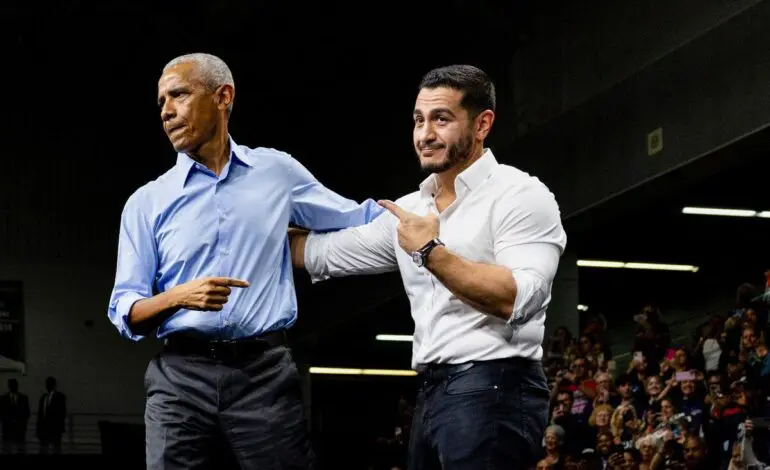

DETROIT, PORT HURON — In the final stretch of Michigan’s fiercely contested U.S. Senate race, former President Obama traveled to Detroit to underscore Democratic Party unity behind its nominee, Abdul El-Sayed. President Trump responded the following day with a campaign rally about 60 miles north of Detroit, in Port Huron, where he sharply attacked El-Sayed and falsely accused him of belonging to the Muslim Brotherhood.
Obama addressed thousands of supporters at Cass Technical High School on Saturday, declaring his full support for El-Sayed as early in-person voting opened statewide in Michigan.
The former president vigorously defended El-Sayed against political attacks by right-wing extremists and Trump, targeting his name and religion.
“They resort to lies, fearmongering and division,” Obama said. “They may even use your name or your beliefs to suggest that you somehow pose a danger… I’ve seen this movie before, and I’m the star of this movie.”
Obama recalled similar campaigns questioning his middle name, Hussein, and his birthplace.
The former president also joked about El-Sayed’s previous public criticism of his administration.
“Abdul didn’t agree with some of my administration’s decisions… But do you know who else doesn’t agree with me on everything? Michelle Obama,” he said, emphasizing that disagreements over specifics did not change the fact that El-Sayed shared his fundamental values.
Obama said El-Sayed was fighting for “real change” aimed at getting corporate money out of politics and providing universal, affordable health care by building on the Affordable Care Act, also known as Obamacare.
During his speech, Obama joked about El-Sayed’s physique, particularly his muscular arms. The former president wondered why El-Sayed always wore short-sleeved shirts or rolled up his sleeves.
“Do you see those biceps? That’s why he always wears those shirts!” Obama said, praising El-Sayed’s athletic background during his school years.
Obama also sharply criticized Trump’s war with Iran, blaming it for higher fuel prices and mounting economic pressure on American families. He called it “an unnecessary war nobody had asked for and nobody voted for.”
He defended the nuclear agreement negotiated during his administration, saying diplomacy had restricted Iran’s nuclear program without requiring military action. Obama argued that Trump’s war had instead left American troops and allies exposed to attacks and strengthened Iran’s strategic leverage over oil shipments through the Strait of Hormuz.
Turning to trade, Obama criticized tariffs on Canada, stressing their consequences for Michigan’s auto industry, whose production networks depend on parts moving between the two countries. He argued that tariffs increase costs for manufacturers and consumers rather than bringing prices down.
Obama also mocked Trump’s confrontational approach toward Canada, describing it as a friendly neighbor and criticizing his talk of annexing the country as the 51st state. He said the administration’s trade policies were raising prices while failing to deliver its promised reduction in federal deficits.
Obama urged voters to turn out and support Michigan’s entire Democratic ticket, including gubernatorial nominee Jocelyn Benson, who joined them onstage.
At the conclusion of the rally, the three clasped hands and raised them together before the crowd gathered in the Cass Tech gymnasium, symbolizing Democratic unity in Michigan ahead of the November 3 election.
Trump holds campaign rally
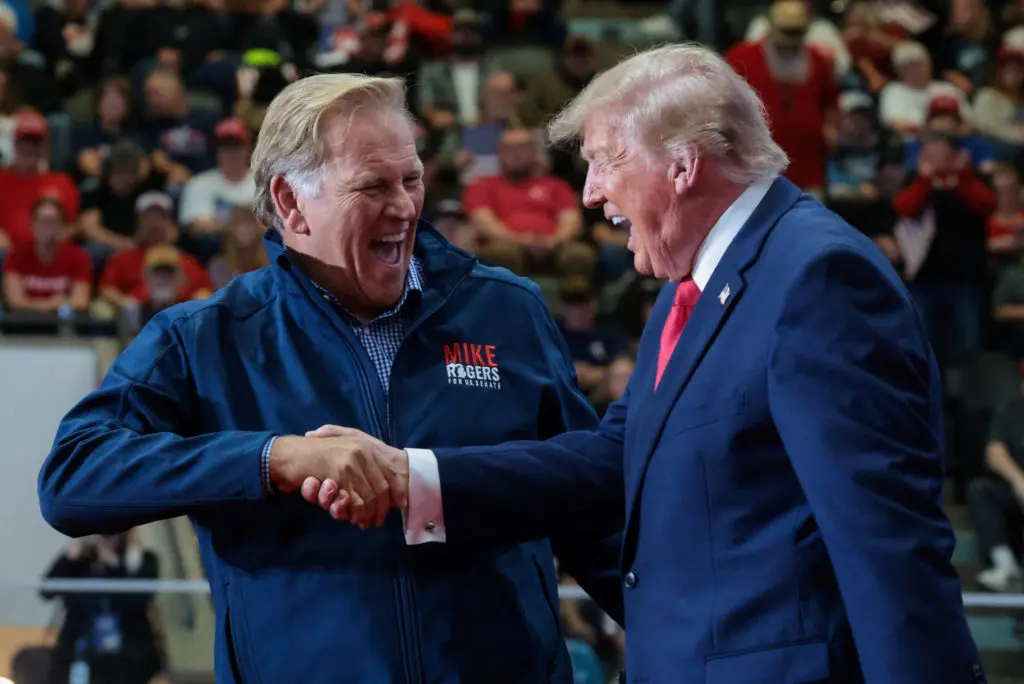
Republican Senate candidate and former U.S. Representative Mike Rogers shakes hands with President Trump during a rally, ahead of the midterm elections, at an entertainment complex in Port Huron, Michigan, U.S., October 25. – Photo by Reuters
Following Obama’s Michigan visit, Trump addressed a campaign rally on Sunday at McMorran Place, a sports and entertainment complex in Port Huron in eastern Michigan, supporting Republican candidates in the midterm elections and directly responding to Obama’s rally the previous evening.
Trump’s speech, which lasted nearly two hours, centered on attacks against El-Sayed. Using harsh and offensive language, he likened him to a “jihadist” and falsely accused him of being “a member of the Muslim Brotherhood”, portraying him as a national security threat who could not be allowed into Congress.
Trump also attacked Michigan’s Democratic gubernatorial nominee, Secretary of State Jocelyn Benson, alleging that she was involved in “the worst election fraud anybody has ever seen,” referring to the 2020 presidential election.
Trump, who is expected to visit Michigan again before Election Day, urged voters to turn out in large numbers for Mike Rogers in the Senate race and John James in the governor’s race.
“Pretend that I’m the one running in this election and that my name is on the ballot,” he said.
Trump also touted his administration’s purported accomplishments and defended his decisions concerning the conflict with Iran and the economic pressure he is imposing on the country, despite the devastating rise in fuel prices.
Trump popularity is at the lowest in his two terms. Recent polls put his popularity at 31 percent.
Sanders campaigns for El-Sayed
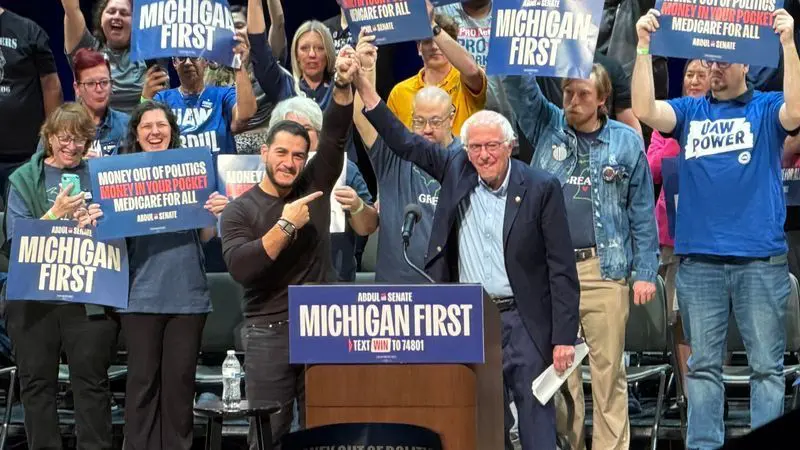
Sanders campaigns for El-Sayed in Grand Rapids
That same evening, El-Sayed responded from Grand Rapids alongside U.S. Sen. Bernie Sanders, a leader of the progressive movement. El-Sayed mocked Trump’s focus on his first name, saying such accusations served only to distract voters from the issues that mattered to them.
As he intensified his campaign, El-Sayed also appeared with Sanders in Alpena, in northeastern Michigan, and Ann Arbor, a progressive stronghold in the Great Lakes State.
During the rallies, Sanders sharply criticized the advertising campaigns Trump and Republicans were waging against El-Sayed, describing them as “racist and disgusting” and rooted in “Islamophobia.” He said Republicans were resorting to such tactics because they lacked real answers or solutions to the economic crises affecting working-class people.
With one week remaining before the November 3 election, 1,392,170 Michigan voters had already cast ballots, representing 18.8 percent of the state’s active registered voters. More than 1.1 million had voted by absentee ballot, while more than 215,000 had cast ballots at early voting centers as of last Tuesday.
Early in-person voting centers will remain open statewide through Sunday. Election Day voting will take place Tuesday from 7 a.m. to 8 p.m.
Leave a Reply