



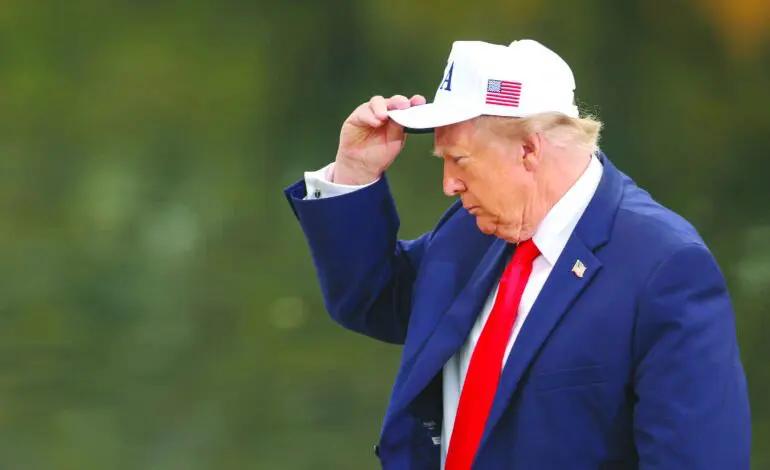

WASHINGTON, D.C. — Under the weight of sharply rising fuel prices, Republicans, led by Donald Trump, suffered a catastrophic defeat in Tuesday’s midterm elections. Democrats swept competitive congressional races, securing a series of historic victories even in states long considered Republican strongholds.
In a sweeping blue tsunami that engulfed electoral battlegrounds across the United States, Democrats captured majorities in both the House and Senate, turning Trump into a “lame duck” during the final two years of his presidency, with impeachment proceedings and removal from office remaining possibilities.
While the president acknowledged the defeat but denied that it represented a personal setback, Vice President JD Vance blamed Republicans’ resounding losses on Israel and the war against Iran, in remarks described as a break with Trump.
Tuesday’s elections included all 435 House seats, 35 of the Senate’s 100 seats and governorships in 36 states.
In addition to Abdul El-Sayed’s victory in Michigan as the first Muslim elected to the U.S. Senate, Democrats flipped at least seven Republican-held Senate seats in Texas, Iowa, South Carolina, North Carolina, Ohio, Maine and Kansas. That number could rise to nine, pending final results in Mississippi and Alaska.
If Democrats also flip those two states, they would hold 56 seats in the next Senate, up from 47 in the current Republican-controlled chamber.
In the U.S. House, Democrats won nearly every competitive district nationwide, including three Michigan districts currently represented by Republicans.
According to preliminary results, Democrats are expected to control more than 260 seats in the new House, compared with 214 in the current chamber.
House Democratic Leader Hakeem Jeffries is expected to become speaker following his party’s sweeping victory, making him the first African American to lead the lower chamber.
However, neither Jeffries’ leadership in the House nor Sen. Chuck Schumer’s leadership in the Senate is assured within the Democratic Party, given divisions between its progressive and establishment wings, particularly over Israel.
Reactions
“Americans sent a clear message tonight: They want politics that brings people together rather than divides them, and leaders who deliver tangible solutions to the challenges they face,” former President Obama wrote on X.
Trump said he did not view the congressional midterm results as a personal setback, adding that although Democrats had gained control of Congress, they were not in a position to impose their will.
Vance, meanwhile, said polling showed that many people voted Democratic because they wanted an end to the war against Iran, relief from living costs and a change in U.S. relations with Israel.
Blaming the Iran war for the defeat, the vice president wrote on X that its consequences demanded an honest discussion within the Republican Party about the conflict’s costs and results.
In one of his first responses to the election, Trump told the New York Times that he was fully prepared to accept the results.
“We will work with the Democrats, and we look forward to working with them,” he said. “Maybe we will come up with something.”
In an interview with Fox News, Trump acknowledged that the Iran war contributed significantly to his party’s losses, while maintaining that voters supported his handling of the conflict.
“I think part of it was because of Iran, but at the same time, people understood the importance of what I did there,” he said.
Trump warned that any effort to impeach and remove him would “destroy the Democratic Party.” At the same time, he expressed confidence that agreements could be reached on some issues despite anticipated disagreements.
He also threatened to use his presidential veto against Democratic legislation, warning of potential political gridlock with power divided between the White House and Congress.
Discussing the next phase of his presidency, Trump said Democrats would send him legislation he described as “crazy” and pledged to veto it.
“They will send me things that make no sense, and I will veto them,” he said. “After two months of vetoes, they will call me and ask: How do we get this done? And we will work together.”
The New York Times, meanwhile, said the election results revealed the extent of Israel’s declining standing in the United States. It noted that Democrats’ strong performance — including victories by candidates sharply critical of the war in Gaza — had reduced the number of Israel’s allies in Congress.
The newspaper said Democrats’ overwhelming victory over Republicans deepened Israel’s growing sense of international isolation.
It added that the future of U.S.–Israeli relations was at stake, along with billions of dollars in annual American military assistance, describing the developments as evidence of declining traditional support for Israel within both major parties.
Unprecedented achievements
Democratic U.S. Rep. Ilhan Omar expressed gratitude that the next Congress would include eight Muslim lawmakers, including one senator, Michigan’s Abdul El-Sayed.
“I am overwhelmed with gratitude that we will now have eight Muslims in Congress,” she said.
The seven Muslim House members listed for the next Congress are Omar of Minnesota, Rashida Tlaib of Michigan and André Carson of Indiana, along with Lateefah Simon and Aisha Wahab of California, Adam Hamawy of New Jersey and Darializa Avila Chevalier of New York.
The midterm elections also broke longstanding, unspoken barriers, opening the way for minority candidates to reach prominent offices for the first time.
Florida elected its first Black governor, Republican Byron Donalds. Georgia elected Keisha Lance Bottoms, making her the first Black woman elected governor in the United States.
On the other side of the country, California chose Democrat Xavier Becerra as governor, making him the first Latino elected to lead the nation’s most populous state.
Bill Shiebler — chief strategy officer at the nonprofit State Voices, a network of advocates for civic engagement and equity — told AFP the night was “a huge rebuke against hate and division.”
“These new leaders do not emerge overnight,” he said. “They come from communities that organize between elections.”
In another milestone, Deb Haaland, a member of the Pueblo of Laguna, became the first Native American woman elected governor of New Mexico.
In Minnesota, Peggy Flanagan achieved another historic first, becoming the first Native American woman elected to the U.S. Senate. She had previously served as the state’s lieutenant governor.



Leave a Reply