



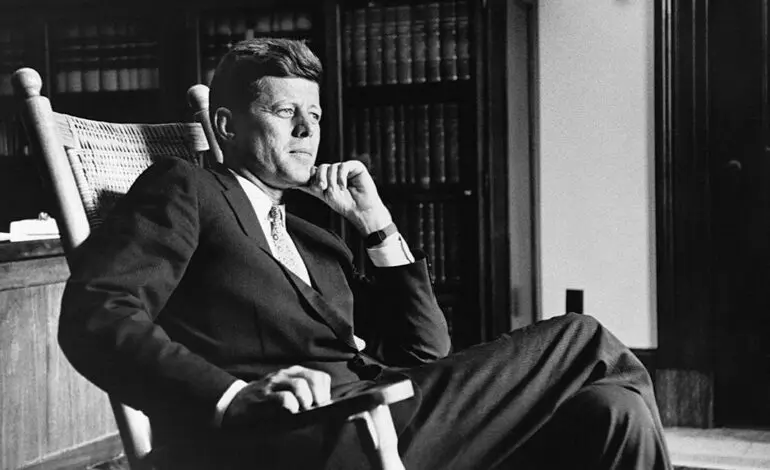

Sixty-three years ago this Sunday, an American president was murdered in broad daylight on a Dallas street. The government told us that one man did it, that he acted alone, and that a single bullet passed through two men, inflicting multiple wounds, before emerging sufficiently intact to become perhaps the most consequential piece of evidence in American history. The alleged lone gunman famously declared himself “a patsy.” Days later, another shadowy figure shot him dead, only to die himself under mysterious circumstances before anyone could fully scrutinize his motives. We were, nevertheless, told to accept the findings of the Warren Commission, put the matter behind us, and get on with the business of being Americans. For sixty-three years, that is largely what we have done.
But what if the official account was wrong? Not mistaken in some minor detail, or incomplete because witnesses were unavailable or evidence was lost. What if the assassination was the product of a conspiracy, and the investigation that followed concealed it? The House Select Committee on Assassinations concluded in 1979 that Kennedy was probably assassinated as the result of a conspiracy, something our government and our media . The Warren Commission’s lone-assassin conclusion remains the official account, but its authority has never recovered from the significant questions surrounding it.
Consider the implications if the conspiracy hypothesis is correct. If Kennedy was murdered in an operation involving elements of the American national security establishment, the most important question is no longer who pulled the trigger. It is what happened to the people who arranged for the trigger to be pulled. Did they simply go home? Did they congratulate themselves on a job well done, retire to their country clubs, and agree that henceforth the American people should be permitted to govern themselves without interference? Did the machinery that made such an operation possible simply dismantle itself?
No serious student of history can deny the striking similarities between the carefully constructed narratives surrounding other political assassinations that followed on the heals of this one. And no student of institutional power could reasonably expect an organization capable of such an extraordinary crime to voluntarily surrender the influence, secrecy, and protection that made it all possible. If such a conspiracy occurred, and if powerful institutions helped conceal it, the implications extend far beyond November 22, 1963. They reach into the legitimacy of the political order under which Americans have lived ever since. That is the question we have spent sixty-three years avoiding.
The machinery survives the men
I have spent considerable time reading books that, taken together, have profoundly altered the way I understand the American century. Kenneth Anger’s Hollywood Babylon first introduced me to the gulf between the carefully manufactured public image of American institutions and the private realities behind them. Tom O’Neill’s Chaos, his investigation into the Manson murders, raised disturbing questions about the intersection of criminality, intelligence operations, law enforcement, and the manipulation of public understanding. Neither book provides a definitive account of the political order, but both illustrate how easily an accepted narrative can obscure a much more complicated reality.
Fletcher Prouty, a career military officer and Pentagon insider, described a national security apparatus whose reach extended far beyond the conventional understanding of military and intelligence operations. In The Secret Team and JFK, he argued that an enormous machinery of covert power had developed within the American government, operating through relationships, faceless bureaucracies, opaque budgets, contractors, and institutions that ordinary democratic oversight could scarcely penetrate let alone control. David Talbot’s The Devil’s Chessboard explores the career of Allen Dulles and the emergence of the CIA as an institution capable of pursuing its own conception of American interests, sometimes in conflict with elected leadership. Whitney Webb’s two volumes of One Nation Under Blackmail trace an unsettling history of organized crime, intelligence relationships, financial power, sexual exploitation, and the possible use of compromising information as an instrument of influence.
These authors differ in their methods, evidence, and conclusions, some of which remain disputed. But their work invites a question considerably more important than whether every allegation in every volume can be proven: How much of the government we believe we control actually operates beyond our ability to see, much less influence? And who benefits from keeping it that way?
The great American disappearing act
Consider just a few examples of what Americans have been asked to accept during the intervening decades. Iran-Contra was not a conspiracy theory. It was a conspiracy. Senior government officials secretly facilitated arms sales to Iran and diverted proceeds to support the Nicaraguan Contras despite congressional restrictions forbidding it. The operation was concealed until the facts began emerging, and even then, a full accounting was obstructed by destroyed documents, conflicting testimony, and the familiar invocation of national security.
The Contra war also exposed the murky intersection of intelligence operations–many of them private and outside our government–and narcotics trafficking. Barry Seal, the notorious drug smuggler who became a government informant, operated in a world where criminal enterprises and covert American foreign policy occasionally crossed paths. His cooperation with federal authorities is documented and, not surprisingly, he died under suspicious circumstances. Then came Gary Webb, whose Dark Alliance investigation explored the relationship between CIA-connected cocaine traffickers and the crack epidemic that devastated American cities. Webb was savaged by the country’s most prestigious newspapers, his career collapsed, and he died in 2004, also under suspicious circumstances. Subsequent official investigations did not validate all his claims, but the CIA’s own inspector general documented serious failures in the agency’s handling of allegations involving Contra-connected drug traffickers. The institutions escaped anything resembling the scrutiny directed at the journalist.
September 11, 2001, transformed the country and ushered in an architecture of surveillance, secrecy, military intervention, and executive power that remains with us. Nearly three thousand Americans were murdered, yet the attacks left an extraordinary legacy of public suspicion surrounding intelligence failures, warnings that went unheeded, the destruction of evidence, the collapses of the World Trade Center towers and Building 7, the Pentagon attack, and financial arrangements involving the World Trade Center complex. One can get lost in the mountains of evidence calling into question the 9-11 Commission’s official narrative—more rabbit holes than Buggs Bunny could dig in a lifetime. Whether you believe in every theory or accept the Commission’s conclusions, the central institutional question remains: How did the national security establishment’s failure to prevent the attacks become the justification for expanding its power so dramatically and who or, more precisely, what benefited from that expansion?
Then came Iraq. The weapons of mass destruction used to justify the invasion were not found. A war that killed enormous numbers of people and destabilized an entire region was sold to the American public through intelligence claims that, once again, proved catastrophically wrong. At the same time, the financial crisis of 2008 subsequently exposed an economic order in which extraordinary risks could be privatized for profit until the losses became so enormous that the public was required to absorb them. Too big to fail, too important to prosecute, too connected to suffer the consequences. Ordinary Americans paid the price while the architects of both catastrophes largely retained and greatly expanded their wealth, influence, and political power at the expense of the general population.
COVID-19 provided another lesson in the hazards of institutional certainty. The possibility that the virus originated in a laboratory was frequently dismissed in public debate before American intelligence agencies began openly acknowledging it as a plausible explanation. That assessment did not prove a laboratory accident. It did demonstrate how confidently public discourse can settle upon conclusions that the underlying evidence has not established. It also demonstrated how the initial official narratives pushed by our government often in close concert with a powerful media elite can persist even after the evidence that eventually emerges makes it implausible.
And now Jeffrey Epstein. Whatever one believes about the more sensational theories surrounding him, the established facts are damning enough. A wealthy and extraordinarily connected sexual predator operated for years while enjoying access to powerful people and, at a critical moment, an astonishingly favorable federal nonprosecution agreement. His crimes were real, his victims were real, and the institutional failures were real. The unanswered questions about the full extent of his network, the possible exploitation of compromising information, and the protection he received cannot simply be dismissed because some people have attached extravagant theories to them. And now even the New York Times has cast doubt on the circumstances surrounding his death.
Even the assassination of Charlie Kirk in September 2025 has become another battlefield over what Americans are supposed to believe. Prosecutors have charged a suspect, while competing narratives alleging intelligence involvement, foreign interference, and betrayal by people within Kirk’s own movement have proliferated while the official narrative becomes almost fantastical. Whatever the eventual findings of the judicial process, the speed with which another political assassination generated mutually incompatible narratives reveals a society in which public confidence in institutions responsible for establishing the facts has deteriorated profoundly.
There is also the recurring specter of Iranian nuclear weapons, invoked across decades of confrontation, sanctions, and threats of war. Conflicting assessments of its capabilities and intentions once again are confused with proof of an imminent nuclear attack. Americans have already witnessed what happens when uncertain intelligence becomes the foundation for categorical claims and catastrophic military decisions. Yet, in spite of overwhelming opposition to this war by the American public, our government continues on a war footing begging the obvious questions I started with: who’s really calling the shots and does our democracy exist in name only? Are we truly a sovereign state?
These episodes are not identical, nor do they establish a single continuous conspiracy. Some involve proven criminal misconduct, others intelligence failures, institutional negligence, contested explanations, or political manipulation. But together they expose a common democratic vulnerability: When powerful institutions control both the information upon which the public must rely and the mechanisms through which their own conduct is investigated, accountability becomes dangerously dependent upon the willingness of those institutions to incriminate themselves.
The most successful political deception may not be convincing Americans that their government is honest. It may be convincing them that every abuse of power is an isolated scandal, every exposed conspiracy an aberration, and every institutional failure an unfortunate mistake, never evidence of recurring structural incentives that reward secrecy and protect those who wield power. That is no way to run a republic.
Red versus blue is the distraction
This brings me to the people who will inherit responsibility for governing this country, including Senator-elect Abdul El-Sayed and the new generation of elected officials who have promised to challenge the political establishment. I supported Senator-elect El-Sayed because I believe he represents something genuinely different. But the greatest danger confronting him and his colleagues is not simply that Republicans will oppose Democrats, or Democrats will oppose Republicans. That is the familiar contest, the one we are permitted to see. The more consequential struggle may be between the institutions Americans believe they govern and the concentrations of power that operate beyond meaningful public scrutiny.
The visible government is composed of presidents, senators, representatives, judges, elections, political parties, and public debates. The less visible world includes intelligence operations, classified budgets, private contractors, financial networks, corporate influence, covert relationships, and the enormous machinery through which information is collected, withheld, shaped, and sometimes weaponized. Not everything concealed is sinister. Governments have legitimate secrets, intelligence agencies perform necessary functions, and national security is not a fiction. But secrecy is a tool, not a source of legitimacy, and the fact that some secrets are necessary does not establish that those keeping them are entitled to decide, without meaningful oversight, where necessity ends and self-preservation begins.
The distinction between Republican and Democrat becomes less reassuring when the most consequential policies survive changes in administration and in defiance of clear mandates. The wars continue, the surveillance expands, the defense budgets grow, the intelligence establishment endures, and the financial institutions retain their extraordinary influence. Meanwhile, the American people are invited every two or four years to believe that choosing between two political parties constitutes meaningful control over the entire apparatus. Perhaps it does over some important things. But over how much? What percentage of the decisions that determine whether our children live in peace or war are actually made by people we can vote out of office? That is a question every member of Congress should be required to answer.
The snow is melting
There is an old expression about what happens when the snow melts. In my neighborhood, the old men used to teach that when the snow melts, the shit shows. The snow is melting, and what it has concealed is beginning to show. Americans increasingly recognize the distance between the official explanations they receive and the realities they experience. They watch institutions insist upon their own integrity while evidence of misconduct, incompetence, or corruption emerges years later. They see officials rewarded for failures that would destroy the careers of ordinary citizens, whistleblowers punished, classified records withheld, investigations delayed, and public controversies dismissed before the underlying evidence has been meaningfully examined.
And they are told that questioning any of this makes them conspiracy theorists. Certainly, some conspiracy theories are nonsense. Others are malicious inventions, while still others exploit legitimate public distrust to advance political or commercial agendas. But the phrase has also become a remarkably convenient substitute for answering difficult questions. The existence of foolish suspicions does not absolve powerful institutions of the obligation to explain themselves, nor does the occasional vindication of a suspicion establish that every suspicion is true. The answer is evidence, disclosure, independent investigation, and genuine accountability.
The deeper problem is that deception, once institutionalized, becomes self-perpetuating. One lie requires another to protect it, one concealed operation creates the need for additional secrecy, and one unaccountable institution develops relationships with others whose interests become intertwined with its own. Eventually, the distinction between protecting the nation and protecting the institutions claiming to act in its name becomes difficult to discern. The public is left watching a political performance on the visible stage while increasingly consequential decisions are made somewhere behind the curtain.
The clock is running
In my January column, I revisited President Kennedy’s extraordinary commencement address at American University on June 10, 1963. Only five months before his murder, Kennedy spoke of the shared humanity of Americans and Russians, of the futility of imagining that nuclear war could produce meaningful victory, and of the obligation to pursue peace even with our adversaries. “We all breathe the same air,” he reminded the world. Those words represented a profound rejection of the notion that humanity’s future should be determined exclusively by the calculations of military planners, intelligence officials, and political elites.
Kennedy understood something that our governing class increasingly seems to have forgotten. There are consequences from which no amount of wealth, influence, secrecy, or institutional power can ultimately insulate us. Nuclear war is one. The destruction of democratic legitimacy may be another. The accelerating concentration of technological, financial, military, and surveillance power raises the stakes still further, particularly as artificial intelligence gives governments and private institutions capabilities that would have been unimaginable even a generation ago.
We are approaching a moment when the ability of powerful, private, and undemocratic institutions to monitor, manipulate, and influence human behavior may exceed the capacity of democratic societies to understand what is happening, much less control it. Artificial intelligence will not create that imbalance. It threatens to magnify one that already exists. And once that imbalance becomes sufficiently great, the formal right to vote may offer increasingly little protection against the practical inability to govern.
This is why the Kennedy assassination matters sixty-three years later. Not because solving a historical mystery would satisfy our curiosity, identifying a villain would make us feel better, or the assassination provides a universal explanation for every American failure since 1963. It matters because, if the president of the United States could be removed through a conspiracy and the truth successfully concealed, then the most fundamental assumption of American democracy would have been violated. The people would not have been sovereign. Someone else would have been. And the burden would fall upon us to determine whether that usurpation was ever meaningfully reversed.
A warning to the next Congress
Senator El-Sayed and his colleagues will arrive in Washington confronting the familiar pressures of party loyalty, legislative bargaining, fundraising, committee assignments, and the endless demands of the next election. Those pressures are real, but they are not the whole job. The next generation of American leadership must be willing to ask questions that transcend party affiliation. Who controls the information upon which our elected representatives depend? Who decides what remains classified? Who benefits financially from permanent military mobilization? What meaningful oversight exists over the relationships between intelligence agencies, private contractors, financial institutions, and the technology companies accumulating unprecedented quantities of information about our lives? What happens when the interests of those institutions conflict with the expressed will of the American people? And who, precisely, has the power to compel an answer?
These are not Republican questions or Democratic questions. They are small “r” republican questions, in the original sense of the word, questions about whether we still possess a government accountable to its citizens. Sixty-three years ago, Americans watched their president murdered and were told that the system had investigated itself and reached its conclusions. For generations, we have argued over whether those conclusions were true. Perhaps it is time to confront the more frightening question: What if the system that emerged from Dallas was never required to prove its legitimacy again?
We have spent sixty-three years fighting over who gets to sit behind the wheel. We have devoted considerably less attention to who built the vehicle, who controls the road, and whether the steering wheel is connected to anything at all. The snow is melting, the machinery is becoming visible, and the clock is running. The question is whether the American people can recover meaningful control over their government before the powers operating beyond their reach make that recovery impossible.
We cannot govern what we are forbidden to see. And we cannot save a democracy whose most consequential decisions are made somewhere beyond its reach.


Leave a Reply