June 2011 - sahtak
27
Nabil Fakih / Pharmacist
Gdü°«ó’Ê fÑ«π a≤«¬
Dearborn Heights
Pharmacy
25524 Ford Rd.
Dearborn Heights MI, 48127
313-724-1111
Mù°ƒeÉä d¨Éjá
03HÉŸÄá d∏ªù°æÚ
GŸù°à∏õeÉä Gd£Ñ«á
GŸ©óGä Gd£Ñ«á YÉd«á G÷ƒOI
eù°à∏õeÉä eôV°≈ Gdù°μôi
U°«ód«á OjôHƒQ¿ gÉjàù¢
Nóeá S°ôj©á, ‡«õI heàîü°ü°á
f†°ªø GCa†°π G’CS°©ÉQ d∏ªù°æÚ
hŸø d«ù¢ dój¡º JÉCeÚ
WASHINGTON
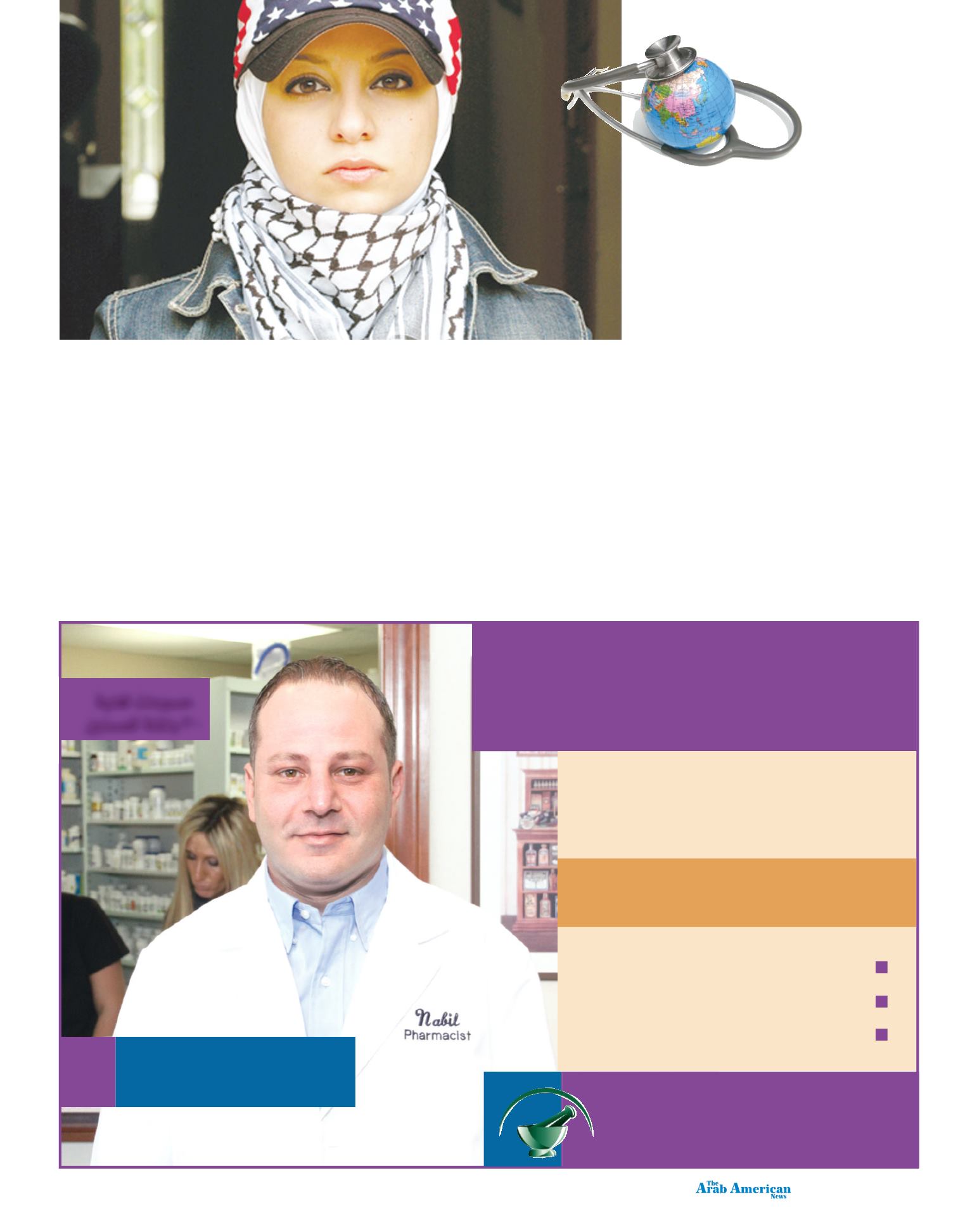
— A lack of understanding of Islamic values
and cultural practices can play a role in health disparities among
American Muslims, according to a report published by the In-
stitute for Social Policy and Understanding.
"When considering the healthcare needs of AmericanMus-
lim patients, providers must be aware of the wide spectrum of
adherence, religious practice, rituals, and traditions within this
community," says Aasim Padela, M.D., the lead author and an
Institute for Social Policy and Understanding fellow who con-
ducted the research as a RobertWood Johnson Foundation Clin-
ical Scholar at the University of Michigan.
AmericanMuslims patients' notions of health and illness are
largely shaped by religious beliefs and cultural norms and prac-
tices, according to the report. These factors influence expecta-
tions of encounters with healthcare providers and adherence to
doctors' recommendations, and ultimately influence health out-
comes. In focus group discussions, participants noted the im-
portance of cultural competency to improve patient-provider
relationships and reduce barriers to health care.
"As healthcare settings are confronted with adapting to an in-
creasingly racially and ethnically diverse patient population,
providers need to be better prepared to respond to a variety of pa-
tient perspectives, values, and behaviors about health and well-
being," says Padela.
"Meeting the Healthcare Needs
of American Muslims," pro-
vides an overview of
American
Muslim
health beliefs, de-
scribes how these be-
liefs
impact
healthcare-seeking prac-
tices, and offers recom-
mendations on how to improve the
healthcare experience of American Muslim patients.
These recommendations include:
To better serve American Muslim patients, healthcare
providers need to understand how American Muslims view
health and healing in order to make more effective treatment de-
cisions.
Health systems should train staff to enhance cultural sensi-
tivity, reduce discrimination, and highlight intra-group differ-
ences.
Hospitals should provide halal foods and medications to al-
leviate the stress and discomfort caused by being confronted with
substances that violate their religious beliefs.
Health systems should consider allocating space for Muslims
to pray. As some patients may pray in their hospital rooms, staff
should be made aware of this practice and told not to disturb
praying patients.
Healthcare institutions should reach out to American Mus-
lims by initiating religiously and culturally sensitive healthcare
awareness campaigns through partnerships with mosques.
Health systems should consider implementing educational
programs in healthcare settings so that hospital pastoral care and
chaplaincy staff, as well as healthcare providers, can become
more aware of the spiritual needs of AmericanMuslim patients.
A practicing emergency physician, Padela conducts research
in the Greater Detroit area on Arab and Muslim health. He has
conducted multiple studies on the influence of religion in Mus-
lim patient and health care provider behaviors, health care chal-
lenges and disparities in AmericanMuslim populations, and the
ways physicians view requests for cultural accommodations. He
is also a visiting fellow at the Oxford Centre for Islamic Studies,
and he works closely with Dar-ul-Qasim, an Islamic educational
institution, to probe the frontiers of Islamic bioethics.
Understanding Islamic values and cultural
prac ces cri cal to mee ng the healthcare
needs of American Muslims


