8
sahtak - June 2011
By Jennifer Nelson, M.S., R.D. and
Katherine Zeratsky, R.D.
M
editation and positive imagery are tools to reduce
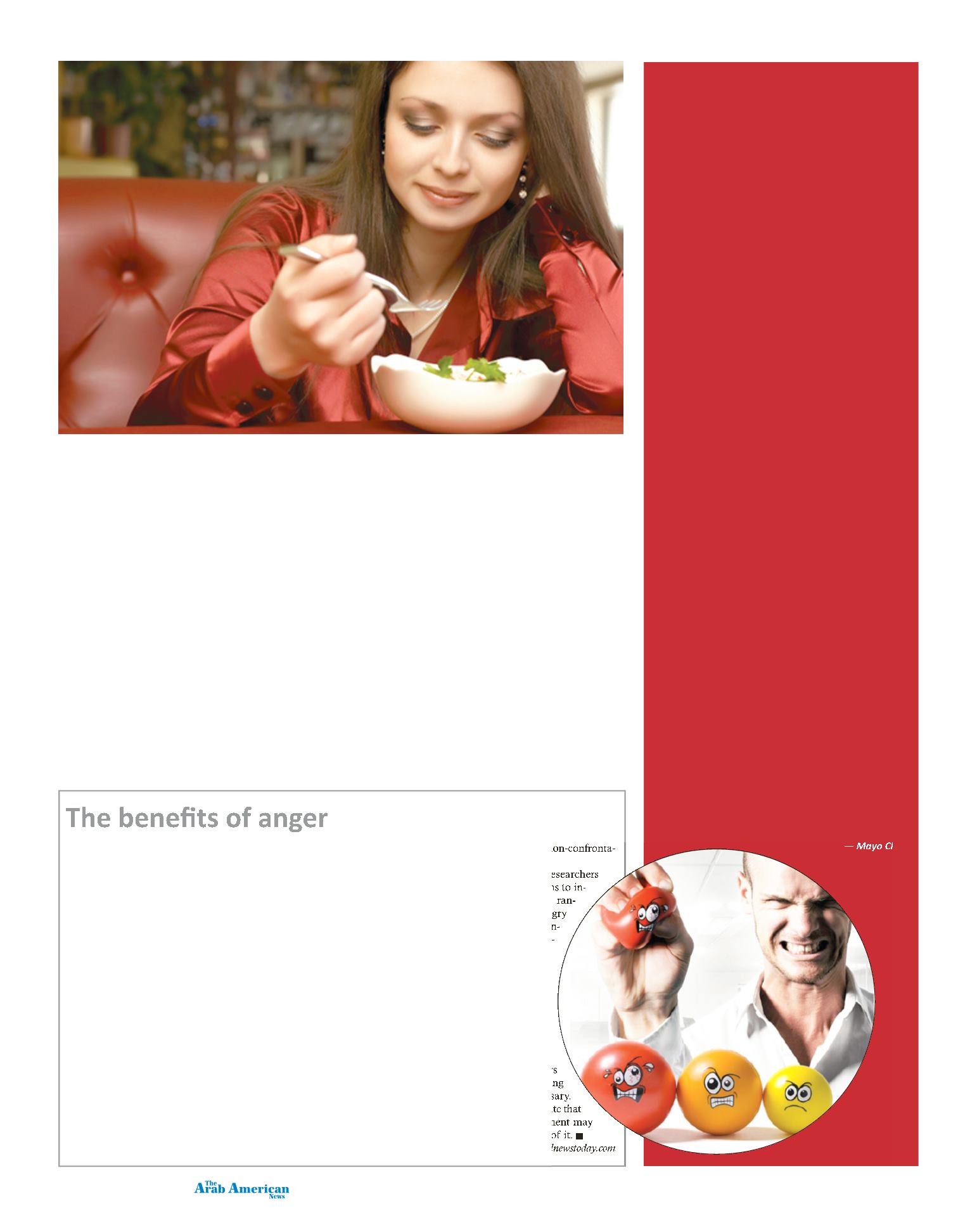
stress. Let's try some food imagery: Picture a plate
with bright green spinach topped with caramel-col-
ored crunchy nuts, moist chunks of lean poultry, and bright or-
ange and red dried fruit. Alongside this beautiful salad, you have
a golden brown whole-grain roll and a cool refreshing glass of
milk. Top this off with a bit of dark chocolate for dessert. Have
I lulled you into a peaceful state of mind?
Can what you eat affect your mood? Can your diet be part of
the equation to reduce stress? Possibly. Take a moment to think
about what you eat and how it makes you feel.
Omega-3 fatty acids, magnesium, tryptophan, folate and
other B vitamins, low glycemic foods, and chocolate have all
been studied to assess their impact on mood. The results are
mixed but seem to show an association — though not a direct
link — between these foods and improved mood.
Of course, these nutrients and foods are part of a healthy diet.
And when you eat a healthy diet, your body reaps the benefits.
For example, when you eat fruits, starchy vegetables and whole
grains throughout the day you keep your body fueled and your
blood sugar level on an even keel. And you're getting vitamins,
minerals, antioxidants and phytonutrients. Combining carbohy-
drates and proteins enhances the availability of serotonin in your
brain. Serotonin is a neurotransmitter said to have a calming ef-
fect and to play a role in sleep.
In addition, simply knowing you are taking care of yourself
can boost your mood. And we're all familiar with the power of
comfort foods. For example, drinking a glass of milk before bed-
time can trigger a comforting memory of your childhood.
Now, think of the foods and behaviors you associate with a
stressed-out lifestyle. Do you see someone who is sleep-deprived,
gulping down caffeine and shoveling in fast food while on the
run? Can you also picture the vicious circle at work here? Stress
leads to sleeping less, which leads to reaching for caffeine and
sugar for a fix, which is followed by a crash and need for another
fix. Add to that skipping regular meals and exercise and maybe
using alcohol to unwind. Alcohol and lack of exercise contribute
to poor sleep. And so the cycle continues. We know that this way
of eating doesn't make us feel good physically or mentally.
—Mayo Clinic
The food and mood connec on
How do I control
stress-induced
weight gain?
By Edward T. Creagan, M.D.
W
hen you're under stress, you may find it harder to
keep up healthy-ea ng habits. Also, during par c-
ularly stressful mes, you may eat in an a empt to fulfill
emo onal needs, which is some mes called stress eat-
ing. And you may be especially likely to eat high-calorie
foods during mes of stress, even when you're not hun-
gry.
To combat weight problems during stress and reduce
the risk of obesity, you need to get a handle on your
stress. When you feel less stressed and more in control
of your life, you may find it easier to s ck to healthy eat-
ing and exercise habits. Try these stress management
techniques to combat stress-related weight gain:
• Recognize the warning signs of stress, such as anxiety,
irritability and muscle tension.
• Before ea ng, ask yourself why you're ea ng — are
you truly hungry or do you feel stressed or anxious?
• If you're tempted to eat when you're not hungry, find
a distrac on.
• Don't skip meals, especially breakfast.
• Iden fy comfort foods and keep them out of your
house or office.
• Keep a record of your behavior and ea ng habits so
that you can look for pa erns and connec ons — and
then overcome them.
• Learn problem-solving skills so that you can an cipate
challenges and cope with setbacks.
• Prac ce relaxa on skills, such as yoga, massage or
medita on.
• Engage in regular physical ac vity or exercise.
• Get adequate sleep.
• Get encouragement from suppor ve friends and family.
• If you try stress management techniques on your own
but they don't seem to be working, consider seeking
professional help through psychotherapy or counseling.
— Mayo Clinic
H
ere's a maxim from the "duh" department: People typ-
ically prefer to feel emotions that are pleasant, like ex-
citement, and avoid those that are unpleasant, like anger.
But a new study appearing in the April issue of Psycho-
logical Science, a journal of the Association for Psycho-
logical Science, says this may not always be the case.
Psychologists Maya Tamir and Christopher Mitchell of
Boston College, and James Gross of Stanford University
tested whether people prefer to experience emotions that
are potentially useful, even when they are unpleasant to ex-
perience.
The authors wanted to examine whether individuals are
motivated to increase their level of anger when they expect
to complete a confrontational task, where anger might en-
hance performance. They told the study participants that
they will either play a computer game that is confronta-
tional (Soldier of Fortune - a first person shooter game
where killing enemies is your primary goal) or one that is
not confrontational ("Diner Dash" - a game in which play-
ers guide a waitress serving customers). They were then
asked to rate the extent to which they would like to engage
in different activities before playing the game.
The researchers found that participants preferred activ-
ities that were likely to make them angry (e.g., listening to
anger-inducing music, recalling past events in which they
were angry) when they expected to perform the confronta-
tional task. In contrast, participants preferred more pleasant
activities when they expected to perform a non-confronta-
tional task.
With this preference established, the researchers
wanted to examine whether these inclinations to in-
crease anger improved performance. They ran-
domly assigned participants to either the angry
or excited emotion induction (or a neutral con-
dition) and then had them play the confronta-
tional and non-confrontational computer
games.
As expected, angry participants per-
formed better than others in the confronta-
tional game by successfully killing more
enemies. However, angry participants did
not perform better than others in the non-
confrontational game, which involved serv-
ing customers.
So it seems that individuals are not always
striving to feel pleasure and may even be willing
to endure some nasty emotions if necessary.
"Such findings," write the authors "demonstrate that
what people prefer to feel at any given moment may
depend, in part, on what they might get out of it.
—


