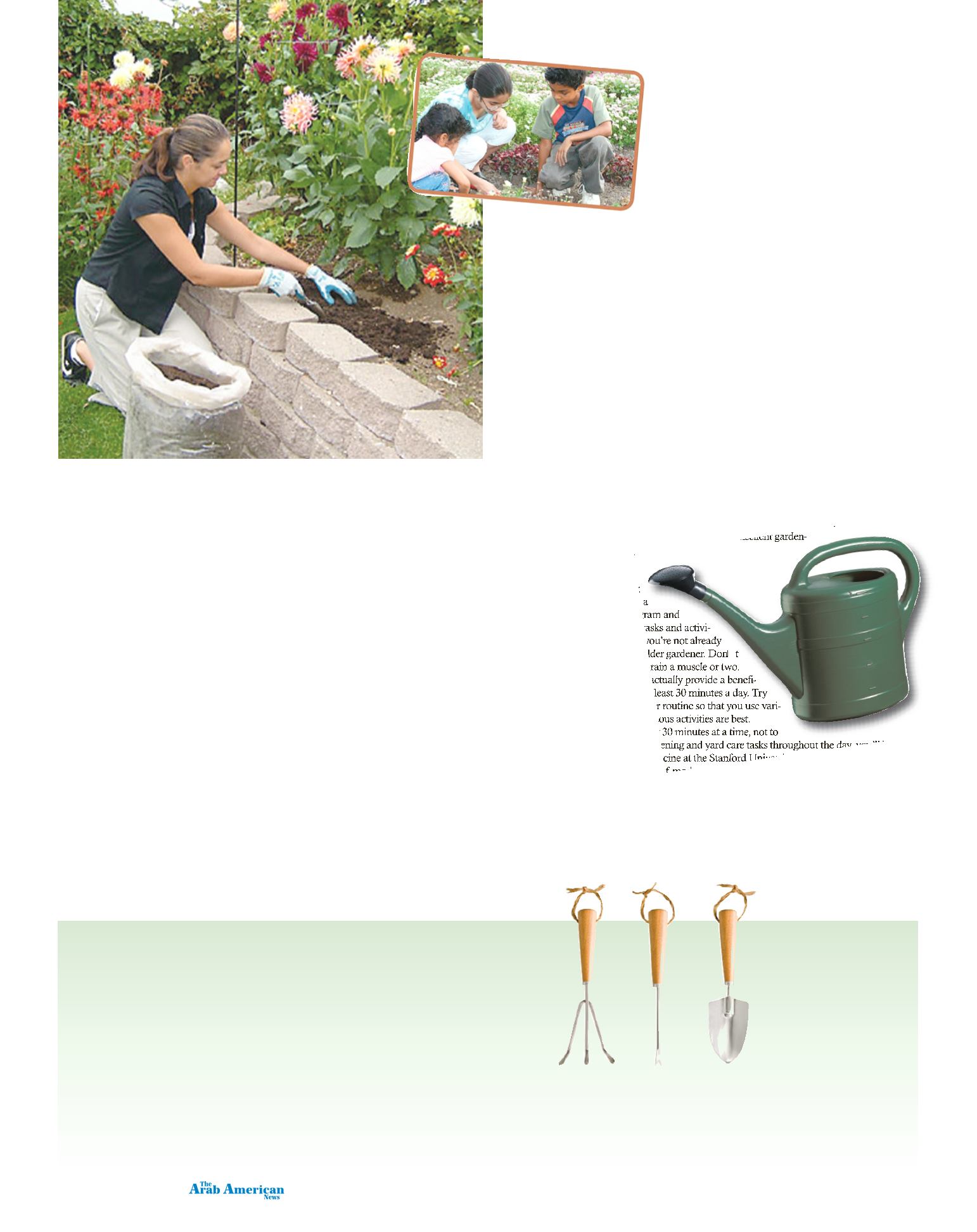
Gardening is good exercise
I
f you garden for pleasure, you may not be aware of how beneficial this hobby is for your
health. While you’re preparing your garden plot to grow fresh veggies, or while you’re busy
turning the compost pile, you’re actually doing a decent amount of exercise as well!
Basic yard care tasks such as mowing the lawn and raking up leaves are also good ways to get
exercise. Additionally, gardening and yard care are beneficial for your mental health, too. Just think
of the relaxation you experience when working in the garden.
Not convinced that mowing the lawn and planting veggies can be as good for you as an aero-
bics class? The research proves it! Various health professionals and university studies show that gar-
dening and yard work are more than just enjoyable hobbies.
In this article we’ll take a look at the research that shows just how beneficial gardening and
yard care is for your health. Additionally, we’ll share some tips with you so that you can maximize
the health benefits of your gardening experience.
What gardening for exercise can do for you
Gardening and yard care are unique forms of exercise that allow you to do something calming,
creative and fun while you work various muscle groups and get a moderate level of cardiovascular
exercise as well.
This is truly the great thing about gardening for exercise, as you can use your whole body while
you’re working. Gardening involves a number of different kinds of exercises, including stretching,
weightlifting, and a moderate cardiovascular workout.
Barbara Ainsworth and Associates published an excellent article about exertion values related
to a number of common gardening activities. The study showed that you can expend as much ef-
fort raking the lawn as you would during a leisurely bicycle ride. Trimming trees and shrubs is
roughly the equivalent of walking at a moderate pace. Heavier work like clearing brush and stack-
ing wood can give you the equivalent workout as a light aerobics class. You can check out the full
results of the study at the Virginia Cooperative Extension website.
Dan Hickey, the former editor of National Gardening Magazine, is also a big fan of garden-
ing and yard work as a form of exercise. He has been involved in studies related to how many
calories you can burn while you garden and claims that 45 minutes worth of gardening can
burn as many calories as 30 minutes of aerobics. He also talks about turning compost as a
great alternative to lifting weights, and raking the lawn as the equivalent to using a rowing ma-
chine. Read more about his study here.
Like other forms of exercise, gardening can help lower
blood pressure and cholesterol levels and keep away prob-
lems with heart disease, diabetes other diseases related to in-
activity and excess weight.
You can also use gardening and yard work to keep extra
pounds off. Later in the article, we have listed some informa-
tion on roughly howmany calories you can burn doing differ-
ent gardening activities. Remember, if you burn more calories
than you consume, you’ll generally loose a little weight.
The National Institute of Health also recommends garden-
ing 3-5 a week for 30-45 minutes as a way to help reduce prob-
lems with obesity. Baptist Memorial Health Care, an award
winning health care network also recommends gardening as a form of exercise. You can read
more about their research and why they recommend gardening at their website.
Activities in the yard and garden are also a form of exercise that is appropriate for a variety of
people and age groups. Depending on the activity, gardening and yard work are not quite as hard
on your body as say jogging and other forms of moderate to strenuous exercise. This means that
even if you’re older, you can still enjoy puttering in the garden and cleaning up your lawn. There
are a lot of activities that you can do in your yard and garden with a wide range of physical exer-
tion levels, so you’re bound to find something to fit your needs.
For older gardeners, especially women, gardening can also help reduce problems with osteo-
porosis. Just make sure you check with your doctor first if you’re older and haven’t already been
gardening for a while. That way you can tackle the gardening tasks that are appropriate for you.
Another great thing about gardening is that for many people it’s already a hobby. If you enjoy
the form of exercise you’re doing, you’ll look forward to it, and you're more likely to stick to your
routine. Personally, I’d much rather be among my plants and out in the sunshine than in a crowded
roomwith music blaring doing aerobics.
If you already garden, good for you! You can increase the amount of time you spend garden-
ing to improve your health even more. If you’re not an active gardener, think about starting a small
garden plot of veggies. This way, you can combine the joys of growing your own food with a light
exercise regimen.
How Best to Garden for Exercise
When gardening, like will other forms of exercise, you’ll need to follow a few basic tips to maxi-
mize your experience. First off, you should warm up a bit. Do some basic stretches so that your
muscles are ready. Also, if you plan on lifting any heavy objects, remember to al-
ways lift with your knees, not your back. Check out this excellent garden-
ing exercise program designed by a
professional.
A good bit of advice Dan
Hickey fromNational Gardening
Magazine gives is to start off with a
moderate exercise/gardening program and
then work your way up to heavier tasks and activi-
ties. This is especially important if you’re not already
an active gardener, or if you’re an older gardener. Don t
overdo it the first time or you may strain a muscle or two.
For gardening and yard work to actually provide a benefi-
cial workout, you must garden for at least 30 minutes a day. Try
including a variety of activities in your routine so that you use vari-
ous muscle groups. Moderately strenuous activities are best.
If you’re busy and don’t garden for 30 minutes at a time, not to
worry. Even if you perform a few gardening and yard care tasks throughout the day, you’ll benefit.
Dr. WilliamHaskell, professor of medicine at the Stanford University Center for Research in Dis-
ease Prevention states that 10 minutes of moderate exercise, 3 times a day, can give you a similar
amount of exercise as an extended 30 minutes program.
You have to be doing something like raking, spreading compost, etc. to make these short spurts
work, though. Haskell also says that ideally you should perform regular aerobic activity to maxi-
mize these benefits. Regular aerobic activity will overall work to strengthen your heart and lungs.
In the winter, you may wonder what kinds of activities you can do in the yard and garden to
keep up a level of activity. Try shoveling snow, turning the compost pile, or having a small collec-
tion of houseplants that you can weed, etc.
CALORIES BURNED DURING
SPECIFIC GARDENING ACTIVITIES
Here, we’ve listed some statistics related to how many calories
you can expect to burn during specific gardening and yard
care activities. Source: Iowa State University.
• Iowa State University claims that women in general can
burn up to 300 calories with an hour of moderately stren-
uous gardening activities like cultivating or using a spade.
Men typically burn around 400 calories per hour while
doing these activities.
• Raking is another good activity and burns a little less
calories that using a cultivator or a spade. This provides
some exercise for your legs, back, and arms as well. The
reason is that the ground is providing resistance and thus,
your muscles work hard to move the earth.
• Using a lawn mower is also an excellent workout. How-
ever, not all mowers will give you the same
kind of exercise. Naturally, we recommend
manual reel mowers to maximize the amount
of calories you burn. If you use a reel mower,
women can burn almost 400 calories an hour,
while men burn almost 500. A power mower
will reduce this to around 250 calories for
women and 350 for men. The folks from the
National Gardening Magazine also recom-
mend using a reel mower instead of a
power mower. In addition to reel mowers,
if you use other manual tools in the gar-
den, like a rake instead of a leaf blower, you’ll be better
off.
• Planting transplants including trees, shrubs, etc. work
out to 250 calories burned for women, and 350 for me.
This activity will also provide your arms some exercise. If
you’re planting trees and shrubs, you can expect to be dig-
ging holes, so that translates to a
pretty decent upper body workout.
• Weeding is a necessary chore in
the garden. Some people hate to
weed, but if you consider that
you’re exercising while you
weed, you can think of as re-
placing a trip to the gym. Weed-
ing burns as least as many
calories as mowing the lawn
with a power mower.
• Some of the best gardening activities you can do
to both work muscles and burn calories are to
move compost, rake, dig holes for transplanting, etc. You
can burn over 100 calories when you turn the compost
pile for 15 minutes.
— DoItYourself.com.
12
sahtak - June 2011


