14
sahtak - June 2011
Ananda Yoga:
Ananda Yoga classes focus on gentle postures designed to move the energy up to
the brain and prepare the body for meditation. Classes also focus on proper body alignment and
controlled breathing.
Anusara Yoga
is a relatively new form of yoga (1997), which pairs strict principles of alignment
with a playful spirit. Postures can be challenging, but the real message of Anusara is to open your
heart and strive to connect with the divine in yourself and others.
Ashtanga (or Astanga) Yoga
is the name given to the system of yoga taught by Sri K. Pattabhi
Jois. This style of yoga is physically demanding as it involves synchronizing breathing with pro-
gressive and continuous series of postures-a process producing intense internal heat and a pro-
fuse, purifying sweat that detoxifies muscles and organs. The result is improved circulation,
flexibility, stamina, a light and strong body, and a calm mind. Ashtanga is an athletic yoga prac-
tice and is not for beginners.
Bikram Yoga
is the method of yoga that is a comprehensive workout that includes all the com-
ponents of fitness: muscular strength, muscular endurance, cardiovascular flexibility and weight
loss. The founder, Bikram Choudhury, was a gold medal Olympic weight lifter in 1963 and is a
disciple of Bishnu Ghosh, brother of Paramahansa Yogananda, (Autobiography of a Yogi). One
of the unusual but most beneficial aspects of Bikram's yoga practice is the 95-105 degree tem-
perature which promotes more flexibility, detoxification, and prevention of injuries. This is the
only yoga style that specializes in using the heated environment.
Hatha
is an easy-to-learn basic form of yoga that has become very popular in the United
States. Hatha Yoga is the foundation of all yoga styles. It incorporates Asanas (pos-
tures), Pranayama (regulated breathing), meditation (Dharana & Dhyana) and kun-
dalini (Laya Yoga) into a complete system that can be used to achieve enlightenment
or self-realization. It has become very popular in America as a source of exercise and
stress management. The ideal way to practice the Hatha Yoga poses (asanas) is to ap-
proach the practice session in a calm, meditative mood. Sit quietly for a few mo-
ments, then begin the series, slowly, with control and grace, being inwardly aware
as the body performs the various poses selected for the practice session. Do not
overdo the asanas or try to compete with others. Take it easy and
enjoy.
Integral Yoga:
This tradi-
tional type of yoga com-
bines postures, breathing
exercises, selfless service,
meditation, chanting, prayer, and
self-inquiry.
ISHTA:
Developed by South African teacher Mani Finger and
popularized in the States by his son Alan, ISHTA (Integral Science
of Hatha and Tantric Arts) focuses on opening energy channels
throughout the body with postures, visualizations, and meditation.
Iyengar Yoga
, developed by yoga master B.K.S. Iyengar more than 60 years ago,
promotes strength, flexibility, endurance, and balance through coordinated breath-
ing and poses that require precise body alignment. The poses are generally held
longer than in other styles of yoga. In Iyengar, you slowly move into a pose, hold
it for a minute or so, and then rest for a few breaths before stretching into another.
Equipment like cushions, blankets, straps, and blocks to help the less flexible also
distinguishes Iyengar from other types of yoga. Although Iyengar incorporates
the traditional postures, or asanas, that make up the broader category of
hatha yoga, the cushions and other props revolutionized yoga by en-
abling everyone -- even the elderly, sick, and disabled -- to practice.
Because of its slow pace, attention to detail, and use of props, Iyen-
gar yoga can be especially good if you're recovering from an injury. Iyen-
gar is still one of the most popular types of yoga taught today.
Jivamukti Yoga:
Developed in 1986 by Sharon Gannon and David Life, the Jivamukti Yoga
method expresses the spiritual and ethical aspects of the practice of yoga that have been disre-
garded or devalued in contemporary times. It is a vigorous and challenging asana form with an
emphasis on scriptural study, Sanskrit chanting, vegetarianism, non-violence, meditation, devo-
tion to God and the role that music and listening play in the practice of yoga. Life and Gannon
currently operate a popular yoga studio in New York City.
Kali Ray TriYoga:
A series of flowing, dancelike movements was developed by Kali Ray in
1980. The practice also incorporates pranayama (breathing exercises) and meditation. Kali Ray
runs the TriYoga Center in Santa Cruz, California.
Kripalu
is called the yoga of consciousness. This gentle, introspective practice urges practition-
ers to hold poses to explore and release emotional and spiritual blockages. Goal-oriented striv-
ing is discouraged and precise alignment is not as important as in some other traditions. There
are three stages in Kripalu yoga. Stage One focuses on learning the postures and exploring your
bodies abilities. Stage Two involves holding the postures for an extended time, developing con-
centration and inner awareness. Stage Three is like a meditation in motion in which the move-
ment from one posture to another arises unconsciously and spontaneously.
Kundalini
practice concentrates on awakening the energy at the base of the spine and
drawing it upward. In addition to postures, a typical class will also include chanting,
meditation, and breathing exercises.
Power Yoga
is essentially yoga with brawn. It's the American interpretation of ash-
tanga yoga, a discipline that combines stretching, strength training, and medita-
tive breathing. But power yoga takes ashtanga one step further. Many of the poses
(also called postures or their Sanskrit name, asanas) resemble basic calisthenics -
- push-ups and handstands, toe touches and side bends -- but the key to power
yoga's sweat-producing, muscle-building power is the pace. Instead of paus-
ing between poses as you would in traditional yoga, each move flows into
the next, making it an intense aerobic workout.
Restorative Yoga:
In a
restorative yoga class
you'll spend long periods
of time lying on blocks,
blankets and yoga bolsters - pas-
sively allowing muscles to relax.
Sivananda Yoga:
Like Integral Yoga, this traditional type of
yoga combines postures, breathing, dietary restrictions, chanting,
scriptural study, and meditation. The popular TV yoga teacher Lilias
got her start practicing Sivananda Yoga.
Svaroopa Yoga:
New students find this a very approachable style, often beginning
in chair poses that are comfortable. Promotes healing and transformation.
Viniyoga:
This is commonly used as a therapeutic practice for people who have suf-
fered injuries or are recovering from surgery. It is a gentle, healing practice that is
tailored to each person's body type and needs as they grow and change.
Vinyasa:
Focuses on coordination of breath and movement and it is a very phys-
ically active form of yoga. It began with Krishnamacharya who later passed it
on to Pattabhi Jois.
White Lotus Yoga:
Amodified Ashtanga practice developed by Ganga
White which is combined with breathwork and meditation.
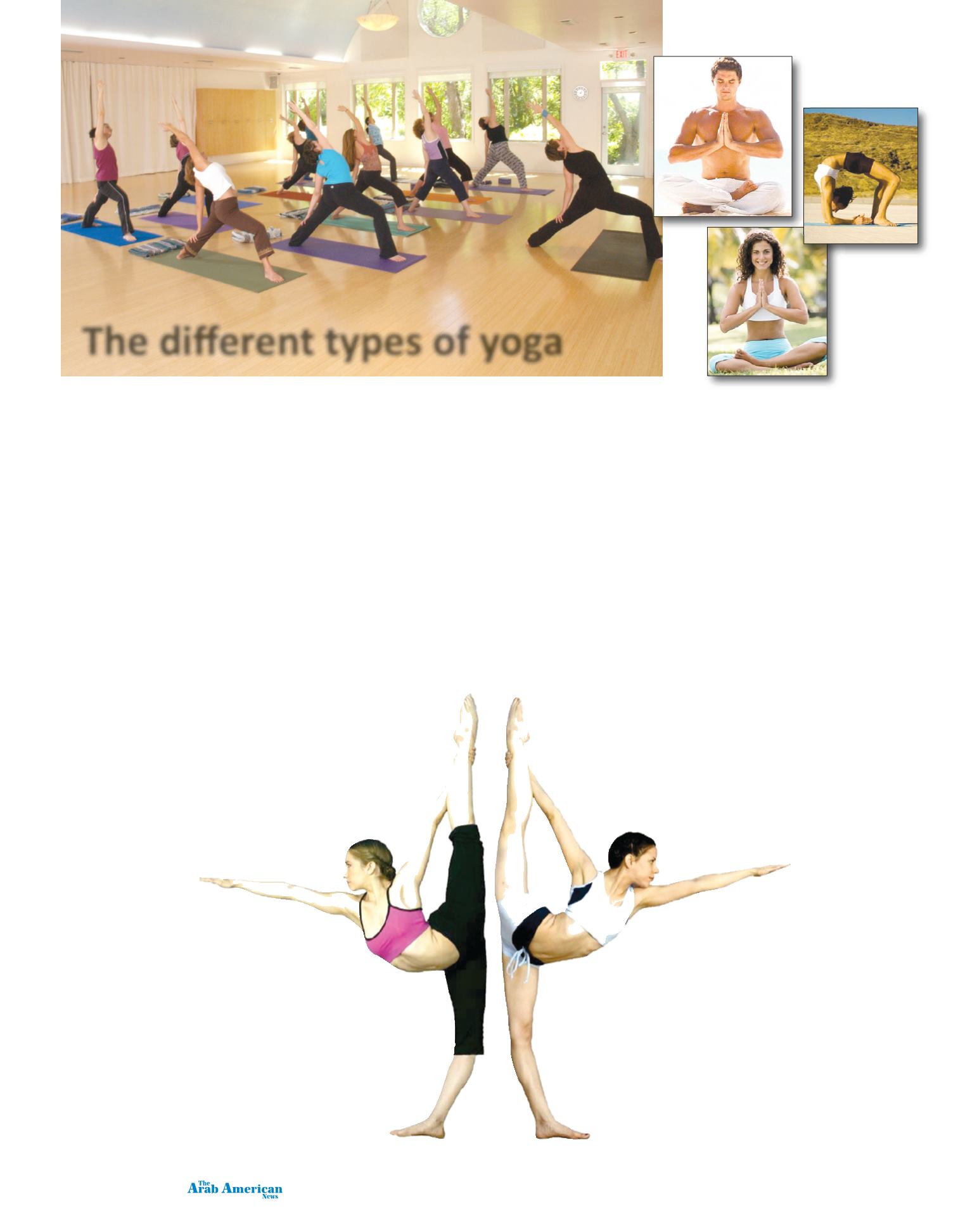
The different types of yoga


