June 2011 - sahtak
11
DEARBORN
— Bringing trauma treatment
services to the community was just a matter
of time for Oakwood Healthcare, Inc. (OHI).
Since the Oakwood Hospital & Medical
Center (OHMC) became a designated Level
II Trauma Center in January of 2010, the
staff there has worked countless hours to help
save lives through the quick treatment of seri-
ous injuries, according to Dr. John Fath, di-
rector of trauma services at the OHMC.
“It’s all about bringing an important serv-
ice to the community,” said Fath. “Without
the ability to treat acute traumatic injuries on
site, a patient would have to be transported
out of his/her community to receive care.”
Trauma centers are subject to review by
the American College of Surgeons (ACS),
which established a Committee on Trauma
(COT) Verification Program in 1987 to pro-
mote the development of trauma centers
where hospitals not only provide the neces-
sary resources for trauma care, but address all
the needs of injured patients—from the pre-
hospital phase to through the rehabilitation
process.
A Level II Trauma Center must have sim-
ilar qualifications to that of a Level I Trauma
Center— it must have continuous general sur-
gical coverage and be capable of managing
the initial care of the majority of injured pa-
tients and conduct education programs for
nurses, physicians, and health care workers in-
volved with trauma. It must also provide com-
prehensive trauma care and have an outreach
program that focuses on prevention of trauma
within the community.
OHMC is the only hospital in Dearborn
that has a Level II Trauma designation,
which means that ambulance services can be
assured that there are resources to meet the
needs of trauma victims. Most of the patients
come from the Dearborn and Dearborn
Heights communities, but others are trans-
ported from places such as, Allen Park, Tay-
lor, Inkster, Garden City, Wayne, Romulus
and Westland.
The hospital has seen more than 2,000
cases since the designation was approved, he
said. They vary in severity from victims of car
crashes to serious falls, as well as victims of
assault and gunshot wounds. The survival
rate for people with severe trauma is greatly
improved if they receive care within ‘the
golden hour,’ that is, the first hour after they
receive the injury. “These are all considered
time-critical,” said Fath.
The trauma designation means that doc-
tors on call at OHMC can handle virtually
any type of injury without having to transport
patients to a higher-level facility; two prime
exceptions are children, who are most often
transported to Children’s Hospital in Detroit,
and burn victims, who are transported to burn
centers located in Detroit or Ann Arbor.
The Oakwood Southshore Medical Cen-
ter (OSMC) in Trenton was designated a
Level II Trauma Center in February as well,
according to Kathy Kempf, the coordinator
of trauma services there. It is the only Michi-
gan hospital south of I-94 to receive the des-
ignation; the next closest one for downriver
residents is in Toledo, OH.
“It is a great service to bring to the com-
munity,” said Kempf. “There was a gap in
care that we are now able to service.”
The health-
care system
also has made
recent
ad-
vances in the
care of cardiac
patients through the use of portable EKGma-
chines in area fire departments. The devices
allow paramedics to take an EKG reading at
the patient’s home or en-route to the hospital
and transmit the data directly to the Emer-
gency Department and in some cases, directly
to the physician’s smart phone. This ad-
vanced warning of a potentially life threaten-
ing problem means that your doctor is ready
upon your arrival to the hospital and that
greatly reduces the time it takes for patients to
receive treatment. The national average is 90
minutes, but that has been reduced to an av-
erage of about 60 minutes at the two hospi-
tals.
“We’re bringing the emergency room right
into the patients’ living room,” said Dr. Samir
Dabbous, MD, FACC, director of heart and
vascular services at Oakwood Healthcare, Inc
(OHI). “It has really clipped a lot of time off
of our door-to-balloon average,” he said.
“We’ve almost cut it in half. It’s making a
major impact.”
The Oakwood Healthcare System has
committed to help fund the technology in fire
departments and ambulance services
throughout its 500-square-mile service area.
So far, the units are in Wayne-Westland,
Inkster, Melvindale, Allen Park, Taylor, Dear-
born Heights and Dearborn.
“Oakwood is committed to this process
because of the successes we’ve had,” said Joe
Murray, manager of the critical care transport
team at OHMC. “We’re looking forward to
getting everyone on board.”
Trauma designa on means be er care for the community
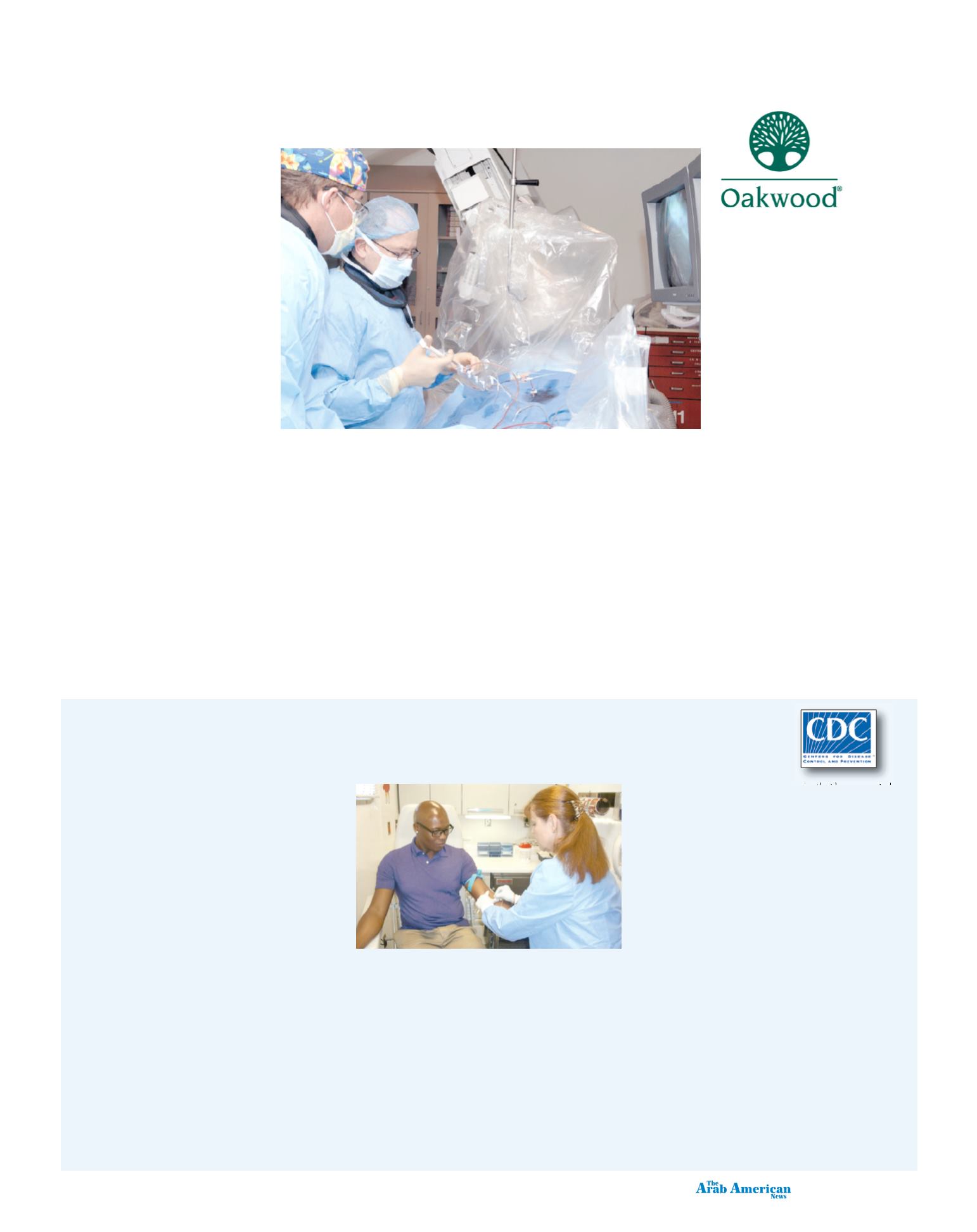
Dr. Samir Dabbous, MD, FACC, performs a cardiac catheteriza on/balloon procedure.
Oakwood Healthcare brings life-saving techniques closer to residents
By Natasha Dado
The Arab American News
DETROIT
—WayneCounty has been selected for theNational
Health and Nutrition Examination Survey (NHANES) which
is conducted by the Centers for Disease Control and Prevention
(CDC). In the next fewweeks CDC representatives will be visit-
ing homes in the region to ask short and easy questions about
one or more residents. The representative will provide official
CDC identification.
She or he will also arrange a convenient time to schedule the
individual's appointment at the mobile examination center,
where a number of tests will be performed.
A report of medical and dental findings will be given to each
participant. Participating adults will receive free health tests of
up to $4,255 in value. Additionally $125 is given to adults at the
mobile examination center. Children are given $40. Other types
of financial incentives are distributed. Transportation is provided
to and from the mobile center if necessary. It takes 10-12 weeks
to complete the report of findings according toNHANES Study
Manager, Janis Eklund.
The National Arab American Medical Association
(NAAMA) is encouragingArabAmericans to participate in this
major national effort, which gathers information to assess the
health and nutritional status of children and adults living in the
United States. "It is critical that the Arab American community
be represented in the survey so the healthcare needs of this pop-
ulation are identified and addressed by both government agencies
and the private sec
tor," NAAMA President Mouhanad Hammami said.
All information is kept strictly confidential, and protected by
public laws. "There is no way anyone can get this information,"
Eklund said. Participants are selected and can't volunteer. Those
who don't participate will not be replaced. Answering the ques-
tions is voluntary, and residents can decide not to answer any.
There are no penalties or loss of benefits of any kind from refus-
ing to answer. "What the CDC is looking for is trends. Some-
thing that is appearing in that population," Eklund said.
Institutions that use the data collected in the surveys include
theU.S. Food andDrugAdministration, AmericanHeart Asso-
ciation, American Diabetes Association and the U.S. Environ-
mental ProtectionAgency. News agencies that have reported the
data are theNewYorkTimes, CNN, USAToday among others.
"You will be among the many people in towns and cities
across the country that help us increase our knowledge about the
health of people in the United States…We will use the informa-
tion only for statistical research and reports. Your answers will
be added to others, so no one can identify which are yours," said
Director of NHANES, Edward J. Sondik, PH.D.
The process of picking the homes and counties are simple.
All the counties in the United States are divided into 15 groups
based on their characteristics. One county is selected from each
large group, and together they form the 15 counties in the
NHANES surveys for the year.
Within each county, smaller groups (with a large number of
households in each group) are formed, and between 20-24 of
these small groups are selected. All of the houses or apartments
within those selected small groups are identified, and a sample of
about 30 households are selected within each group.
NHANES interviewers go to each selected household and
ask for information (age, race, gender, and general income level)
on all persons in the household. Acomputer algorithmrandomly
selects some, all, or none of the householdmembers. "The com-
puter could be looking for someone who is one-years-old or 75-
years-old," Eklund said. Each person selectedmay represent up
to 65,000 similar people in the United States.
For additional information, please call the NHANES of-
fice at 800.452.6115 or visit
.
To reach NHANES Study Manager Janis Eklund call
800.398.1394.
Community’s par cipa on in na onal survey cri cal to
addressing healthcare needs of Arab Americans
A medical employee draws blood as part of a series of tests inside
the mobile examina on center in Wayne County on June 13. Arab
Americans were spo ed at the center having tests conducted on
them as part of the na onal health survey
.


