




A new poll conducted by Zogby Research Services reveals that a majority of Palestinians across Gaza, the West Bank and East Jerusalem believe a one-state reality under Israeli control has already taken hold or is imminent. The findings, released during a July 9 webinar hosted by the Arab American Institute, exhibit widespread Palestinian disillusionment as those under occupation face continuous displacement, economic hardship and diminishing hope for statehood.
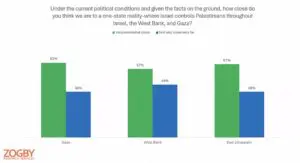
Palestinian belief of an imminent one-state reality.
The poll surveyed more than 1,400 Palestinians across all three regions on topics of resource accessibility, unemployment, political beliefs, and Israeli-imposed restrictions and expulsions.
In Gaza, 54 percent of respondents reported having a family member who had been killed or gone missing, and 64 percent said they had been forced to relocate more than four times in the past nine months. Access to basic necessities is severely limited: fewer than 20 percent reported that clean water, shelter or food were “always available.”
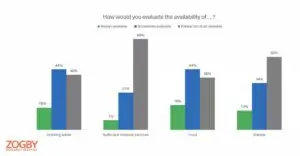
Availability of necessities in Palestine.
Trust in current leadership is also low: only 4 percent in Gaza prefer Hamas governance after the war, and just 11 percent in the West Bank favor the Palestinian Authority. Instead, large segments support either a national unity government or a transnational coalition, highlighting a growing demand for structural alternatives and international oversight.
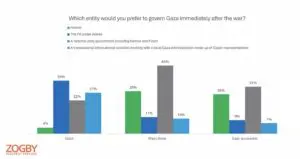
Assessing which political entity Palestinians prefer to govern Gaza after the war.
However, an additional question posed to Gazans asked what they most wanted to see in their future.
“In Gaza, 42 percent — the largest share — said they just want things to go back to how they were before October 7, so they could feed their families and live in peace,” said James Zogby, president of the Arab American Institute.
“This sign of almost despair and resignation is deeply troubling,” Zogby said, referencing the lack of Gazan interest in political resolution. “They don’t want to talk about complicated stuff right now. They’re just trying to survive.”
The reality behind peace rhetoric
Across the West Bank and East Jerusalem, Palestinians overwhelmingly believe Israeli violence, land seizures, home demolitions and economic restrictions are “very serious threats” — numbers that exceed 90 percent of respondents.
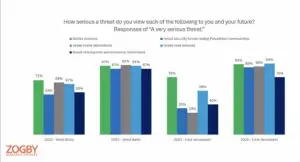
Evaluating to what extent Palestinians feel Israeli occupation is a serious threat.
As daily realities grow more unlivable, Palestinians continue to feel excluded from the very conversations that claim to chart a path forward. Efforts across the Middle East to reshape Palestine through diplomatic and economic agreements have neglected the case for Palestinian sovereignty, and made their rights negotiable, if acknowledged at all.
Zogby emphasized that ongoing U.S.-backed normalization deals and Israeli security plans systematically silence Palestinian voices.
“Everything is factored into the plan—except what Palestinians want,” he said. “Plans that accommodate Israeli and American concerns, but not Palestinian lived experience.”
Given that a majority of Palestinians believe they are already close to living in a one-state reality under Israeli control, talks of peace negotiations appear to be insincere and disconnected from the conditions on the ground.
Zogby made it clear that U.S. and Israeli leaders use “two-state solution” language strategically to hide a long-term project of control, noting that the two-state framework has become “the emperor’s new clothes.” The Arab American Institute refers to this as two-state absolution — a false narrative that promises Palestinian sovereignty while enabling permanent Israeli occupation.
Accountability and the path forward
While Zogby was hesitant to label U.S. policy as intentionally malicious, he emphasized that American inaction facilitates Israeli expansion.
“The result is that they become complicit in the Israeli act, but think that they’ve got a clean slate because they’ve said something differently.”
Zogby was more direct about Israel’s intentions.
“I think they want ‘the land of Israel.’ They want to occupy the whole thing and keep it, and they want Palestinians out any way they can get them out.”
He concluded the session by underscoring the need for international accountability — not condemnations, but sanctions and coordinated pressure — as the only effective challenge to a system of occupation.
“The Israelis have to get the hell out,” he said. “Occupation is the problem, not the Palestinians.”
The poll reflects a Palestinian public increasingly focused on daily survival and long-term stability rather than abstract political initiatives. As regional normalization efforts continue and negotiations remain stalled, the demand for concrete international efforts, beyond rhetoric, is clear. A just resolution that dismantles the horrors of Israeli occupation appears out of reach, but this trajectory must be challenged by demanding action from global institutions and resisting Palestinian erasure.

Leave a Reply