



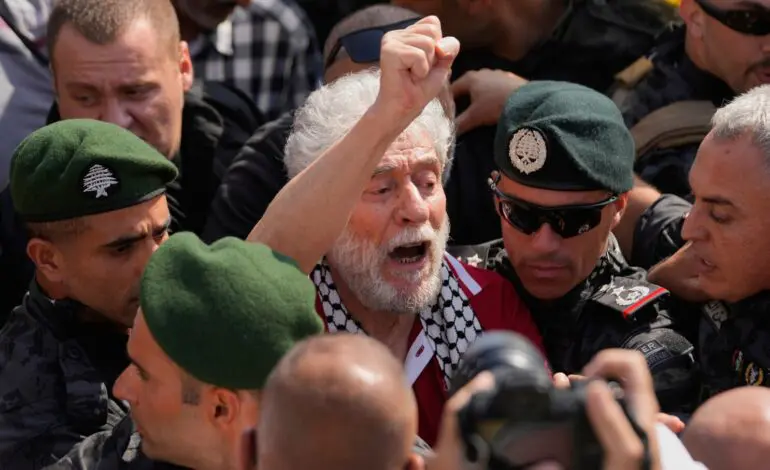

BEIRUT – French authorities released Georges Ibrahim Abdallah, the Lebanese leftist pro-Palestinian and Europe’s longest-held political prisoner, last Friday, after 41 years in detention. Abdallah, who was arrested in the early 1980s on charges of conspiring to assassinate an American and an Israeli diplomat, arrived at Beirut’s Rafic Hariri International Airport to a crowded warm welcome from supporters waving Palestinian and Lebanese flags and the banners of the Lebanese Communist Party and the Syrian Social Nationalist Party, following a quiet reception in the airport’s VIP lounge by a small group of family members, members of the campaign that advocated for his release and media representatives.
His release marks the end of a long struggle marked by public and legal pressure, particularly since Abdallah completed his minimum sentence in 1999. Despite this, French authorities kept him imprisoned, citing political considerations — a move activists denounced as a politicization of French justice under American and Israeli pressure.
Although the Paris prosecutor’s office filed an appeal against the release decision with the Court of Cassation, that appeal — which takes several weeks to process — did not suspend the ruling, allowing Abdallah to return to Lebanon.
Now 74-years-old, Abdallah left Lannemezan Prison in southwestern France early last Friday morning, escorted by a six-vehicle security convoy. His release followed a ruling by the Paris Court of Appeal, which conditioned his freedom on permanently leaving French territory.
Four decades is a long time, but you don’t feel it when your life has a revolutionary purpose. — Georges Ibrahim Abdallah, upon his release after 41 years in prison
Judges at the appellate court ruled that Abdallah’s detention was disproportionate to the crimes committed and to his age. They described him as a “symbol of the past Palestinian struggle”, noting that the small group he once led — comprising secular and Marxist Lebanese Christians and pro-Palestinian activists — had disbanded and had not committed any acts of violence since 1984.
The court acknowledged that Abdallah showed no remorse or sympathy for the victims, whom he continued to view as enemies. Still, the judges concluded that the activist, who now intends to spend his final days in his northern Lebanese village and possibly engage in local politics, no longer poses a threat to public order.
Eligible for release for 25 years
Abdallah — whose once black thick beard is now white — was sentenced to life in prison in 1987 for complicity in the 1982 assassinations of U.S. military attaché Army Lieutenant Colonel Charles R. Ray and Israeli diplomat Yacov Barsimantov. He became eligible for parole 25 years ago, but all 12 requests for release were denied.
Following the recent court ruling, Agence France-Presse (AFP) visited Abdallah in his prison cell — adorned with a large poster of Che Guevara on a red background, a world map and pro-Palestinian stickers — alongside Andrée Taurinya, a member of the French National Assembly from the far left.
“Four decades is a long time, but you don’t feel it when your life has a revolutionary purpose,” Abdallah said.
A Marxist struggle against imperialism
Abdallah was wounded during Israel’s 1978 invasion of southern Lebanon and later joined the Popular Front for the Liberation of Palestine (PFLP), the Marxist-Leninist group founded by George Habash. He later co-founded, along with family members, the Lebanese Armed Revolutionary Factions (LARF) — a Marxist, anti-imperialist group that claimed responsibility for five attacks in Europe between 1981 and 1982, in support of the Palestinian cause. Four of those attacks caused deaths in France.
For many years, Abdallah was blamed for a wave of bombings in Paris in 1985 and 1986 that killed 13 people and instilled fear across the city.
In 1986, a court in Lyon sentenced him to four years in prison for criminal conspiracy and possession of weapons and explosives. The following year, a special criminal court in Paris convicted him of complicity in the assassinations of Ray and Barsimantov, as well as the attempted assassination of another diplomat in 1984.
It is a disgrace for history that Arabs remain bystanders to the suffering of the Palestinian people and the people of Gaza. — Georges Ibrahim Abdallah, in his first public remarks from Beirut
Abdallah never confessed to involvement in the assassinations, categorizing them instead as acts of “resistance” against Israeli and American oppression, in the context of the Lebanese Civil War (1975–1990) and Israel’s invasions of Lebanon in 1982.
Aside from a small but committed group of annual protesters outside his prison and a few leftist parliamentarians, Abdallah was gradually forgotten by the public — though in the 1980s he was France’s most wanted militant and one of its most prominent prisoners.
A symbol of resistance
Today, Georges Abdallah stands as a symbol of leftist, anti-imperialist and anti-Zionist struggle in the region. He has become an icon for Arab and global liberation movements, who view his case as emblematic of a broader battle against systems of oppression and hegemony.
At his reception inside Beirut’s VIP airport lounge, Abdallah reaffirmed his commitment to resistance in his first public remarks.
“I remain committed to the path of resistance,” he said. “I salute the martyrs of the resistance — the foundation of every liberation idea.
“The endurance of prisoners depends on the resilience of their comrades outside,” he added. “Our resistance is not weak, but deeply rooted, and it must be embraced now more than ever.”
On the question of Palestine, Abdallah called for escalating resistance against Israeli occupation and brutality.
“It is a disgrace for history that Arabs remain bystanders to the suffering of the Palestinian people and the people of Gaza.”
During his meeting with a delegation from Hezbollah, Abdallah emphasized that “the resistance is Lebanon’s shield in building a state for all its citizens.”
He called for unity behind the Lebanese National Army.
“We are not fond of bearing arms,” he said. “Those who offered their finest leaders as martyrs in defense of Lebanon’s borders are the cornerstone and the true guardians of the nation’s dignity.
“The resistance will not kneel. We are not in a position of weakness. The resistance upholds the banner of Lebanon’s unity and the strength of its army — an army capable of confronting aggression. Lebanon will never be a tool or platform for any project that serves the Zionist enemy in any form whatsoever.”
Leave a Reply