



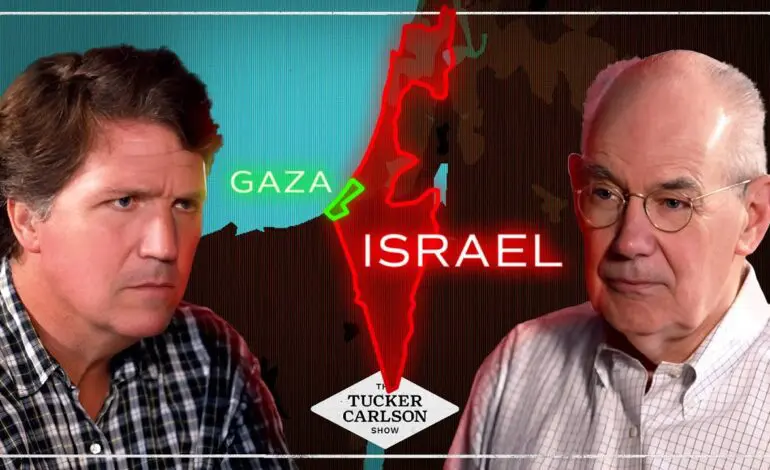

In a recent and highly charged interview that has reverberated across international political discourse, Tucker Carlson sat down with Professor John Mearsheimer, one of the most respected and controversial voices in American foreign policy analysis, to discuss the ongoing humanitarian catastrophe in Gaza. The conversation, released as part of Carlson’s independent media platform, pulled no punches. Mearsheimer, known for his realist approach to international relations and for co-authoring The Israel Lobby and U.S. Foreign Policy, painted a grim and unapologetically honest picture of what he considers to be one of the most shameful foreign policy entanglements in modern American history: the unwavering support of the United States government for what he calls Israel’s systematic campaign of ethnic cleansing and, more provocatively, genocide in Gaza.
Ethnic cleansing and genocide: Mearsheimer’s stark terms
Mearsheimer began the interview by addressing the current state of affairs in Gaza with striking clarity and moral urgency. He asserted that what Israel is doing cannot simply be dismissed as a defensive war against Hamas or a tragic consequence of counterterrorism gone awry. According to him, Israel is engaged in a deliberate campaign to make Gaza uninhabitable, not just for militants, but for the entire Palestinian population. He described the relentless bombardments, the destruction of hospitals, schools and refugee shelters, and the calculated targeting of civilian infrastructure as tactics designed to force Palestinians to flee. He referred to this as ethnic cleansing in its rawest form. But he went even further. Using the term “genocide” with full awareness of its weight, Mearsheimer claimed that Israel’s actions in Gaza meet the definition under international law: the intent to destroy, in whole or in part, a national, ethnical, racial or religious group.
America’s role: From ally to accomplice
What makes this campaign particularly devastating, Mearsheimer explained, is that it is not being carried out in isolation. It is occurring with the full political, financial and military backing of the United States government. The Biden administration, he said, supplied Israel with the bombs that are falling on Gaza, provided the diplomatic cover to shield it from international condemnation and vetoed multiple ceasefire resolutions at the United Nations Security Council. This, in Mearsheimer’s words, makes the United States not merely a passive observer but an active accomplice in the unfolding humanitarian crisis. The professor argued that without U.S. support, without the billions in military aid, the constant flow of weaponry, and the ironclad diplomatic shield, Israel would not be able to sustain its campaign in Gaza. The entire operation, he claimed, is propped up by American power, and therefore the moral and political responsibility rests squarely on Washington as well.
A strategy rooted in expansion, not peace
Delving deeper into the historical context, Mearsheimer linked the current violence to a long-standing Israeli objective: the consolidation of control over the land stretching from the Mediterranean Sea to the Jordan River, what some refer to as Greater Israel. This goal, he asserted, has always been incompatible with the presence of millions of Palestinians who demand sovereignty and dignity. According to Mearsheimer, the Israeli leadership has never genuinely accepted a two-state solution and instead has consistently pursued policies aimed at fragmenting and weakening the Palestinian national movement, making the prospect of a viable Palestinian state impossible. The occupation of the West Bank, the settlement enterprise, the siege on Gaza and now the mass displacement caused by this war are, in his view, all part of a coherent and deliberate strategy.
The high cost of silence and suppression
Mearsheimer also challenged the dominant narratives that pervade mainstream American media and political discourse. He expressed frustration that critics of Israeli policy are often accused of anti-Semitism or of being insufficiently supportive of America’s closest ally in the Middle East. He dismissed this line of attack as intellectually dishonest and morally bankrupt. To him, it is entirely possible and in fact necessary to oppose anti-Semitism while also holding the Israeli government accountable for crimes against humanity. He pointed out that many Jewish voices, both in Israel and abroad, have condemned the actions in Gaza and have called for an end to the occupation and the apartheid-like conditions under which Palestinians live. Silencing dissent, he warned, only further entrenches bad policy and isolates the United States from the global community.
Strategic folly: How supporting Israel hurts the U.S.
Tucker Carlson, known for his sharp critiques of American foreign policy and for giving voice to perspectives often ignored by the establishment, appeared visibly struck by the gravity of Mearsheimer’s claims. While he allowed the professor ample room to express his views, Carlson also asked probing questions about the consequences of such an indictment. What, he asked, would be the fallout for America’s moral authority, for its standing in the world, if it is indeed seen as a sponsor of genocide? Mearsheimer responded that the consequences are already unfolding. The United States, he said, is rapidly losing its credibility on the world stage. Its claims to champion human rights, democracy and international law ring hollow when it supports, funds and protects a regime that is accused of committing atrocities against a stateless and impoverished people. This hypocrisy, he warned, is not lost on countries in the Global South, on younger generations of Americans or on human rights observers across the globe.
Mearsheimer did not only focus on the moral implications. He also addressed the strategic dimension of U.S. support for Israel. From a realist standpoint, he argued, the alliance with Israel no longer serves America’s national interest. In fact, it undermines it. By tying itself so tightly to Israel, Washington is alienating allies in the Arab world, inflaming anti-American sentiment and entangling itself in conflicts that have little to do with the security or prosperity of the American people. He pointed out that many of America’s adversaries, including Iran and various non-state actors, use America’s unwavering support for Israel as justification for their hostility. Furthermore, Mearsheimer warned that continuing down this path risks dragging the United States into a broader regional war, especially as tensions with Hezbollah in Lebanon and Iranian-backed militias in Iraq and Syria escalate. The professor’s message was clear: American support for Israel is not only morally indefensible, it is strategically disastrous.
Human cost beyond the headlines
One of the most powerful moments in the interview came when Mearsheimer spoke about the Palestinian people themselves. Stripping away the layers of geopolitical analysis, he reminded viewers that behind every statistic is a human life. Children buried under rubble, mothers weeping for their lost sons, families displaced for the third or fourth time, these are not abstract problems, he said; they are the real and present suffering of an entire people. He lamented the dehumanization of Palestinians in Western media and politics, where they are often portrayed as terrorists or collateral damage rather than as victims of one of the most powerful militaries in the world. He urged Americans to look beyond the propaganda, to see the humanity of Palestinians and to demand that their government stop enabling their destruction.
Conclusion: A call for moral reckoning
Carlson concluded the interview by thanking Mearsheimer for his honesty and courage. The professor, in turn, expressed hope that the American public would begin to ask harder questions about their country’s role in the world, particularly when it comes to Israel and Palestine. He reiterated that this is not about being anti-Israel or anti-Semitic. It is about upholding basic principles of justice, morality and international law. If the United States is to be a force for good in the world, he argued, it must stop supporting policies that lead to mass suffering and begin holding its allies accountable, starting with Israel.
The interview has since sparked intense debate. Supporters of Israel have condemned Mearsheimer’s comments as inflammatory and biased, while critics of U.S. foreign policy have praised him for speaking truth to power. Regardless of one’s position, it is clear that the interview has struck a nerve. At a time when Gaza lies in ruins, when the international community is paralyzed and when American bombs continue to fall on Palestinian neighborhoods, Mearsheimer’s words challenge us to reconsider what kind of nation we are, what kind of world we want to build and whether we are willing to stand up for justice even when it means confronting uncomfortable truths about our closest allies.
In the end, Mearsheimer’s argument is simple but profound. A nation that claims to defend human rights cannot pick and choose which lives are worthy of protection. A superpower that prides itself on the rule of law cannot support war crimes with impunity. And a democracy that values free speech cannot silence those who speak out against injustice. The United States, he insists, must choose a different path, one that aligns its foreign policy with its professed ideals. Until then, Gaza will remain a stain on America’s conscience and the words of John Mearsheimer will continue to echo in the hearts of those who still believe that truth matters.
– Amjad Khan is a contributing writer for The Arab American News. He is an educator, writer and academic researcher with a deep commitment to addressing the challenges facing the Muslim world. Through his work, he seeks to inspire meaningful dialogue and help chart a path toward unity, justice and peace.


Leave a Reply