



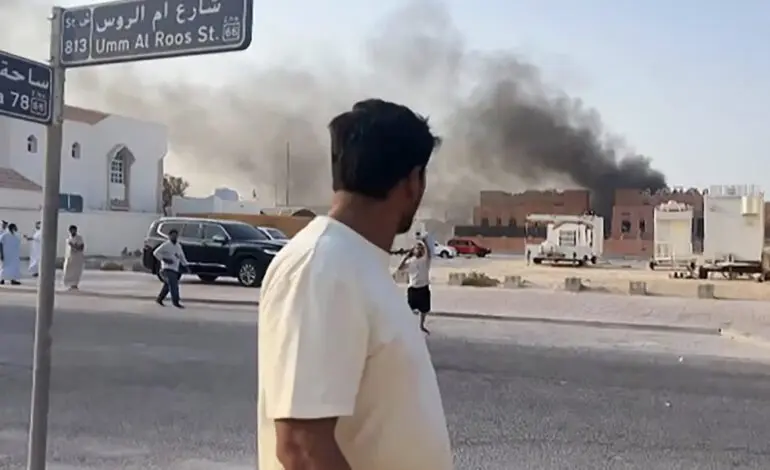

From Gaza and the West Bank to Lebanon, Syria and Yemen — and even reaching Qatar — Israeli arrogance continues to violate Arab lands and their sovereignty without restraint, while the U.S. administration appears either helpless or complicit with Benjamin Netanyahu’s madness. He has escalated his “eternal war” into a new phase after a failed attempt to assassinate Hamas leaders during a meeting in Doha to discuss President Trump’s proposal to end the war in Gaza.
Striking Doha
With fire and steel, Netanyahu responded to Trump’s Gaza ceasefire proposal by ordering an unprecedented cross-border airstrike on the Qatari capital. Israeli warplanes bombed residential buildings linked to Hamas in Doha, killing a Qatari internal security officer and five Palestinians, including Hammam Al-Hayya, son of Hamas Gaza leader Khalil Al-Hayya, who survived along with other Hamas officials because they were meeting elsewhere.
While the brazen attack underscored that Netanyahu seeks neither negotiations nor solutions, Washington rushed to deny prior knowledge of the assault. Trump personally assured Qatar that such an attack would not be repeated. Hamas confirmed the failure of the assassination attempt but announced the deaths of members of its negotiating delegation, including Khalil Al-Hayya’s son and Jihad Lubad, the official’s chief of staff.
At least 10 Israeli fighter jets participated, flying over Jordan, Syria, Iraq and Saudi Arabia to launch 10 precision missiles at what was believed to be the Hamas leadership meeting site in Doha. The operation, code-named “Summit of Fire”, was not simply a military-security strike but a direct attempt to sabotage ongoing mediation over Gaza, undermine Qatar’s efforts at brokering a ceasefire and send a warning to all states hosting Hamas that they, too, are within Israel’s reach.
“I say to Qatar and all countries that host terrorists: either expel them or hand them over to justice,” Netanyahu declared in a video message. “If you do not, we will do it ourselves.” He vowed that Hamas leaders had “no immunity anywhere.”
The international response was swift. The U.N. Security Council issued a statement condemning the attack on Doha and expressing regret for civilian casualties — though it stopped short of naming Israel as the aggressor. All 15 members, including the United States, endorsed the text drafted by Britain and France, reaffirming support for Qatar’s sovereignty and praising its mediation role.
Council members stressed that prisoner release and ending the Gaza war must remain top priorities. Trump’s proposal for ending the conflict included the release of all 48 Israeli captives (20 of them alive) and Israel’s full withdrawal from Gaza, to be handed over to a new authority not affiliated with Hamas.
Meanwhile, the Qatar News Agency reported that Doha would host an emergency Arab-Islamic summit on Sunday and Monday to discuss responses to the Israeli attack.
On Thursday, under heavy security and with the presence of Emir Tamim bin Hamad Al Thani, Qatar held funerals for the attack’s victims at a mosque in Doha. Streets around the mosque were closed and security forces deployed heavily.
Qatar’s government denounced the strike as “state terrorism.” Prime Minister and Foreign Minister Mohammed bin Abdulrahman bin Jassim Al Thani vowed Doha would not tolerate any violation of its sovereignty and announced the formation of a legal team to pursue retaliatory measures. He blasted Netanyahu as a “rogue” figure “leading the region toward irreparable disaster.”
Within Israel, however, divisions surfaced. Channel 13 reported that senior officials considered the timing “inappropriate”, preferring to exhaust negotiations mediated by Qatar. KAN revealed that the army chief of staff, the director of the Mossad, the head of Military Intelligence and the National Security Council chief all expressed reservations about the timing — though not about the principle of the operation. Channel 12 noted that the Mossad did not directly participate despite prior knowledge.
In Washington, Trump’s advisors told Axios that “Israel did not consult Washington before the strike” and that the U.S. only received official notice 10 minutes after the attack — though American radar tracked Israeli planes earlier. The delay caused frustration, particularly as the attack came during active U.S.-led mediation. Israel Hayom reported that plans to target Hamas leaders in Qatar had circulated for a year but were previously blocked due to U.S. objections, until Netanyahu allegedly got the “green light” after Minister Ron Dermer visited Washington days earlier.
Trump distanced himself, saying the Doha strike was “Netanyahu’s decision, not mine” and that unilateral bombing in Qatar “serves neither Israel’s nor America’s interests.” While affirming that eliminating Hamas was a “legitimate goal”, Trump stressed that Qatar was a “strong ally and friend of the United States.” He said he instructed his secretary of state to expedite a new defense cooperation agreement with Doha and assured the emir that such an incident would not recur.
Hamas called the Israeli strike an “open declaration of war” against all Arab and Islamic states, urging concrete measures to confront “Zionist arrogance.”
“This was not just an attempt to assassinate our delegation, but a deliberate strike on the entire negotiation track and Qatar and Egypt’s mediation role,” Spokesman Fawzi Barhoum said. “Netanyahu’s criminal gang is determined to sabotage every regional and international effort to end genocide and starvation in Gaza.”
Barhoum accused the U.S. of full partnership in the crime, holding it morally and politically responsible for shielding Israel.
“These crimes will not alter our positions,” he said. “We demand an end to the aggression, full Israeli withdrawal from Gaza, a genuine prisoner exchange, humanitarian relief and reconstruction.”
Gaza invasion and West Bank annexation
As the Israeli army delays Netanyahu’s order to invade Gaza City, Doctors Without Borders (MSF) warned of a worsening humanitarian catastrophe. The group said it was impossible to force 1 million residents to flee into overcrowded, resource-poor southern zones — a “death sentence” for many.
Netanyahu has vowed a massive ground assault and urged civilians to evacuate. In a video address, he boasted of destroying “50 terror towers” in Gaza in two days, calling it “just the beginning” of a major ground offensive.
Yet Haaretz reported that the army faces serious obstacles, including slow civilian displacement, exhausted troops, equipment shortages, low morale and indiscipline among some officers. Only 10 percent of residents have fled south, leaving military plans stalled.
Despite these struggles, Hamas military operations continued: Four Israeli soldiers were killed in Jabalia and six others in a an ambush near Jerusalem.
Meanwhile, Netanyahu openly declared expansionist aims in the West Bank. At a ceremony launching the E1 settlement project in Ma’ale Adumim, east of Jerusalem, he vowed, “There will never be a Palestinian state. This land is ours.” He described Israel’s eastern border not as Ma’ale Adumim but the Jordan Valley, pledging to build more “cities like Ma’ale Adumim.”
The Jerusalem Governorate warned that Israel’s “framework agreement” with the Ma’ale Adumim municipality to build 7,600 settlement units — including 3,400 in E1 — was a bid to encircle Palestinian communities, expel Bedouins and cement “Greater Jerusalem” in order to prevent a sovereign Palestinian state with East Jerusalem as its capital.
Israeli rampage beyond Palestine
Qatar and Palestine were not the only targets. Israel also bombed Syria, Lebanon and Yemen throughout the week.
In Syria, despite U.S.-French-backed talks on a possible security arrangement tied to normalization, Israel intensified strikes nationwide. Reports suggested a planned meeting between Israeli Strategic Affairs Minister Ron Dermer and Syrian Foreign Minister Asaad Al-Shibani. Meanwhile, transitional Syrian President Ahmad Al-Sharaa is scheduled to attend the U.N. General Assembly later this month, the first Syrian head of state to do so in six decades. Washington has already delisted Al-Sharaa’s bloc from terrorism lists and is lobbying the Security Council to follow suit.
In Lebanon, even after a temporary defusing of tensions between the Lebanese army and Hezbollah, Israeli airstrikes continued. Hezbollah Deputy Secretary-General Sheikh Naim Qassem reaffirmed that Israel’s occupation could not continue.
“There is no solution to the question of our arms outside a national defense strategy,” he said. “Support the resistance to protect your countries and regimes.”
In Yemen, fresh Israeli strikes were met with condemnation from Abdul-Malik Al-Houthi, leader of Ansar Allah, who blasted Arab governments’ “strategy of statements” after every attack. He announced that Yemeni armed forces launched 38 missiles and drones in the past two weeks in solidarity with Gaza, successfully striking Ramon Airport and Ben Gurion Airport, vowing continued operations despite Israeli retaliation.

Leave a Reply