



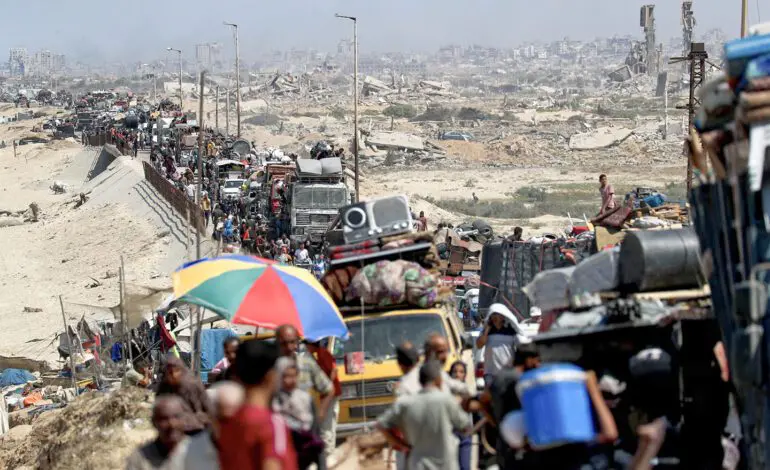

After a feeble Arab–Islamic summit that limited itself to verbal condemnations of the Israeli aggression on Doha and vague calls to review diplomatic and economic relations with the occupation state, the Israeli army — under orders from Prime Minister Benjamin Netanyahu and with an American green light — began an invasion of Gaza City. The stated goal was to push hundreds of thousands of Palestinians toward the south as part of Zionist schemes to displace the people of the devastated Strip under the pretext of eliminating Hamas. This came despite the grave risks posed by such a wide ground offensive to the lives of the remaining Israeli captives and the heavy losses the occupation army may incur in personnel and equipment.
While Israel’s killing machine escalated bombing and incursions into Gaza, Washington once again acted as a barrier to international efforts to end the war. On Thursday, the U.S. delegate used the veto against a Security Council resolution that called for an immediate and permanent ceasefire, the lifting of restrictions on aid entry and the immediate and unconditional release of hostages.
The resolution had been presented by all 10 non-permanent member states of the Council, in another attempt to end a brutal war that has raged for more than 23 months. Although the resolution included a clause demanding the release of Israeli captives — an issue President Trump repeatedly raises when asked about Gaza — the U.S. veto confirmed beyond doubt Washington’s complicity in the continuing aggression against the Strip, whose population is suffering famine according to the United Nations.
The resolution received 14 votes, including all 10 elected members, but Washington’s veto overturned it. The U.S. had previously rejected five similar resolutions since the start of the Gaza war, the most recent in June.
U.S. envoy Morgan Ortagus said during the latest session that America rejected the resolution because it “equates Israel with Hamas and does not recognize realities on the ground.” She claimed Israel had accepted terms for ending the war while Hamas had refused, adding that Hamas must release detainees and “surrender immediately.” She blamed Hamas for obstructing aid to Gaza’s needy and for using civilians as tools to achieve its goals.
Russia and other states criticized the American veto, stressing that the resolution could have stopped Gaza’s tragedy. Denmark’s envoy, speaking on behalf of several countries, said famine in Gaza is a reality and demanded that aid be delivered to the Strip immediately.
Rhetorical escalation at the Doha Summit
Amid the absence of most Gulf Cooperation Council leaders, the Arab–Islamic summit in Doha on Monday produced no practical measures to respond to the failed Israeli attempt to assassinate the Hamas negotiating team in the Qatari capital on September 10. The final statement merely condemned “the brutal aggression that undermines chances for peace in the region.”
The statement stressed that the attack on a neutral site for mediation undermines international peace processes. It praised Qatar’s “civilized and wise” stance in handling the treacherous assault and rejected any justification for Israel’s aggression, including renewed threats to target Qatar again.
It also condemned Israeli policies that created an unprecedented humanitarian catastrophe in Gaza, warned against annexation of occupied Palestinian lands, described such actions as violations of international law and destruction of peace efforts, and reaffirmed opposition to any attempts at Palestinian displacement. It called for suspending Israel’s U.N. membership.
The statement said the “brutal aggression against Qatar, and the continuation of aggressive Israeli practices — including genocide, ethnic cleansing, starvation, siege, settlement and expansionist policies — undermine peace and coexistence in the region and threaten all progress toward normal relations with Israel, including current and future agreements.”
Israel’s attack on Qatari sovereignty provoked Arab and international condemnations, with calls to restrain Tel Aviv from violating international law. President Trump disowned the assault on Qatar, which failed to kill Hamas Gaza leader Khalil al-Hayya but led to the killing of his chief of staff Jihad Labad, his son Hammam, three Palestinian aides and one Qatari internal security officer.
Emir Tamim’s opening address
In his opening speech, Qatar’s Emir Tamim bin Hamad Al Thani described the attack as “brazen, treacherous and cowardly.” He said that “those who methodically attempt to assassinate the party they are negotiating with are in fact trying to sabotage the negotiations.” He accused Israel of dreaming to make the Arab region its sphere of influence and pledged that Qatar will do whatever international law allows to defend its sovereignty and confront Israeli aggression.
He argued that freeing captives “is not the enemy’s priority” and that negotiations for Israel are “merely part of the war, a political tactic to mislead Israeli public opinion.” What Israel truly wants, he said, is to make Gaza uninhabitable to force its people into exile. He warned that Netanyahu believes in “Greater Israel”, is exploiting the war to expand settlements, alter the status quo at Al-Aqsa, tighten oppression in the West Bank and plan annexation.
He said the treacherous attack revealed Netanyahu’s true goal: Giving Israel the right to enter any place at any time. He cautioned that the extremist settler government dreams of making the Arab world a zone of Israeli influence, to the point where Israeli airstrikes against Arab capitals would become routine — as already seen in Lebanon, Syria and Yemen.
Arab and Muslim leaders’ stances
-
Iraq’s Prime Minister Mohammed Shia al-Sudani condemned Israel’s attacks and insisted the occupation must be deterred from openly redrawing international borders by force.
-
Jordan’s King Abdullah II said the attack on Qatar shows Israeli threats know no boundaries.
-
Egypt’s President Abdel Fattah al-Sisi for the first time labeled Israel an “enemy”, urging the creation of an Arab–Islamic coordination mechanism.
-
Turkey’s President Recep Tayyip Erdoğan called for intensifying sanctions, describing Israel as operating with a “terrorist mindset feeding on chaos and blood.”
-
Iran’s President Masoud Pezeshkian said the attack on Qatar was pre-planned to destroy diplomatic efforts to end the genocide in Gaza, declaring that it was not just a crime but a blatant announcement that force — not law — will rule.
GCC and Saudi responses
The GCC Defense Council met after the summit and condemned the “serious” Israeli military assault on Qatar. Secretary-General Jasem al-Budaiwi said the Council decided to increase intelligence sharing through the joint military command and accelerate the early warning system against ballistic missiles.
Saudi Crown Prince Mohammed bin Salman met Iranian official Ali Larijani in Riyadh to discuss regional security. Saudi Defense Minister Prince Khalid bin Salman also met Larijani. In addition, Saudi Arabia and Pakistan signed a strategic defense pact declaring that any attack on one is an attack on both. The joint statement came after Gulf states felt the danger of unchecked Israeli aggression following the strike on Doha, supposedly under U.S. protection.
Netanyahu, in a press conference, threatened to target Qatar again, accusing it of hosting and financing Hamas.
“It has powerful levers but chose not to use them,” he said. “Therefore our action was entirely justified.”
The focus on Gaza
Hardly had the Doha summit ended when Israel announced on Tuesday the expansion of its offensive in Gaza City under “Operation Gideon Chariots 2.” Troops advanced on the city’s outskirts, aiming to control it and push residents south. The army, with intelligence guidance, targeted alleged Hamas arms depots, while Divisions 162 and 98 pressed operations in Gaza City and Division 143 acted in Khan Younis and Rafah.
Israeli media reported preparations for intensified artillery and airstrikes to force evacuations. Hundreds of thousands remain in the city, refusing to flee because of dangers along the road, shortages in the south and fear of permanent displacement. Israel already holds eastern suburbs, bombing neighborhoods like Sheikh Radwan and Tel al-Hawa to open paths toward central and western districts sheltering most civilians.
On Wednesday, Israel announced the main stage of its ground assault, opening a 48-hour corridor for evacuation. Aid groups reported 55,000 fled between Sunday and Wednesday, but more than 500,000 remained.
Most of Gaza City was destroyed in 2023’s initial war stages, but nearly a million returned to live among its ruins. Forcing them out again would concentrate the Strip’s population in southern camps already plagued by severe hunger.
The U.N., aid agencies and foreign governments condemned Israel’s offensive and displacement. A U.N. commission of inquiry concluded Israel had committed genocide. Israel denounced the finding as “shameful” and “false.” Gaza’s Health Ministry reported more than 65,000 martyrs and about 166,000 wounded. Palestine Telecom announced service interruptions due to strikes on network routes. WHO chief Dr. Tedros Adhanom Ghebreyesus warned of hospitals on the brink of collapse, saying forced evacuations push families into ever-smaller, unlivable areas.
Hamas’ response
Hamas’ al-Qassam Brigades vowed Gaza would be a graveyard for Israeli troops, claiming to have suicide fighters, thousands of traps and explosives, and declaring, “We are ready to send your soldiers’ souls to hell.” They warned Israel will gain no prisoners alive or dead if the assault continues, since captives are spread throughout Gaza neighborhoods.
Qatar’s Foreign Ministry said negotiations were unrealistic under bombardment. Hamas condemned Israel’s escalation as “a new chapter of genocide and systematic ethnic cleansing” carried out under U.S. political and military cover, making Washington a full partner in the crimes.
Notable resistance operations included:
-
Thursday: four Israeli officers, including a major, killed in Rafah by an explosive device.
-
Same day: a soldier and an officer killed in a shooting and stabbing on the Israeli side of the Allenby Bridge; Jordan confirmed the assailant was a Jordanian aid driver.
U.S. campaign to pressure regional resistance
Continuing its pressure to disarm resistance forces, Washington designated Harakat Hezbollah al Nujaba, Kataib Sayyid al Shuhada, Harakat Ansar Allah al Awfiya and Kataib al Imam Ali as foreign terrorist organizations last week. The State Department said these groups threaten U.S. and allied forces and work with Iran’s Revolutionary Guard. Officials framed it as part of limiting Iran’s influence and deterring Tehran-backed militias.
The U.S. noted earlier designations of groups like Kataib Hezbollah (2009) and Asa’ib Ahl al-Haq (2020).
Syria: U.S. mediation and Israeli proposals
Israeli attacks on Syria slowed amid U.S. efforts to broker a security deal. Transitional Syrian president Ahmed al-Sharaa admitted direct talks with Israel and suggested results may come before his U.N. trip.
Axios reported Israel proposed a Camp David-style accord, dividing southern Syria into three security zones with varying demilitarization, no heavy weapons near the border and continued Israeli presence on Mount Hermon. Al-Sharaa demanded Israeli withdrawal from positions seized after December 2024 but deferred the Golan Heights issue, calling it “too big and complex.” He ruled out Abraham Accord-style normalization for now.
Lebanon and Yemen
On the anniversary of Israel’s September 2024 escalation, the Israeli army bombed southern Lebanon heavily, vowing to continue its campaign regardless of political negotiations. Prime Minister Nawaf Salam emphasized diplomacy and Hezbollah disarmament, while Speaker Nabih Berri condemned the strikes as an attack on all Lebanon.
U.S. envoy Morgan Ortagus is due in Beirut to meet military officers only, part of U.S. efforts to push the army into confrontation with Hezbollah.
Meanwhile, Yemen saw relative calm, with no notable clashes between Houthis and Israel.

Leave a Reply