



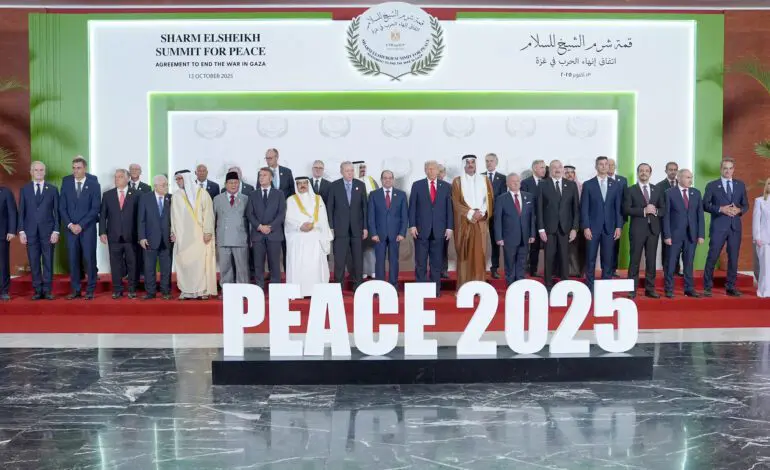

SHARM EL-SHEIKH, Egypt — Led by President Trump and Egyptian President Abdel Fattah el-Sisi, the “Peace in the Middle East” Summit convened on Monday, October 13, in the Egyptian resort city of Sharm el-Sheikh, bringing together leaders and representatives from 30 countries to celebrate the signing of the Gaza ceasefire agreement.
The accord followed intensive mediation efforts by the United States, Egypt and Qatar to end the brutal two-year war in Gaza, coinciding with the second anniversary of its outbreak.
The summit, which came just days after Trump’s surprise visit to Israel and his speech before the Knesset, was described by observers as a “victory tour” for the U.S. president, who played a decisive role in brokering a ceasefire and prisoner exchange between Israel and Hamas.
But while the ceremony marked the official start of the first phase of Trump’s “Gaza Peace Plan” — and despite his repeated claims that “the war is over” — the days following the summit brought renewed doubts about Israel’s sincerity and Hamas’ willingness to advance into “Phase Two”, which aims to disarm the Palestinian resistance, establish a Palestinian state and normalize ties between Arab states and Israel.
Analysts warn that Phase One, involving the ceasefire, hostage and prisoner exchanges, limited Israeli withdrawals and humanitarian aid access, was the easy part. The real challenge, they say, lies ahead, with “Phase Two” expected to face fierce resistance and political obstacles.
Hostage and prisoner exchange
On Monday, Hamas released the final 20 surviving Israeli hostages as part of the ceasefire deal, while Israel freed 1,986 Palestinian prisoners, including 250 serving life sentences and 1,736 detainees from Gaza captured after Hamas’ “Al-Aqsa Flood” operation on October 7, 2023.
The exchange marked the end of one of the bloodiest chapters in modern Middle Eastern history — a war that killed or injured more than 10 percent of Gaza’s 2.3 million residents, displaced millions multiple times and leveled much of the territory.
According to Gaza’s Health Ministry, Israel’s bombardment killed more than 68,000 people and turned most of the Strip into a wasteland of ruins, under catastrophic humanitarian conditions.
In Tel Aviv, crowds greeted freed hostages with tears and chants at “Hostage Square.” In Gaza and the West Bank, thousands welcomed home their newly freed relatives — many of whom had spent years in Israeli prisons.
“The skies are clear, the guns are silent, the sirens have stopped and the sun shines on a holy land finally at peace,” Trump said at the Knesset. “The nightmare is over.”
Later that day, Trump and President el-Sisi hosted more than 20 world leaders at the Sharm el-Sheikh Summit, joined by Qatar’s Emir Sheikh Tamim bin Hamad Al Thani and Turkish President Recep Tayyip Erdoğan, who signed a joint declaration titled “The Trump Declaration for Lasting Peace and Prosperity.”
Notably, no representatives from Israel or Hamas attended, nor did Saudi Arabia or the United Arab Emirates.
The “Trump declaration for lasting peace and prosperity”
The joint declaration, signed by the attending leaders, praised the ceasefire as “a true historic commitment to end over two years of suffering” and pledged to “build a new era of peace, hope and shared prosperity in the Middle East.”
“We are united in dismantling extremism in all its forms. No society can thrive when violence and hate become normalized. We commit to fostering education, opportunity, and mutual respect as foundations of lasting peace.
“Future conflicts must be resolved through dialogue and diplomacy — not force or endless wars,” the declaration further stated. “The tragedies of the past two years should remind us that the next generation deserves better than the failures of history.”
However, critics described the summit as a symbolic display of U.S.-Israeli dominance — and a subtle Arab capitulation, with several Arab leaders pressured to endorse a process that prioritizes Israel’s security over Palestinian sovereignty.
The stumbling block: Remains of Israeli captives
Barely days after the prisoner swap, a new obstacle emerged: the remains of Israeli hostages killed in Gaza, which quickly became a flashpoint threatening to derail Phase Two negotiations.
Observers fear that Prime Minister Benjamin Netanyahu’s hardline coalition could exploit the issue to resist U.S. pressure and undermine the truce.
Two ultranationalist ministers — Bezalel Smotrich and Itamar Ben-Gvir — have already called for the resumption of military operations in Gaza, arguing that Hamas is “stalling.”
According to Axios, Israeli Strategic Affairs Minister Ron Dermer told White House envoys Jared Kushner and Steve Witkoff that Hamas was “dragging its feet” in locating and returning the remains of Israeli captives — an accusation Hamas vehemently denied.
Israel also cut humanitarian aid deliveries by half, from 600 to 300 trucks per day, and banned the entry of fuel and gas, except for limited “basic humanitarian needs.”
The move was widely viewed as an attempt to pressure Hamas into surrendering the remains of 28 deceased hostages identified in Trump’s plan.
“We know they can do more, and no one should reward them with concessions,” an unnamed Israeli official told Axios.
U.S. envoys reportedly urged Israel to share all available intelligence on the possible burial sites, while American advisers pointed to “technical challenges”, saying heavy equipment needed to retrieve bodies is currently unavailable in Gaza.
“It’s a horrific process,” Trump himself told reporters. “They’re digging through rubble and tunnels; some bodies have been there for months. Hamas is trying to locate them.”
By Thursday, Hamas had delivered the remains of nine hostages under the terms of the U.S.-brokered plan.
Trump’s mixed signals and renewed threats
In the following days, Trump’s statements oscillated between optimism and threats.
He warned that if Hamas refuses to disarm voluntarily, the U.S. would “support Israel in doing it by force.”
“The mission is not over,” he wrote on Truth Social. “Phase Two begins now.”
He went further in later comments, threatening to “kill Hamas members” if the group continued its “executions” in Gaza, referring to Hamas’ reported public killings of alleged collaborators after the ceasefire.
Analysts noted that Trump’s shifting tone — alternating between peace broker and war hawk, raised concerns that the fragile truce could unravel quickly, especially as Hamas refuses to surrender its weapons and Israel resists full withdrawal.
Phase Two: Disarmament, governing Gaza and reconstruction challenges
Experts agree that the most contentious issue ahead is Hamas’ disarmament, which Israel demands as a precondition for complete withdrawal.
This condition, embedded in Trump’s 20-point Gaza Peace Plan, could serve as Israel’s justification to resume hostilities.
Other disputed points include the creation of an international peacekeeping force, the establishment of a transitional Gaza administration and the reconstruction of the Strip, estimated to cost $70 billion, according to the U.N. Development Program (UNDP) — a process that could take more than a decade.
Pierre Krähenbühl, director-general of the International Committee of the Red Cross (ICRC), said rebuilding Gaza will require “unprecedented effort and coordination.”
“In my 30 years of humanitarian work, I’ve never seen destruction on this scale,” he said.
Control and governance of Gaza “the day after the war”, analysts note, remain the most complex and divisive topics — deliberately deferred to Phase Two to avoid collapsing the ceasefire talks.
With negotiations uncertain, observers predict Israel will adopt a “Hezbollah model” approach — maintaining intermittent airstrikes and assassinations against Hamas leadership while avoiding full-scale reoccupation.



Leave a Reply