



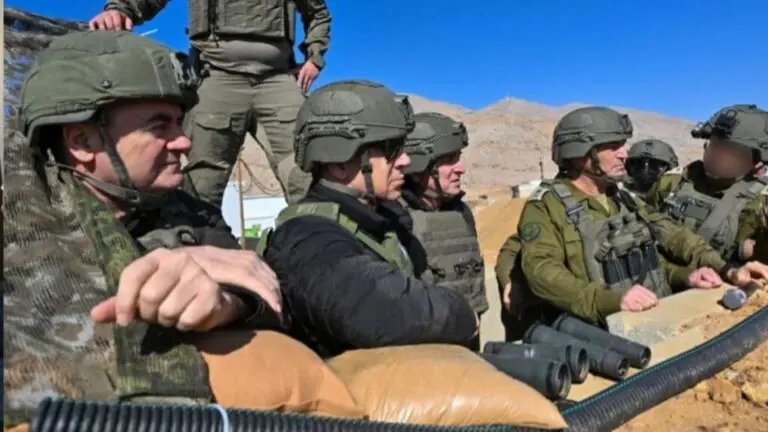

Over the past week, significant developments unfolded on multiple fronts across the Middle East. As Tel Aviv escalated its attacks on Lebanon amid growing threats of launching a full-scale war in response to Hezbollah’s refusal to lay down its arms, Israeli Prime Minister Benjamin Netanyahu toured the occupied Syrian south, accompanied by the foreign and defense ministers, as well as the chiefs of staff and the Shin Bet security service, stressing the importance of keeping Israeli forces there “to ensure the security stability” of the state.
These Israeli moves on the northern front came as Netanyahu continued to exploit the Gaza ceasefire agreement in ways that serve his extremist government, whether by periodically bombing the Strip under various pretexts or by attempting to reinterpret President Trump’s peace plan.
U.N. Security Council backs U.S. plan for international force to disarm Gaza resistance, but the task is difficult
As part of its effort to signal readiness for escalation on all fronts, Israel’s Ministry of Defense revealed that the 1,000th cargo plane landed Wednesday at Ben Gurion Airport as part of the air bridge that has been ongoing since October 7, 2023 to supply the occupation forces with military hardware.
The ministry noted that it and the army had jointly led transcontinental logistical airlifts on a scale unprecedented in Israel’s history, with the aim of supporting all the current and future needs of the occupation army. It stated that “more than 120,000 tons of military equipment, ammunition, weapons systems and protective gear have been brought in aboard 1,000 aircraft and around 150 ships.”
The Israeli Ministry of Defense confirmed that these operations were the product of joint cooperation with the United States and Germany, through which advanced munitions, weapons, armored vehicles, medical equipment, communications systems and personal protective gear were purchased and transported.
According to the ministry, this air and sea bridge has been a decisive factor in maintaining the continuity of Israel’s security apparatus, replenishing emergency stockpiles and ensuring a rapid and precise response to military needs on various fronts.
Netanyahu stalls implementation of the Gaza agreement
In Gaza, Israeli Prime Minister Benjamin Netanyahu continues to exploit the ceasefire agreement in ways that serve his extremist government. He is selectively applying whatever elements he chooses from the “first phase” of Trump’s peace plan, citing the failure to receive the remains of all Israeli captives as a precondition for starting “phase two”, which calls for a full withdrawal of Israeli forces from the devastated Strip.
Netanyahu has also shown little enthusiasm for the U.N. Security Council resolution establishing an international security force in Gaza, as stipulated in Trump’s plan. He said he had informed the U.S. administration that the timeline for forming and “testing” such a force “is not open-ended.”
He stressed that the primary mission of the international force “is to dismantle Hamas and disarm the Gaza Strip.”
Netanyahu, who is wanted by the International Criminal Court for war crimes in Gaza, added that the Israeli army would continue operating to recover the remains of the last three Israeli captives. He noted that if the Rafah crossing is opened, it will only be for the exit of Palestinians from Gaza, and only after completing the phase of recovering the captives’ bodies.
Under the “first phase” of the agreement, Palestinian resistance factions released 20 Israeli captives alive and handed over the remains of 27 others, out of 28, according to their announcements. Israel, however, claimed that one of the bodies it received did not belong to any of its captives, and that another set of remains was not new but additional parts belonging to a captive whose partial remains had already been returned.
Since the ceasefire was signed, Israeli escalation and repeated violations have killed more than 300 Palestinians in the Gaza Strip, in parallel with the ongoing policy of demolishing and blowing up homes and the continued closure of the Rafah land crossing.
In a statement protesting these violations, the Islamic Resistance Movement (Hamas) said on Thursday that the Israeli occupation forces was committing a flagrant breach by continually pushing the so-called “Yellow Line” westward on a daily basis, causing mass displacement of Palestinians. Hamas added that this alteration of the Yellow Line contradicts the maps agreed upon in the ceasefire deal, and called on mediators to pressure Israel to immediately stop these violations.
The Yellow Line is the boundary to which Israeli occupation forces withdrew as part of the first phase of the ceasefire agreement, which entered into force on October 10.
Hamas’s statement came after a new wave of Israeli attacks that killed dozens of Palestinians over the past week, under the pretext of gunfire allegedly directed at an Israeli force positioned beyond the Yellow Line, claims Hamas has denied.
For its part, the Government Media Office in Gaza said that the Israeli occupation army had changed the locations of the yellow markers and expanded the area under its control east of Gaza City. It reported documenting around 400 Israeli violations that have led to the killing of more than 300 Palestinians since the ceasefire took effect.
The media office called on mediators and guarantors of the agreement to move seriously to stop the occupation’s crimes and compel it to abide by the ceasefire and the humanitarian protocol.
In response, the Israeli army claimed that its Kfir Brigade forces are operating in the Yellow Line area in the Gaza Strip in accordance with the ceasefire agreement and directives from the political leadership. It said these forces are carrying out defensive missions and “clearing” the area.
Israel’s genocidal war in the Gaza Strip began on October 7, 2023 and ended two years later under the ceasefire agreement, after having killed more than 69,000 Palestinians and wounded more than 170,000 — most of them children and women. The United Nations has estimated reconstruction costs at around $70 billion.
On Monday, the U.N. Security Council adopted a U.S.-drafted resolution backing the Gaza ceasefire agreement that was reached based on President Trump’s 20-point plan. The resolution won the support of 13 member states, while Russia and China abstained.
The latest version of the resolution’s text provides for the creation of a “Peace Council”, a transitional governing body for Gaza that Trump would nominally chair, with a mandate extending through the end of 2027. It also calls for establishing an “International Stabilization Force” to work with Israel, Egypt and newly trained Palestinian police to help secure border areas and disarm the Gaza Strip.
One of the key provisions of the resolution states that the Peace Council “will provide the framework for Gaza’s redevelopment until such time as the Palestinian Authority has satisfactorily completed its reform program.”
The text also says that “conditions may finally be in place for a credible pathway toward Palestinian self-determination and statehood. The United States will launch a dialogue between Israel and the Palestinians to agree on a political horizon for peaceful and prosperous coexistence.”
The resolution underscores “the importance of the full resumption of humanitarian assistance to the Gaza Strip, in coordination with the Peace Council, in accordance with relevant principles of international law, and through cooperating organizations, including the United Nations, the International Committee of the Red Cross and the Red Crescent, while ensuring that this assistance is used solely for peaceful purposes and that armed groups do not divert it.”
Trump hailed the Security Council vote late Monday night/early Tuesday in support of his plan to end the war in Gaza, saying it would lead to “greater peace all over the world.” In a post on his Truth Social platform following adoption of the resolution, he described it as “one of the greatest agreements in U.N. history”, adding, “Congratulations to the world on the amazing vote at the U.N. Security Council, recognizing and endorsing the Peace Council that I will chair, which will include the strongest and most respected leaders from across the globe.”
U.N. Secretary-General António Guterres’ spokesperson, Stéphane Dujarric, said that the Security Council’s adoption of the Gaza resolution was an important step in solidifying the ceasefire.
“We are committed to carrying out the roles assigned to the United Nations in the Security Council resolution and to increasing the volume of humanitarian aid to Gaza,” he said, noting that Guterres emphasizes the need to advance to the second phase of the U.S. plan for Gaza.
On the Israeli side, the clause dealing with the establishment of a Palestinian state provoked anger within Netanyahu’s government, with the prime minister insisting that he “has not changed his position on rejecting the two-state solution.”
Security Minister Yisrael Katz likewise stressed that “the international force must be effective and have executive authority to disarm Hamas”, while several other ministers ramped up their rhetoric against the resolution. Among them was far-right Finance Minister Bezalel Smotrich, who told his party’s Knesset faction meeting that “there will be no ‘pathway to a Palestinian state.’ This is the state of the Jewish people and it will remain so.”
National Security Minister Itamar Ben-Gvir went even further, calling for “assassinations against Palestinian Authority leaders and the arrest of Abu Mazen (Mahmoud Abbas)”, vowing that “I will personally take care of him in prison” if international recognition of what he called the “invented State of Palestine” continues.
Hamas rejects international mandate over Gaza
For its part, Hamas also rejected the U.N. resolution, arguing that it imposes international trusteeship over the Gaza Strip. In a statement, the movement said the decision “imposes an international guardianship mechanism on Gaza, which our people, their forces and factions reject. It also creates a mechanism to achieve the goals of the occupation, which it failed to realize through its brutal genocidal war.”
Hamas said the resolution “detaches the Gaza Strip from the rest of the Palestinian geography and seeks to impose new realities that are far removed from our people’s constants and legitimate national rights, depriving them of their right to self-determination and to establish their Palestinian state with Jerusalem as its capital.”
Hamas affirmed that “resistance to the occupation by all means is a legitimate right guaranteed by international laws and conventions, and that the resistance’s weapons are tied to the existence of the occupation.” It stressed that “any discussion of the weapons file must remain an internal national matter linked to a political process that guarantees an end to the occupation, the establishment of the state and the realization of self-determination.”
Regarding the mandate of the international force, Hamas argued that “assigning the international force roles and missions inside the Gaza Strip, including disarming the resistance, strips it of neutrality and turns it into a party to the conflict in favor of the occupation.” Hamas added that “any international force, if established, must be deployed only along the borders to separate forces and monitor the ceasefire. It must be fully under U.N. supervision and work exclusively in coordination with official Palestinian institutions.”
Hamas concluded its statement by calling on the international community and the Security Council “to restore respect for international law and human values and to adopt decisions that achieve justice for Gaza and for the Palestinian cause, by putting a real end to the genocidal war on the Gaza Strip, rebuilding it, ending the occupation and enabling our people to exercise their right to self-determination and to establish their independent state with Jerusalem as its capital.”


Leave a Reply