



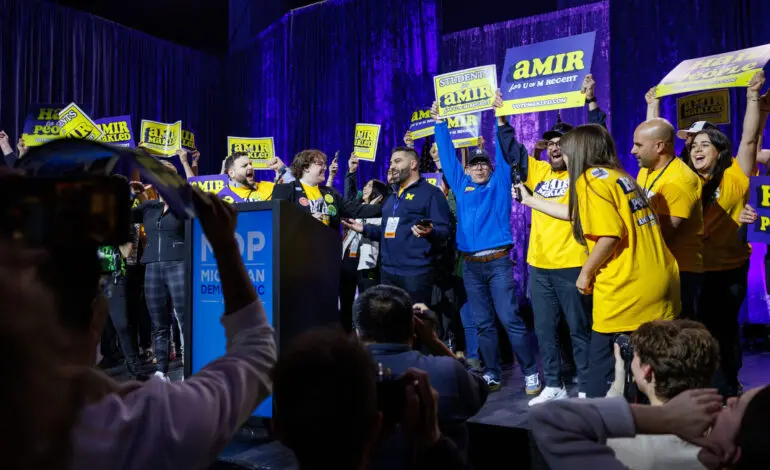

DETROIT – With record participation exceeding 7,250 delegates from across Michigan and an unprecedented Arab American presence, the Michigan Democratic Party selected its nominees for several statewide races during its convention held Sunday, April 19, in Detroit.
The outcome of the convention — both in the candidates chosen and the tone of the event — reflected a clear ascendancy of the progressive wing within the party. This was evident in the enthusiastic reception given to U.S. Senate candidate Abdul El-Sayed, as well as in the selection of two Arab American civil rights attorneys who have been prominent in defending pro-Palestinian student activists at Michigan universities.
The convention, held at Huntington Place, finalized a slate of 12 Democratic nominees for key statewide positions, including attorney general, secretary of state, two open seats on the Michigan Supreme Court, two seats on the State Board of Education and six seats across the governing boards of the state’s three major universities — the University of Michigan, Michigan State University and Wayne State University.
In contrast to the Republican slate, which consisted entirely of White candidates, the Democratic nominees reflected notable ethnic diversity — including, for the first time in the party’s history, two Arab American candidates: Amir Makled and Shereef Akeel.
Progressives and pro-Palestinian activists shape outcomes
The convention was marked by a strong turnout of progressive delegates and pro-Palestinian activists, whose votes played a decisive role in boosting progressive candidates over more traditional, pro-Israel figures.
This dynamic was most evident in the race for the University of Michigan Board of Regents, where delegates ousted incumbent Jordan Acker, a supporter of Israel, in favor of Dearborn attorney Amir Makled.
Democratic and Republican nominees — along with potential third-party candidates — will face off in the general election on November 3.
Unlike these convention-selected positions, candidates for governor and for seats in the state legislature will be chosen directly by voters in the August 4 primary.

Gilchrist wins nomination for secretary of state
Delegates selected Lt. Gov. Garlin Gilchrist II as the Democratic nominee for secretary of state over Ingham County Clerk Barb Byrum and former Lottery Commissioner Suzanna Shkreli.
Gilchrist, a former software engineer, will face Republican candidate Anthony Forlini, currently the Macomb County clerk, in November.
He is seeking to succeed Secretary of State Jocelyn Benson, who is running for governor. The office oversees elections, driver’s licenses, state identification and vehicle registration.
In his acceptance speech, Gilchrist pledged to modernize and improve the efficiency of the department while protecting voting rights across Michigan.
Known for his close ties to the Arab American community and his opposition to Israel’s war on Gaza, Gilchrist — the first Black lieutenant governor in Michigan history — said his campaign is focused on “ensuring every voice is heard and expanding freedoms.”
Eli Savit nominated for attorney general
Democrats nominated Washtenaw County Prosecutor Eli Savit for attorney general over Oakland County Prosecutor Karen McDonald.
Savit will face Republican Eaton County Prosecutor Doug Lloyd in the general election.
“We are in the heart of the fight right now,” Savit said after securing the nomination. “We face challenges from Washington, and from the corrupting influence of money in our politics.”
Savit, a progressive prosecutor, has drawn attention for refusing to prosecute pro-Palestinian student activists protesting Israel’s war on Gaza. He has also taken positions opposing large data center expansion, defending environmental protections and civil rights, and pushing back against federal overreach into state matters.
He is seeking to succeed Attorney General Dana Nessel, who drew criticism for pursuing charges against University of Michigan protesters by bypassing Savit’s office.
Makled defeats Acker in heated race
In one of the most closely watched contests, delegates voted to replace Acker as a University of Michigan regent with Makled, who gained prominence for defending students arrested over pro-Palestinian protests.
Makled will join incumbent Regent Paul Brown as the Democratic nominees for the two seats, facing Republican candidates Lena Epstein and Michael Schostak in November.
Makled credited student activists for his victory.
“You reminded all of us what a public university should be,” he told them.
The race was highly contentious. Makled faced criticism over past social media posts that were later deleted, while Acker — a pro-Israel Jewish candidate — was reported by the Guardian to have made vulgar and inappropriate comments about a Democratic official and a University of Michigan student on Slack.
Akeel wins Wayne State University board seat
In the race for the Wayne State University Board of Governors, Arab American civil rights attorney Shereef Akeel secured one of the Democratic nominations alongside labor attorney Richard Mack.
They defeated other contenders, including Michigan Democratic Party Vice Chair Nazmul Hassan and Detroit activist Jeremiah Wheeler, and will face Republican candidates Andy Anuzis and Christa Murphy in November.
Addressing the delegates, Akeel emphasized the importance of education as a pathway to opportunity.
“Education is the lifeline of our community,” he said, describing Wayne State as a leading institution for upward mobility and pledging to increase graduation rates among first-generation students.
Other races and party leadership
In the Michigan State University Board of Trustees race, incumbents Brianna Scott and Kelly Tebay Zemke secured the Democratic nominations, defeating State Sen. Sylvia Santana.
They will face Republicans Julie Maday and Roger Victory.
In uncontested races, Democrats re-nominated Michigan Supreme Court Justices Megan K. Cavanagh and Noah Hood, as well as State Board of Education members Tiffany Tilley and Judy Pritchett.
Democrats currently hold a 6–1 majority on the Michigan Supreme Court and a 6–2 majority on the State Board of Education.
Delegates also re-elected Michigan Democratic Party Chair Curtis Hertel to lead the party into the 2026 election cycle.
High-profile speakers and El-Sayed’s standout speech
The convention featured speeches from prominent Democrats, including former Vice President Kamala Harris, Gov. Whitmer and Benson, a leading gubernatorial contender.
However, the speech that drew the most attention — and energized the progressive base — came from Arab American U.S. Senate candidate Abdul El-Sayed, who is seeking the Democratic nomination in the August primary against U.S. Rep. Haley Stevens and State Sen. Mallory McMorrow.
El-Sayed’s remarks focused on challenging the Democratic Party establishment and calling for bold reforms, urging Democrats to present a positive vision rather than simply opposing Donald Trump.
He reiterated that his platform centers on:
- Universal health care
- Abolishing U.S. Immigration and Customs Enforcement (ICE)
- Limiting corporate money in politics to “put money back in people’s pockets”
He also sharply criticized the influence of lobbying groups, particularly the American Israel Public Affairs Committee (AIPAC).
“We cannot continue to accept a political system that tells us the best use of taxpayer dollars is to send them elsewhere in the form of bombs and tanks,” El-Sayed said.
Democratic Party candidates list
■ Michigan Secretary of State
– Garlin Gilchrist II
■ Michigan Attorney General
– Eli Savit
■ Michigan Supreme Court
– Megan Cavanagh
– Noah Hood
■ Michigan State Board of Education
– Judith Pritchett
– Tiffany Tilley
■ Michigan State University Board of Trustees
– Brianna Scott
– Kelly Tebay Zimny
■ University of Michigan Board of Regents
– Amir Makled
– Paul Brown
■ Wayne State University Board of Governors
– Shereef Akeel
– Richard Mack

Leave a Reply