



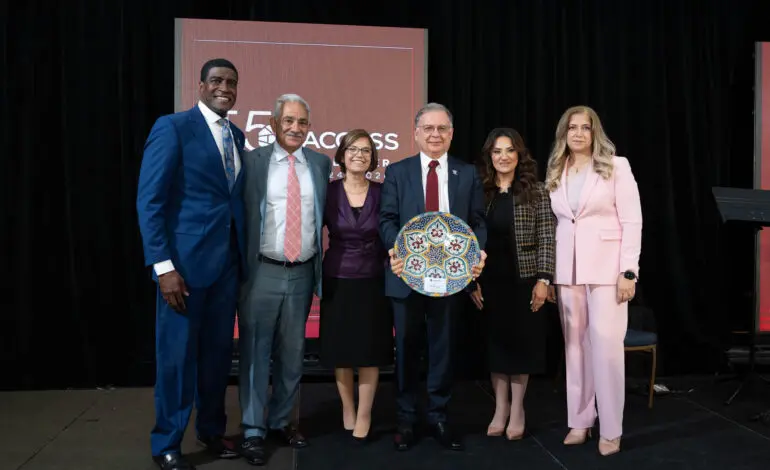

DETROIT – Under the theme “From the Neighborhood to the Nation”, ACCESS celebrated the 55th anniversary of its founding on the evening of April 24 with a large gala dinner at the Detroit Marriott at the Renaissance Center.
The event drew more than 1,500 guests, including high-ranking government officials, local leaders and representatives from private sector companies and nonprofit organizations.
The evening, hosted by journalist Priya Mann of WDIV-TV Local 4, featured a retrospective of the organization’s journey and a forward-looking vision of its future. Visual presentations highlighted ACCESS’ early beginnings and evolution, alongside remarks from prominent leaders, including Assad Turfe, deputy executive of Wayne County, and Mary Sheffield, mayor of Detroit.
Both emphasized the importance of government partnership with ACCESS in building opportunities and advancing social equity. These sentiments were echoed by Abdullah Hammoud, mayor of Dearborn, who spoke about the cultural and social significance of ACCESS at the heart of the Arab American community, noting that the organization was founded in 1971 as the Arab Community Center for Economic and Social Services.
Speakers included ACCESS Board Chair Hussein Shousher, who welcomed guests and outlined the board’s vision for institutional growth.
ACCESS President & CEO Maha Freij delivered the keynote address and also presented a comprehensive overview of the organization’s 55-year journey, addressing current challenges while reaffirming ACCESS’ steadfast commitment to “serving and empowering the community.”
The event opened with a performance by the National Arab Orchestra, whose musical presentation added a distinct cultural dimension to the evening.
Kenneth Donaldson, CEO of the Black United Fund of Michigan, delivered remarks and highlighted the importance of cross-cultural solidarity and collaborative community work.
The evening also included recognition of approximately 500 ACCESS employees, board members and partners, honoring their collective efforts built on trust, collaboration and commitment. Freij told The Arab American News that the relationship between ACCESS and its staff lies at the core of the organization’s work, emphasizing that continued success depends on a broad network of partners and individuals who share its vision and mission.
One of the evening’s highlights was the honoring of Dr. Wael Sakr, dean of the School of Medicine at Wayne State University, who received the 2026 Arab American of the Year Award in recognition of his outstanding contributions to medicine and education, as well as his leadership within the academic community. Sakr has played a key role in advancing medical education and scientific research and has overseen the training of generations of physicians.

From the neighborhood to the nation
The large-scale celebration reflected the broad relationships ACCESS has built since its founding in the Dix neighborhood of Dearborn in 1971, when it began as an initiative to support the Arab American community in overcoming language barriers and accessing services. Over time, it evolved into one of the most comprehensive nonprofit organizations in the United States.
Today, ACCESS provides hundreds of programs and services in health, education, economic development and social services, operating under a “whole-family service model” that goes beyond delivering assistance to building long-term pathways toward stability and empowerment.
With this expansion “from the neighborhood to the nation”, ACCESS’ presence is no longer confined to the local level but has extended nationally through major institutions, including the Arab American National Museum, the Center for Arab American Philanthropy and the National Network for Arab American Communities.
These institutions have strengthened ACCESS’ role as a leader in community and cultural work on a broader scale, helping connect communities and expand their presence and impact across multiple sectors.
During the evening, Freij offered deeper reflections on ACCESS’ journey, noting that the large turnout filling the hall reflected the breadth of services, relationships and partners supporting the organization. She added that the event was not merely an annual celebration, but a collective moment of recognition of the scale of commitment and work accomplished, emphasizing that such gatherings allow the organization to demonstrate its impact tangibly and reconnect attendees with its core mission.
Speaking about the most impactful moments of the evening, Freij told The Arab American News that what moved her most was seeing the founding generation alongside the current generation of leaders and staff. She described this as a living embodiment of the organization’s journey — from a small office with limited resources to an institution serving millions.
She added that the evening was not only an opportunity to reflect on the past, but also to reaffirm commitment to the future, particularly in light of the growing challenges facing communities today.
Legacy and the future
Discussing ACCESS’ trajectory, Freij emphasized that she sees no contradiction between preserving the organization’s legacy and looking toward the future. Rather, she considers them natural extensions of one another. She noted that the organization’s journey “from the neighborhood to the nation” reflects this ongoing connection, where community roots remain the foundation while tools and strategies are continuously developed to meet evolving needs — giving ACCESS the ability to sustain and expand its impact in diverse environments.
Despite the celebratory tone, Freij did not overlook the complex realities facing communities today. She said the current period is marked by rising living costs, increasing economic pressures and reductions in some essential services due to shifts in social support systems. She also pointed to the impact of global crises, which directly affect mental health within local communities.
These overlapping challenges, economic, social and humanitarian, require thoughtful and sustainable responses grounded in a deep understanding of people’s needs.
“The challenges ahead are real and significant, but our ability to confront them is even greater — through the ACCESS team and our community,” Freij stressed in her remarks during the event.
“Together, we will continue to serve, build and lead — from the neighborhood to the nation,” she added.
In this context, Freij revealed ACCESS’ plan to build a new addiction recovery center as part of a broader strategy to deliver integrated behavioral health and substance use treatment services. She noted that demand for these services has increased significantly in recent years.
The project, she said, comes after years of planning and development and is based on a comprehensive model that combines medical care, psychological support and social services — aimed at achieving long-term recovery rather than temporary solutions.


Leave a Reply