




DETROIT – The race for one of Michigan’s two seats in the United States Senate has emerged as a key battleground in the fight for control of the chamber, which allocates two senators to each state.
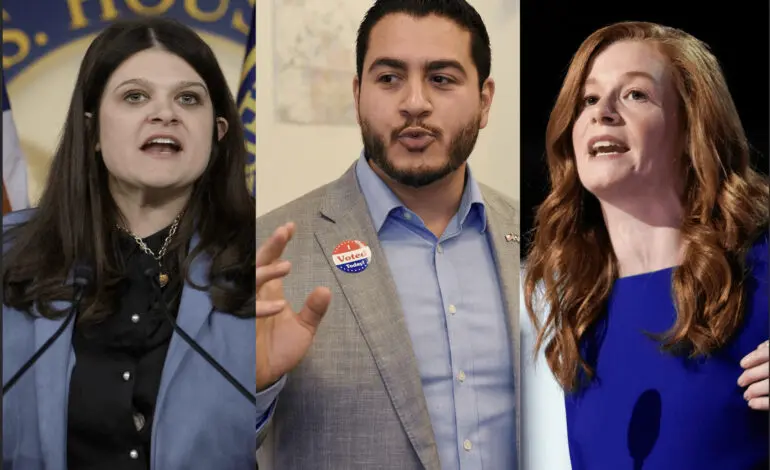
In addition to Michigan’s status as a swing state, the decision by Democratic Sen. Gary Peters not to seek re-election has opened the field wide, particularly on the Democratic side. Three candidates representing different political currents within the party are competing:
- U.S. Rep. Haley Stevens, from Oakland County, widely seen as the preferred candidate of the pro-Israel lobby AIPAC, which has poured millions of dollars into her campaign.
- Abdul El-Sayed, an Arab American candidate with progressive views and opposition to Israeli occupation, who enjoys strong support among younger voters and the party’s progressive wing, led by Sen. Bernie Sanders.
- State Sen. Mallory McMorrow, from Oakland County, positioning herself as a centrist candidate in the race.
The three candidates will compete in the Democratic primary on August 4, when voters across the state will choose their preferred nominee in what appears to be a highly competitive race, according to polls that also indicate a large share of undecided voters.
A tight contest
Polling almost four months ahead of the primary shows varying but closely aligned results among the three candidates.
In the latest survey conducted by Glengariff Group for the Detroit Regional Chamber, Stevens led with 25 percent, followed by El-Sayed with 23 percent and McMorrow with 16 percent, while 36 percent of respondents said they remain undecided.
However, another poll conducted by Emerson College days earlier showed El-Sayed and McMorrow tied for the lead at 24 percent each, while Stevens trailed at 13 percent, with 36 percent still undecided.
In a third poll published earlier in April by Data for Progress, the numbers were nearly identical among the three candidates, with a slight edge for Stevens at 23 percent, compared to 22 percent each for El-Sayed and McMorrow, while 33 percent remained undecided.
Beyond polling, the race is also highly competitive in fundraising. Campaign finance reports filed at the end of the first quarter of 2026 show Stevens raising $8.87 million, compared to $8.62 million for McMorrow and $7.65 million for El-Sayed.
Political dimensions
Michigan’s U.S. Senate race is among the fiercest contests in the country this year following Peters’ decision not to seek a third six-year term.
While former U.S. Rep. Mike Rogers appears poised to secure the Republican nomination with little opposition in the August primary, the Democratic contest is far more competitive, reflecting deeper divisions within the party — particularly after Democrats suffered a significant defeat in the 2024 elections.
This is precisely what concerns Democratic leaders, who fear that a contentious August primary could deepen divisions within their voter base at a time when they must retain Peters’ seat if they hope to regain control of the Senate, currently held by Republicans with a 53–47 majority.
Analyzing recent polling data, Richard Czuba said Stevens’ strength lies in attracting older voters, Black voters and non-college-educated voters, noting that non-college voters are expected to form a majority in this election.
El-Sayed, according to Czuba, enjoys strong support among young voters as well as broad backing from progressive voters.
According to the Glengariff poll, El-Sayed performed best among younger voters, receiving 40 percent support among those aged 18–39 and 34 percent among those aged 40–54. Stevens, meanwhile, drew her strongest support from older voters, with 35 percent among those aged 55–64 and 31 percent among those over 65.
McMorrow, on the other hand, received her strongest backing from voters aged 40–64, with relatively even support across various Democratic constituencies, including progressives, college graduates and non-graduates, union and non-union households and voters in the greater Detroit area.
Stevens also posted strong results among Detroit-area voters (30.5 percent), non-college-educated voters (30.5 percent) and Black voters (37 percent). El-Sayed led among rural voters (27 percent), male voters (31 percent) and progressive voters (about 43 percent).
Stevens performed weakest among rural voters, with just over 10 percent support, with most of her base concentrated in Wayne County (46.5 percent), Oakland County (40 percent) and Macomb County (34.5 percent).
El-Sayed attracts nearly half of likely Democratic primary voters in southwest Michigan, as well as 27 percent in the Upper Peninsula and northern Michigan.
According to the Glengariff poll, El-Sayed also has the highest name recognition, at 58 percent, with 24 percent favorable, 5.5 percent unfavorable and 41 percent unfamiliar with him.
Stevens’ name recognition stands at 55.7 percent, including 27.5 percent favorable, 7 percent unfavorable and 44 percent unfamiliar.
McMorrow has the lowest name recognition at approximately 40 percent, including 19 percent favorable and 4.5 percent unfavorable, while 60 percent of respondents said they had never heard of her.
Czuba noted that McMorrow “still faces a real challenge in building name recognition”, but added that campaign advertising has yet to begin and that “everything could change once the airwaves open up.”
The Democratic winner will face the Republican winner in the general election on November 3.

Leave a Reply