



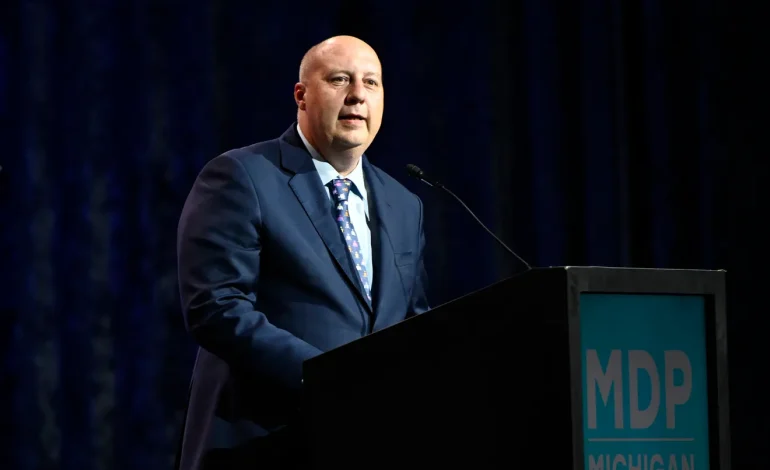

WASHINGTON, D.C. — “The road to the White House runs directly through our state.”
That was the message delivered by Curtis Hertel, chair of the Michigan Democratic Party, as he formally presented the state’s bid to become one of the nation’s earliest presidential primary contests in the 2028 election cycle.
Party Chair Curtis Hertel tells national Democrats that “The road to the White House runs directly through Michigan”
Representing Michigan Democrats, Hertel appeared before the Democratic National Committee’s Rules and Bylaws Committee in Washington on Wednesday, where party officials heard presentations from several states seeking coveted early voting status in the next presidential nominating process.
The committee is expected to select one state from each of four regions, the East, Midwest, South and West, to participate in the first wave of presidential primary elections that will help shape the Democratic Party’s nomination contest in 2028.
Michigan competing with Iowa and Illinois
Michigan is competing against Iowa and Illinois for the Midwest’s early primary slot.
The Great Lakes State previously occupied the fourth position on the Democratic presidential primary calendar in 2024, a relatively quiet election cycle in which then-President Biden and then-former President Trump faced little serious competition for their respective party nominations.
Political observers expect the 2028 race to be significantly more competitive, with a potentially crowded Democratic field vying to succeed a generation of party leaders.
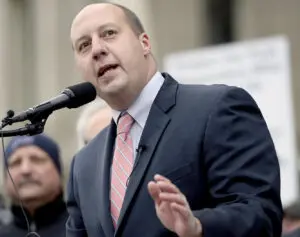
Curtis Hertel
“A national battleground”
In his presentation, Hertel argued that Michigan’s unique political and demographic characteristics make it an ideal testing ground for presidential candidates.
He described Michigan as a traditional battleground state and emphasized its racial, ethnic and economic diversity, arguing that it more closely reflects the broader American electorate than many states that have historically voted early in the nomination process.
“Michigan is a national battleground,” Hertel told committee members, arguing that campaign investments made in the state during the primary season would also help position Democratic candidates for success in the November 2028 general election.
Supporters of Michigan’s proposal contend that an early primary in the state would provide candidates with an opportunity to compete before a diverse electorate while testing messages in one of the country’s most closely contested political environments.
Winning requires more than money
Responding to questions from committee members, Hertel acknowledged that advertising costs in the Michigan media market are among the highest in the country. However, he argued that success in Michigan is not determined solely by campaign spending.
As evidence, he pointed to Sen. Bernie Sanders’ upset victory over former Secretary of State Hillary Clinton in Michigan’s 2016 Democratic presidential primary.
“You don’t have to spend the most money to win Michigan,” Hertel said. “I think we’ve already proven that.”
His comments were intended to counter concerns that placing Michigan earlier in the calendar could favor well-funded candidates while disadvantaging lesser-known contenders.
Decision expected in coming weeks
The Democratic National Committee is expected to make its decision in the coming weeks.
Several other states are also competing for the coveted early primary positions.
In the Eastern region, Delaware and New Hampshire are seeking consideration. In the South, the contenders include Georgia, North Carolina, South Carolina, Tennessee and Virginia. Western candidates include Nevada and New Mexico.
The outcome could significantly influence the trajectory of the 2028 Democratic presidential race, as candidates traditionally devote substantial time, resources and attention to states that vote early in the nominating process.



Leave a Reply