



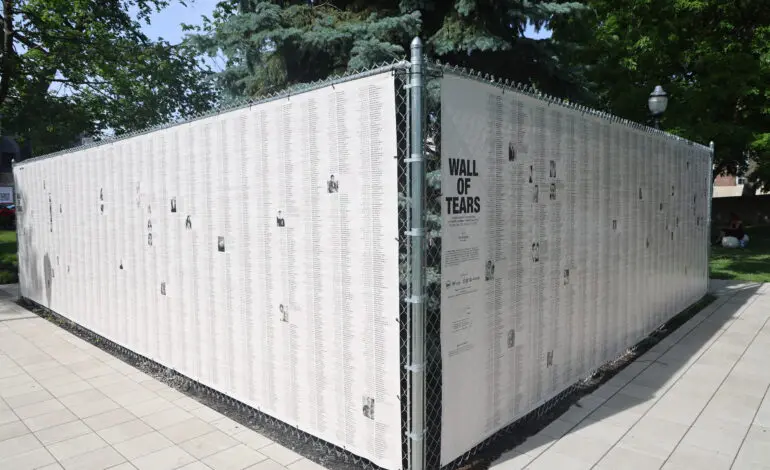

DEARBORN — Community members, elected officials, faith leaders and activists gathered at Dearborn PEACE Park East on June 11 for the opening of the “Wall of Tears”, a large-scale public art installation created by American artist Phil Buehler that memorializes thousands of Palestinian children killed in Gaza since Oct. 7, 2023.
The exhibition, which will remain on display through the end of July, marks the latest stop in a traveling international project that combines art, historical documentation and political commentary to highlight the human cost of the war in Gaza.
Stretching 100 feet in length and standing 7.5 feet tall, the memorial wall serves as a visual record of 18,457 Palestinian children killed in Gaza. The names, ages and stories of the children are displayed in both Arabic and English and arranged chronologically by date of death. Color-coded markings distinguish between boys and girls, transforming statistics into individual lives, identities and stories.
The exhibition was organized through a partnership between the city of Dearborn, Jewish Voice for Peace–Detroit, the U.S. Palestinian Community Network (USPCN) and the Arab Community Center for Economic and Social Services (ACCESS).
Speakers at the opening ceremony included Dearborn Mayor Abdullah H. Hammoud, U.S. Rep. Rashida Tlaib, Rabbi Alana Alpert of Congregation T’chiyah and artist Phil Buehler.
The installation has previously been exhibited in New York City, London, San Francisco, New Jersey and several Australian cities, attracting international attention for its fusion of art, political expression and remembrance. Following its stay in Dearborn, the exhibit is scheduled to travel to Mexico City, Dallas and Portland.
Art as testimony
Buehler is known for creating large-scale public art projects that function as powerful visual statements from a distance while inviting viewers to engage more deeply with individual stories up close.
The “Wall of Tears” includes photographs, biographies and family stories that encourage visitors to reflect on the human cost of war and the devastating losses endured by Palestinian families, including families that have been entirely wiped out.
Speaking before the exhibition opened, Buehler said the project had strengthened his connection to the Palestinian community while acknowledging concerns about sharing its message in the United States and abroad without being accused of anti-Semitism.
“I feel like part of the Palestinian community through this project,” Buehler said.
He added that the mural was designed to work on multiple levels.
“You might be curious from a distance and be drawn in to read some of their stories and look at the family photos,” Buehler said. “How could someone walk away without thinking that this could be my kid, my niece, my neighbor’s kid? Our love of children is universal.”
Mayor Hammoud: A memorial and a call to conscience
Hammoud described the installation as both a memorial and a moral appeal.
“For nearly three years, the world has witnessed the Israeli government’s genocidal campaign in Gaza, a campaign that has taken the lives of tens of thousands of innocent children and families,” Hammoud said.
He added that the destruction had also spread into Lebanon, displacing millions and erasing entire villages from the map.
“This monument stands in memory of those children and as a call to conscience, reminding future generations of the cost of silence and the responsibility to never look away,” Hammoud said.
Documenting lives, not just numbers
In an interview with The Arab American News, Buehler said the true number of child victims in Gaza is likely far higher than the 18,457 documented on the wall and could exceed 50,000 children, including many whose bodies remain buried beneath the rubble.
He explained that his research extended beyond data released by the Gaza Ministry of Health. The project also incorporates photographs and personal stories of 100 Palestinian children gathered from internationally recognized news organizations, including the Washington Post and the Guardian, as well as the Gaza Shaheed Project, which preserves memorial images and tributes shared online by families of victims.
Buehler said the installation required hundreds of hours of research, verification and artistic work.
“The goal was never simply to display a list of names,” he said. “It was to tell their stories, preserve their dreams and ensure they are remembered.”
Second installation highlights destruction of Gaza
The Dearborn exhibition is also accompanied by a second installation titled “Gaza City,” which was presented June 13 at the Henry Ford Centennial Library.
The project is a collaboration between Buehler and Palestinian photojournalist Shroug Alaiya, whose photographs documenting the destruction in Gaza were digitally stitched together to create a panoramic visual experience.
The event also featured a screening of the Academy Award-nominated film The Voice of Hind Rajab, remarks by Freedom Flotilla organizer Huwaida Arraf and a live virtual update from physicians working in Gaza.
When asked whether she wished to be credited publicly despite concerns for her safety, Alaiya responded, “You can mention my name, no risk in this. I’ve already survived a genocide.”
For visitors, the “Wall of Tears” offers more than a work of art. It serves as a powerful reminder of the human lives behind the headlines and an appeal not to forget the children whose futures were cut short by war.
Leave a Reply