



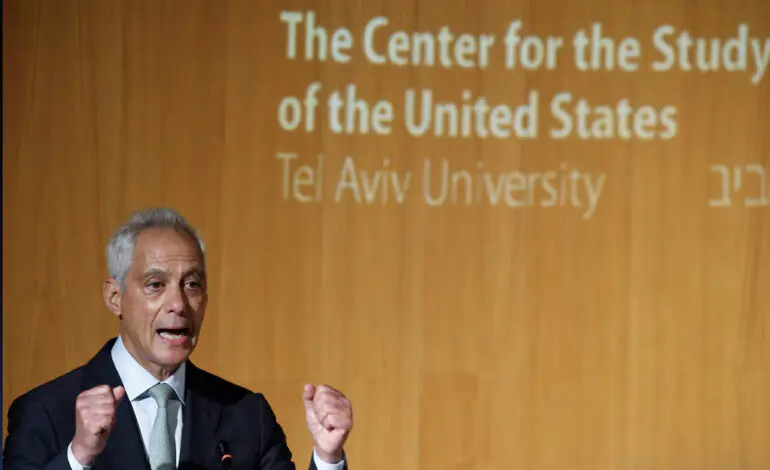

Several observations can be made regarding Rahm Emanuel’s recent speech at Tel Aviv University: what he said and didn’t say, and what impact (if any) his words might have.
Emanuel has been a fixture in U.S. politics for decades. After volunteering with the Israeli Defense Forces in 1991, he returned to the U.S. to work in the Clinton administration, as a member of Congress, in the Obama administration, then mayor of Chicago and ambassador to Japan.
It’s unsurprising that Emanuel would consider running for president. But given dramatically shifting Democratic attitudes toward Israel and Emanuel’s deep connections to Israel, questions were immediately raised about how he’d navigate these turbulent waters in a presidential primary.
Heeding the maxim to “shine a light on your problem”, Emanuel delivered this speech — laying out his bona fides as a long-time Israel supporter, while delivering a sharp rebuke to its policies.
It’s inexcusable for Emanuel to blame Palestinians and absolve Israel.
It was a strange hodgepodge. After noting his long ties with Israel, Emanuel launched into the Israeli historical narrative of the post-Oslo period, echoing the well-worn “Palestinians never miss an opportunity to miss an opportunity.” He repeated the Clinton administration’s false claims that Palestinians turned down “the best deals ever” offered by former Prime Ministers Rabin, Barak and Olmert and then unleashed violence against innocent Israelis. While this fabrication served the Clintons’ electoral purposes, it doesn’t jibe with reality.
In the ‘90s, I saw firsthand in the Occupied Territories how the Israeli government was expanding settlements, blocking Palestinian economic development and establishing humiliating restrictions on Palestinian movement. Within a few years of Oslo, Palestinians were poorer, less free to move about, had less control of land and were losing hope in peace. Palestinian support for their leaders who’d signed agreements with Israel was collapsing and support for rejectionists was rising. And so, it’s true that Hamas used terror against innocent Israelis in order to sabotage Oslo and discredit the Palestinian Authority. The Israeli government then sidelined the PA, treated all Palestinians as guilty and in the process created more anger. The Clinton administration did nothing to challenge Israel’s role in sabotaging Oslo. It’s inexcusable for Emanuel to blame Palestinians and absolve Israel.
As for Barak’s offer, Palestinians never rejected it, continuing negotiations with Israel at Taba until Barak, facing electoral defeat, ended the negotiations, leaving Palestinians in the lurch. Olmert’s offer of 98 percent was indeed enticing, but — as he was facing imminent removal from office and a prison term — his “offer” was dismissed by Palestinians as not serious.
Then, Emanuel launches into a full-throated criticism of Israel’s recent policies in the Occupied Territories, lamenting they’ve made the country a “territorial pariah.” He catalogues the horrors Israel’s visited upon Palestinians and acknowledges that the U.S.’ unconditional support of Israel has contributed to the sense of impunity fueling Israel’s inhumane behaviors. Even more interesting is Emanuel’s embrace of the threat of applying sanctions not only to settlers who violate Palestinian rights, but also to government ministers, banks and contractors.
While Emanuel’s criticisms are harsher than those of his fellow mainstream Democrats, he ignores systemic problems and focuses blame on Benjamin Netanyahu. The speech is largely a plea to Israelis to rid themselves of the leader damaging their international standing.
Only sanctions that shock the Israeli polity will cause new leadership to emerge that’s willing to abandon their fantasy of Greater Israel and embrace Palestinian humanity.
But that isn’t enough — Netanyahu’s opponents accept his overall approach to Palestinians. That won’t change until the U.S. actually punishes Israel’s bad behaviors. Only sanctions that shock the Israeli polity will cause new leadership to emerge that’s willing to abandon their fantasy of Greater Israel and embrace Palestinian humanity.
Emanuel sidesteps this direct approach, embracing what is an equally dangerous fantasy of a broad regional peace between Israel and 21 Arab states as the way forward. In this imagining, the Arabs would be responsible for getting Palestinians to stop rewarding those who kill Israelis and stop teaching hatred of Israel.
While this might be compelling to liberal Zionists in Israel and the U.S., it doesn’t address reality. Instead of first imposing restraints on Israel, the burden is placed on Palestinians. Emanuel falls silent on how to roll back Israel’s repressive abuse of Palestinians and restore their rights.
Emanuel’s speech isn’t a “groundbreaking” speech changing the U.S. debate over Israel, but instead defines the emerging conventional wisdom.
In the end, Emanuel’s speech isn’t a “groundbreaking” speech changing the U.S. debate over Israel, but instead defines the emerging conventional wisdom: Netanyahu is bad, the U.S. shouldn’t pay for Israel’s misbehavior and if the Arabs would step in, control the Palestinians, and make peace with Israel, all would be well. This is, as we say, “nice, but no cigar.”
– Dr. James Zogby is the president and founder of the Washington based Arab American Institute (AAI)



Leave a Reply