



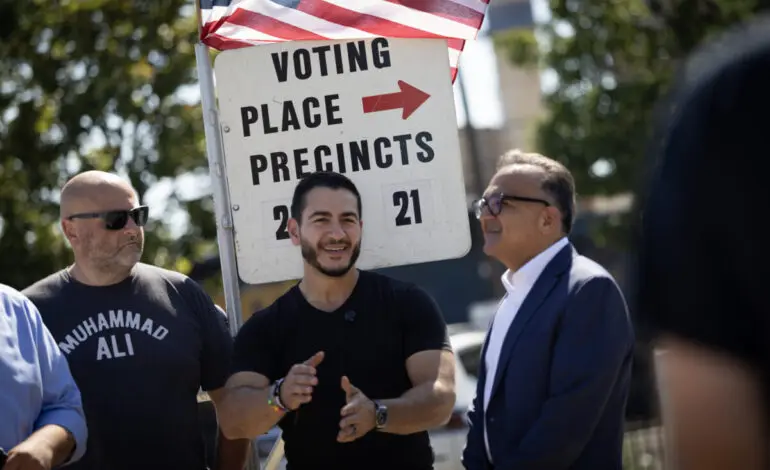

Once again, Arab American voters in the Dearborn area demonstrated their growing electoral importance across Michigan.
After helping Donald Trump carry the state in the 2024 presidential election, the August Democratic primary for U.S. Senate provided further evidence that Arab American voters in Dearborn and Dearborn Heights can serve as a decisive bloc capable of tipping a close statewide race.
That influence was reflected in Abdul El-Sayed’s historic victory over U.S. Rep. Haley Stevens for the Democratic nomination earlier this month.
A decisive voting bloc
Just as Dearborn and Dearborn Heights voted for Trump in 2024 — going against the overall result in Wayne County, which supported Democratic presidential nominee Kamala Harris — the two cities again broke with the countywide trend in the latest Democratic primary.
This time, record numbers of voters in the two heavily Arab American cities backed El-Sayed, providing him with a margin large enough to overcome Stevens’ advantage elsewhere and win statewide.
Across Dearborn and Dearborn Heights, El-Sayed received 16,265 more votes than Stevens. That margin proved decisive in a race he ultimately won statewide by only 15,697 votes.
Dearborn delivers for El-Sayed
In Dearborn alone, El-Sayed received 15,899 votes, or 77.6 percent, compared with 4,160 for Stevens — a margin of 11,739 votes.
Two principal factors contributed to that overwhelming advantage in the city often described as the capital of Arab America.
The first was record participation. A total of 24,447 Dearborn voters cast ballots in the Aug. 4 primary, representing more than 34 percent of the city’s registered voters and an unprecedented turnout for a primary election in the city.
The second was voters’ overwhelming decision to participate in the Democratic primary. About 84 percent of Dearborn voters — 20,491 people — cast ballots in the Democratic U.S. Senate contest, reflecting El-Sayed’s popularity and his campaign’s ability to energize voters.
El-Sayed must still defeat Republican nominee Mike Rogers in the November general election to complete another historic milestone. If elected, he would become the first Muslim to serve in the U.S. Senate.
The pattern repeats in Dearborn Heights
The picture was nearly identical in neighboring Dearborn Heights, where El-Sayed received nearly 72 percent of the vote, compared with approximately 26 percent for Stevens, whose campaign and supporting outside groups spent record sums in the race.
El-Sayed received 7,084 votes in Dearborn Heights, compared with 2,558 for Stevens, who has represented Michigan in Congress since January 2019.
Overall turnout in Dearborn Heights reached approximately 25.6 percent, with 12,561 of the city’s roughly 49,000 registered voters casting ballots.
That participation rate was almost double the 12.9 percent recorded during Michigan’s 2024 U.S. Senate primary, when Elissa Slotkin defeated Hill Harper with approximately 69 percent of the Democratic vote in Dearborn Heights.

A margin greater than the statewide victory
El-Sayed’s margin over Stevens in Dearborn Heights was 4,526 votes. Combined with his 11,739-vote advantage in Dearborn, his margin across the two cities reached 16,265 votes — 568 more than his final statewide margin.
Final results showed El-Sayed receiving 743,455 votes, or 48.5 percent, compared with 727,758 votes, or 47.5 percent, for Stevens.
Michigan State Sen. Mallory McMorrow, who withdrew from the Democratic primary shortly after ballots were printed in June, received 61,407 votes statewide. She collected 418 votes in Dearborn and 203 in Dearborn Heights.
On the Republican side, former U.S. Rep. Mike Rogers ran unopposed with Trump’s endorsement. Rogers received roughly 3,000 votes in Dearborn and 2,000 in Dearborn Heights, along with more than 880,000 votes statewide.
Echoes of the 2024 presidential election
The results echoed the 2024 presidential election.
Trump carried Dearborn with approximately 42 percent of the vote, compared with 36 percent for Harris and 18 percent for Green Party candidate Jill Stein. He also carried Dearborn Heights with about 44 percent, compared with 38.3 percent for Harris and 15.1 percent for Stein.
Although Trump and El-Sayed prevailed in the two Dearborn communities in 2024 and 2026, respectively, both lost Wayne County overall. The contrast further illustrates the increasingly distinctive electoral character of the two heavily Arab American cities.
Toward historic representation in Lansing
Beyond El-Sayed’s historic victory, strong Arab American turnout in Dearborn and Dearborn Heights helped pave the way for unprecedented representation in the Michigan legislature.
Abbas Alawieh is positioned to become the first Muslim elected to the State Senate after winning the Democratic nomination in the Second District. Jalal Abdallah, meanwhile, is poised to double Arab American representation in the State House by joining State Rep. Alabas Farhat.
Both Farhat and Abdallah won commanding Democratic primary victories in the Third and 15th House Districts, respectively, which have traditionally favored Democratic candidates.
Alawieh wins key Senate primary
Alawieh secured the Democratic State Senate nomination largely on the strength of his performance in Dearborn and Dearborn Heights.
He received nearly 13,000 votes in Dearborn and 6,198 in Dearborn Heights, finishing more than 9,000 votes ahead of his opponent, State Rep. Erin Byrnes, across the two cities.
Alawieh’s performance was less dominant in other portions of the Second Senate District, which also includes parts of Allen Park and Detroit.
Districtwide, Alawieh received 23,722 votes, or 58.9 percent, compared with 16,567 votes, or 41.1 percent, for Byrnes.
Abdallah wins open State House race
In the 15th State House District, Abdallah scored a decisive victory over two familiar local political figures, former Wayne County Commissioner Gary Woronchak and former Dearborn City Councilwoman Leslie Herrick.
Abdallah received 40 percent of the vote in the western portion of Dearborn, collecting 2,937 votes. In Dearborn Heights, he received 5,434 votes, representing more than 60 percent of the ballots cast in that contest.
Districtwide, Abdallah received 8,371 votes, or 51.3 percent — more than either of his two opponents individually and enough to secure the Democratic nomination in a district that traditionally favors the party.
Abdallah could join Farhat, currently the only Arab American serving in the State House.
Farhat secures another nomination
Farhat comfortably defeated Hussein Berry and Othman Alaansi in the Democratic primary for the Third House District.
He received 8,208 votes, or 63.2 percent, in the district he has represented since January 2023. The district includes most of Dearborn and portions of west Detroit.
Three Arab American lawmakers
If they prevail in November, Arab Americans would send three lawmakers from the Dearborn area to the State Capitol at the beginning of the next legislative session in January 2027: Alawieh in the Senate and Farhat and Abdallah in the House.
With partisan control of both legislative chambers closely contested, the three lawmakers could also hold pivotal votes on divisive legislation in Lansing.
Tlaib scores an overwhelming victory
All three would represent portions of the same broader area represented in Congress by Arab American U.S. Rep. Rashida Tlaib, who also won her Democratic primary by an overwhelming margin.
Tlaib defeated former State Rep. Shanelle Jackson and Inkster Mayor Byron Nolen in Michigan’s 12th Congressional District, which includes Dearborn, Dearborn Heights, Livonia, portions of western Detroit and communities in southern Oakland County, including Southfield.
She received more than 102,000 votes, compared with approximately 36,000 for her two challengers combined.
In another indication of elevated voter enthusiasm, Tlaib received approximately 10,000 more votes in Dearborn than she did during the 2024 primary. She also gained about 4,300 votes in Dearborn Heights compared with her total two years earlier, when she ran unopposed.
A growing statewide political force
Taken together, the results demonstrate that Arab American voters in Dearborn and Dearborn Heights are no longer merely an important local constituency.
In closely divided statewide and legislative races, they have emerged as a pivotal electoral force capable of shaping Michigan’s political direction.


Leave a Reply