



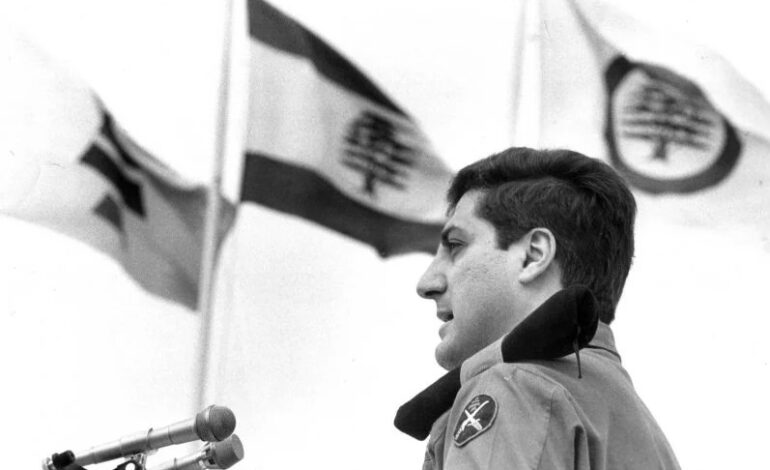

Monday, September 14, marked 44 years since the assassination of Bachir Gemayel, and I have to admit I was amused sitting and listening to speaker after speaker praise his extraordinary “leadership”, “vision”, “courage” and supposed dream of a strong and sovereign Lebanon. Listening to these tributes, one might think Lebanon had lost a great statesman whose presidency had transformed the country, only to be tragically cut short. There is one inconvenient truth with that story: Bachir Gemayel never actually governed Lebanon. He was elected president on August 23, 1982, and assassinated on September 14, only 22 days later. He never took the constitutional oath, formed a government, administered the state or implemented a national program. Nor did he have the opportunity to demonstrate that he could govern a country divided among Christians, Muslims and Druze, with the Palestinian issue unresolved and Syrian and Israeli forces operating on Lebanese soil. What we are celebrating, therefore, is not a record of presidential leadership, but a legend built around a presidency that never happened.
What we are celebrating, therefore, is not a record of presidential leadership, but a legend built around a presidency that never happened.
There is no question that Bachir was charismatic, ambitious, courageous and exceptionally effective at accumulating power. But running a militia is fundamentally different from running a state. A militia leader can demand obedience; a president has to build consensus. A militia leader can defeat his enemies; a president has to find a way to live with them.
The origins of the civil war itself should make anyone uncomfortable with the romanticized version of Bashir’s legacy. On April 13, 1975, Pierre Gemayel, Bachir’s father and leader of the Phalange Party, was attending a church ceremony in Ain el-Rummaneh when gunmen attacked his entourage. Several people were killed, although Pierre survived. The Phalangists believed Palestinians were responsible. Later that same day, Phalangist gunmen opened fire on a bus carrying Palestinians passing through Ain el-Rummaneh, killing and wounding passengers. The incident became known as the Ain el-Rummaneh bus massacre and is widely regarded as the immediate spark of Lebanon’s civil war.
That episode captures the insanity that consumed Lebanon. An attack occurs, responsibility is assumed and retaliation is directed against members of an entire community. Instead of establishing who committed the original crime, Palestinians on a bus became targets. That is not the logic of justice or the rule of law. It is the logic of sectarian warfare. Bachir’s political career unfolded within precisely that environment, and the violence surrounding his rise cannot simply be erased when he is commemorated decades later.
A militia leader can demand obedience; a president has to build consensus. A militia leader can defeat his enemies; a president has to find a way to live with them.
The violence escalated later that same year. On Black Saturday, December 6, 1975, following the killing of several Phalangists, gunmen associated with the Phalange established checkpoints in Beirut and carried out sectarian killings of Muslims. Accounts of the death toll vary, but hundreds of people were reportedly killed or disappeared. Black Saturday is important because it exposes the human cost behind the political mythology. It is one thing to describe Bachir’s movement as a disciplined force defending Lebanese Christians. It is another to confront what sectarian warfare meant on the streets of Beirut, where a person’s name, religion or identity could become a matter of life and death.
Then came Tel al-Zaatar in 1976. The Palestinian refugee camp was besieged by Christian militias, including forces associated with the Phalange. After the camp fell, large numbers of Palestinians were killed. The precise death toll remains disputed; contemporary reporting placed the number killed during the siege and fall in the range of roughly 1,000 to 3,000. Tel al-Zaatar remains one of the darkest episodes of the Lebanese Civil War. It is impossible to discuss Bachir’s rise honestly without acknowledging the violent environment in which his movement operated and the devastating consequences of the campaign against Palestinian camps.
His hostility toward the Palestinian armed presence became one of the defining features of his political life. Bachir viewed the PLO as a threat to Lebanese sovereignty and to the Christian community. His supporters would argue that he was defending Lebanon from an armed organization that had effectively created a state within a state. But Bashir’s answer was increasingly destructive, militaristic and uncompromising. His objective was not simply to coexist with his adversaries; it was to defeat and eliminate them.
His objective was not simply to coexist with his adversaries; it was to defeat and eliminate them.
Then there is the contradiction of Bachir’s relationship with Israel. Here was a man who presented himself as fighting for Lebanese sovereignty while developing a close military and political relationship with Israel. From Bachir’s perspective, this was strategic necessity: Israel possessed the military power needed to confront the PLO and Syria. But the contradiction remains: how do you restore Lebanese sovereignty with the assistance of a foreign army operating inside Lebanon? Whatever the complexity of the relationship, Bachir’s reliance on Israeli military and political support remains an unavoidable part of his history.
So, on this 44th anniversary, I listened to the speeches and wondered whether Lebanon is commemorating a leader — or a fantasy of one. Bachir wanted to defeat the madness consuming Lebanon. Yet he was also a product of that madness and, in important ways, contributed to it.
Lebanon did not lose a proven great president on September 14, 1982. It lost a president-elect whose record had already been written as a militia leader. We will never know what kind of president Bachir Gemayel would have been. But if his record as a militia commander is the best evidence we have — and history should judge leaders by what they actually did, not by what their admirers imagine they might have done — then perhaps it is time to separate Bachir Gemayel the man from Bachir Gemayel the myth. Forty-four years of mythology are not the same thing as 44 years of leadership.
– Jamal I. Bittar is a university professor and opinion writer focused on Middle East politics and U.S. foreign policy. He is based in Toledo, Ohio. The views expressed are solely his own and do not represent those of any institution with which he is affiliated.


Leave a Reply