



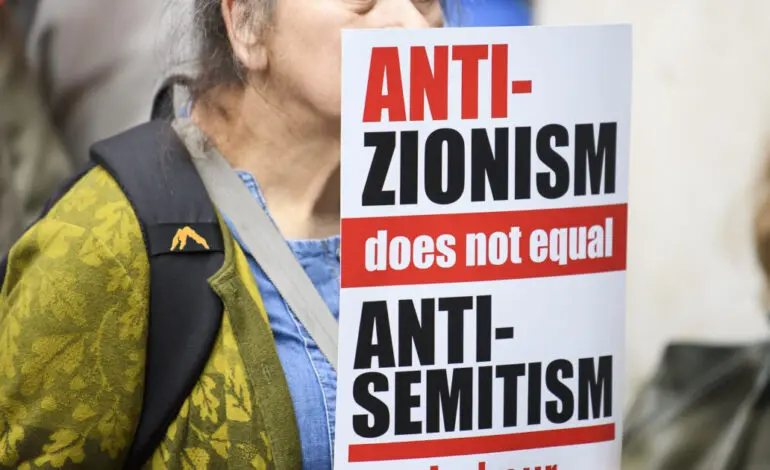

The Green Party of the United States formally adopted a resolution Monday, November 9, declaring Zionism a form of racism and identifying itself as an anti-Zionist political party, alongside its longstanding support for Palestinian liberation.
Wissam Charafeddine, a national co-chair of the party, described the decision as an unprecedented development, saying it makes the Greens the first major American political party to formally declare itself anti-Zionist.
National co-chair Wissam Charafeddine calls the resolution historic, saying the Greens are the first major American political party to formally adopt an anti-Zionist position
The resolution, titled “Zionism Is Racism: Green Party Opposition to Zionism and Support for Palestinian Liberation”, passed with 77 votes in favor, four opposed and four abstentions. The party’s official voting record lists 85 votes from 35 state and caucus delegations.
The measure establishes an official party position and requires public communications concerning Zionism and Palestinian liberation to reflect its principles. It also encourages party committees, candidates and elected officials to incorporate those principles into their work.
The resolution contains seven principal sections defining the ideological and practical framework of the party’s position. It characterizes Zionism as a political ideology and project that establishes and maintains Jewish ethnonational sovereignty and political supremacy in historic Palestine through structures that privilege one population over the indigenous Palestinian population.
It explicitly distinguishes opposition to Zionism from antisemitism, rejecting hatred or discrimination against Jewish people and affirming that Jewish identity is not synonymous with Zionism.
Palestinian rights and U.S. policy
The resolution affirms Palestinians’ inalienable rights to self-determination, liberation and return under international law. It also recognizes resistance to occupation and colonial domination, subject to international law and international humanitarian law, while rejecting intentional attacks on civilians, hostage-taking and collective punishment.
The measure reaffirms support for the Palestinian-led Boycott, Divestment and Sanctions movement, or BDS, as a nonviolent means of pursuing Palestinian rights and compliance with international law.
It calls on Washington to end military assistance to Israel and diplomatic protection for Israeli violations of Palestinian rights. It also encourages Green parties internationally to examine the relationship between Zionism, colonialism, apartheid and Palestinian liberation.
The historical background outlined in the Arabic report traces the Palestinian question to the 1917 Balfour Declaration, which endorsed establishing a “national home for the Jewish people” in Palestine while referring to the Arab majority as the “existing non-Jewish communities.”
That account cites a Jewish population share of approximately 6 percent and an Arab share of 94 percent — figures also presented in historian Rashid Khalidi’s discussion of the declaration in The Hundred Years’ War on Palestine.
The report also traces the subsequent displacement of Palestinians through the 1948 Nakba and points to Israeli legislation, including the 1950 Law of Return and Absentees’ Property Law, and the 2018 Basic Law: Israel — The Nation State of the Jewish People.
Charafeddine sees an international shift
Charafeddine, who serves on the party’s Steering Committee and was the resolution’s floor manager, told The Arab American News that the decision forms part of a growing political movement among Green parties internationally. His name and leadership position are confirmed in the party’s official directory
He pointed to the position adopted in early October by the Green Party of England and Wales, which declared itself anti-Zionist and recognized Zionism, as defined in its policy, as a form of racism.
The U.S. resolution welcomes that decision while explicitly stating that the American party adopted its position independently, based on its own principles, rather than incorporating another Green party’s resolution.
Charafeddine said the convergence between Greens in the United States and their counterparts in England and Wales represents a strategic shift toward a shared political approach on both sides of the Atlantic.
He described it as a foundation for an international political front committed to challenging the moral and political legitimacy of what he characterized as a colonial system, while making Palestinian liberation an integral part of international Green politics.
Charafeddine said the resolution carries particular significance at a moment when American politics is becoming more responsive to grassroots demands and less subject to the authority of traditional Republican and Democratic leaders.
He pointed to Arab American Democrat Abdul El-Sayed’s historic victory in Michigan’s U.S. Senate race as an example of that shift, saying El-Sayed overcame extraordinary efforts to discredit candidates who support social justice and human rights, particularly Palestinian rights. El-Sayed’s victory over Republican Mike Rogers was reported by the Associated Press.
Grassroots support and political independence
Charafeddine said the resolution’s overwhelming passage — with 77 delegates supporting it and only four opposing it — demonstrates the depth of changing American attitudes and growing rejection of official policies supporting Israel.
He argued that the Green Party can represent those views independently because it rejects corporate contributions and financing tied to powerful political interests.
That independence, he said, gives the party greater freedom to adopt positions reflecting its grassroots membership and a principled commitment to justice and human rights worldwide.
Charafeddine urged American voters to consider the Green Party a serious political option for electing candidates independent of the two dominant parties who reflect public aspirations.
At the same time, he acknowledged that the U.S. party continues to lag behind Green parties in Europe, where they have become significant parliamentary forces and participated in governing coalitions.
He attributed that gap to an American electoral system dominated by two parties, along with restrictive ballot access requirements and complicated procedures that impede third-party participation and limit fair political representation.
Charafeddine nevertheless maintained that the Green Party is well positioned to challenge that dominance.
“The new decision recognizing the Zionist movement as a racist ideology in the United States is an unprecedented historic development in an American political landscape witnessing a powerful shift in public opinion against Israel,” he said.



Leave a Reply