



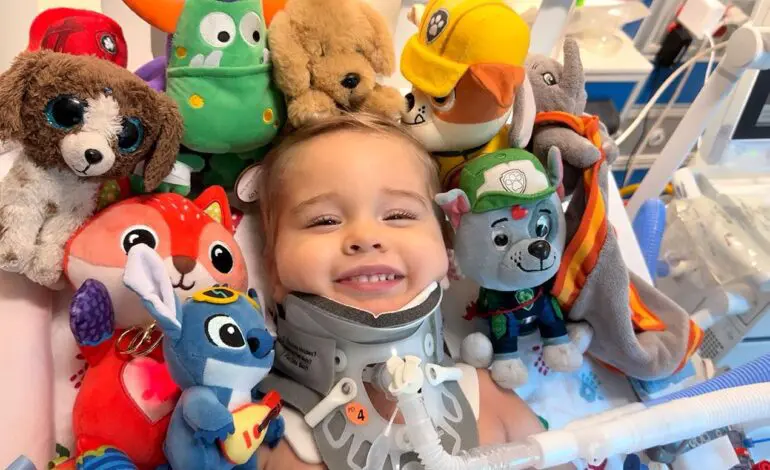

Dr. Mohamad Bydon saves toddler after near-decapitation, in what experts call one of the most extraordinary spinal surgeries ever recorded
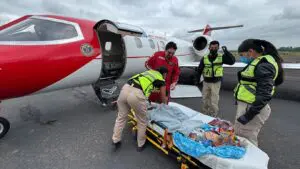
Oliver Staub is carefully loaded onto a medical jet to transport him for treatments. – Photo courtesy of the Staub family
CHICAGO — In a story that has stunned the medical world, Lebanese American neurosurgeon Dr. Mohamad Bydon, chair of the Department of Neurological Surgery at the University of Chicago Medicine, has successfully reattached the head of a 2-year-old boy after it was nearly severed from his spine in a catastrophic car accident.
The boy, Oliver Staub, was traveling with his family on April 17 when an armored vehicle crashed into their minivan at nearly 70 miles per hour during their vacation in Mexico. Everyone in the car was injured — but no one more severely than Oliver, who suffered a complete separation of his skull from his spine, a condition known as atlanto-occipital dislocation.
Doctors in Mexico initially told Oliver’s parents, Laura and Stefan Staub, that their son was brain dead and would not survive. His spinal cord had been transected — essentially disconnected from his brain.
“They told us to prepare to say goodbye,” Laura Staub said. “It was every parent’s worst nightmare.”
Yet, in a turn of events that physicians now describe as unprecedented, Oliver not only survived — he is now smiling, talking and beginning to walk again.
A journey of faith and science
When doctors in Mexico could do no more, the Staubs began caring for their son at home under constant supervision. He wore a neck brace and vest to stabilize his head, which was no longer connected internally to his body. During that time, he even suffered cardiac arrest but somehow survived.
Bydon later said it was a miracle in itself that the boy lived long enough to reach Chicago.
“If his parents had made even one wrong move during those two months, it could have meant instant death,” Bydon said. “You should never count out a 2-year-old. They can surprise you.”
The family’s search for help led them to Bydon, whose groundbreaking research on stem cell therapy for spinal cord injuries at UChicago Medicine offered a glimmer of hope. When most hospitals turned them away, Bydon agreed to take the case — provided they could safely get Oliver to the United States.
Global solidarity and “the Oliver Effect”
The Staubs’ appeal for help went viral on social media. A friend encouraged them to contact the Toni Kroos Foundation, founded by the German soccer star. Two days later, the foundation’s director, Claudia Bartz, called to say they would cover the entire cost of Oliver’s medical transport and surgery in Chicago.
“We cried and cried. We couldn’t believe it,” Staub said. “None of this would have been possible without Toni Kroos.”
The story spread rapidly, making headlines in Germany and the U.S. Supporters dubbed it “the Oliver Effect” — a wave of fundraising, prayer circles and international goodwill that followed the toddler’s fight for survival.
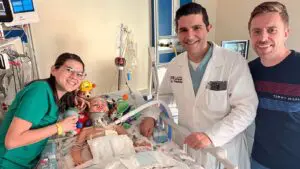
Mohamad Bydon, chair of the Department of Neurological Surgery at UChicago Medicine, with 2-year-old Oliver Staub and his parents, Laura and Stefan Staub. – Photo courtesy of the Staub family
The “impossible” surgery
In July, Oliver was flown to UChicago Medicine Comer Children’s Hospital aboard a medical jet. Dr. Bydon assembled a multidisciplinary team of neurosurgeons, orthopedic specialists and pediatric intensive care doctors to perform two surgeries that he later described as “harrowing.”
The first operation, an occipital-cervical fusion, lasted several hours and involved reconstructing Oliver’s spine, reattaching his skull to the cervical vertebrae, and stabilizing the connection with titanium rods and screws. Two days later, a second operation was performed to reinforce the front of his spinal cord and repair a herniation.
“Every movement during surgery carried the risk of instant death,” Bydon said. “We used microsurgical precision to stabilize the vertebrae while maintaining blood flow to the brain. It demanded absolute concentration and teamwork.”
For days afterward, Oliver’s condition was critical. His heart stopped once and he suffered severe brain swelling. Yet five days later, he smiled for the first time since the accident. Within a month, he could grasp his mother’s hand, push objects away and begin to breathe without a ventilator.
“We know the spine is communicating with the brain and body again,” Bydon said. “Nothing like this has ever been reported in neurosurgery.”
From despair to recovery
Oliver was discharged from Comer Children’s Hospital on August 15, just four months after the crash. He will continue physical therapy and medication to reduce inflammation. If all goes as planned, his neck brace will be removed early next year.
Bydon plans to oversee a stem cell therapy trial next spring to further improve Oliver’s neurological recovery, pending approval by the U.S. Food and Drug Administration.
“After months of rehabilitation, Oliver can walk, talk, and play again,” he said. “This case reminds us that medicine is not just science — it’s a calling.”
The University of Chicago Medicine announced that Oliver’s case will be included in specialized research on pediatric spinal cord injuries and could help develop new treatment protocols worldwide.
A Lebanese American making history
Dr. Mohamad Bydon, whose family hails from southern Lebanon, is recognized as one of the leading neurosurgeons in America. Before joining the University of Chicago, he served as a professor and neurosurgeon at the Mayo Clinic in Minnesota, where he conducted pioneering studies in spinal regeneration.
His achievement has resonated deeply within the Arab American and Lebanese communities across the Midwest, where his success story has been celebrated as a testament to excellence, perseverance and compassion.
“What happened with Oliver reminds us that medicine is not merely a profession — it’s a human mission built on faith, empathy and hope,” Bydon said.
As for the Staub family, they have since relocated to Mexico to continue Oliver’s care and plan to return to Chicago next spring for follow-up treatment.
“He didn’t promise us a miracle,” Staub said through tears, “but he delivered one.”


Leave a Reply