



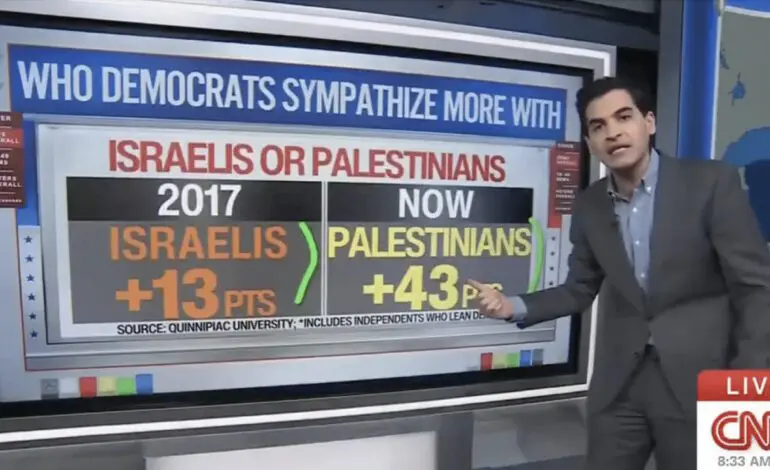

U.S. voters’ attitudes towards the Israeli Palestinian conflict have changed, but media commentators and political consultants haven’t figured that out. They are stuck in the past with outdated assumptions about the electorate and as a result continue to operate from an old playbook.
A feature article in last week’s Washington Post — “Ones to Watch as the 2026 Midterm Races Kick Into Gear” — provides the best evidence of just how out of touch the analysts are. The piece featured six races Post writers deemed worth watching next year.
One of the highlighted races was Arab American Dr. Abdul El-Sayed’s bid for the Democratic nomination for the Senate seat from Michigan. After describing El-Sayed’s “unapologetic progressivism” — i.e. he supports Medicare-for-all and raising taxes on billionaires, and has been endorsed by Senator Bernie Sanders — the author delivers this blow:
“His views on foreign policy are perhaps his most controversial. He has called Israel’s actions in Gaza a genocide and favors cutting off military aid to the Jewish state.”
What indicts the author as “out of touch” is the assertion that accusing Israel of genocide or calling for cutting military aid to Israel are controversial policy proposals.
What indicts the author as “out of touch” with today’s political realities is the assertion that accusing Israel of genocide or calling for cutting military aid to Israel are controversial policy proposals. This might have been true a few years back, but Israel’s war on Palestinians has taken a toll, both on that state’s favorable ratings with U.S. voters and on the policies these voters want their government to take to rein in Israeli behaviors. This is especially true among Democrats — the voters El-Sayed will need to win in next year’s primary contest.
A wide range of polls have established just how extensive the changes in attitudes are. The most recent and comprehensive of these U.S. public opinion polls was conducted by the Economist in August. Here’s some of what it found:
• 43 percent of voters favor decreasing military aid to Israel, with only 13 percent wanting to see an increase in such aid. Among Democrats the decrease/increase ratio is 58 percent to 4 percent. Among Independents, it’s the almost the same.
• Is Israel committing genocide? Among all voters, 44 percent say “yes” and 28 percent say “no.” Among Democrats, it’s 68 percent to just 8 percent. Among Independents, it’s 45 percent to 19 percent.
Other polls show voters affirming that they are more likely to support candidates who advance such positions and less likely to vote for those who defend Israeli policies and want to maintain current levels of military aid to Israel.
Candidates who take positions like those of El-Sayed are not at all controversial — they are part of the new American mainstream.
The obvious conclusion is that candidates who take positions like those of El-Sayed are not at all controversial. In fact, they are a part of the new American mainstream.
As if to provide further evidence of this shift, with less than a year before the midterm elections, it’s striking to note that more than two dozen congressional candidates have already declared their intent to reject PAC contributions from pro-Israel groups. This includes three sitting members of Congress, all of whom have previously been strong supporters of Israel and have, in previous elections, been the recipients of millions of dollars from pro-Israel sources, including PACs and dark money independent expenditures. One of these members of Congress recently spoke at the U.S. Holocaust Memorial Museum in which she termed Israel’s actions in Gaza as genocide and announced her support for cutting U.S. military arms to Israel.
It used to be said that criticism of Israel was akin to touching the “third rail” in American politics — avoid it or get burned. In a way, it still is but in reverse. Support for Israel was once the issue sine qua non for candidates for Congress. Polls now show that voters are less likely to vote for candidates who refuse to criticize Israel or who take money from pro-Israel PACs.
In 2026, what will be controversial are Israeli policies and pro-Israel campaign contributions, not the opposite.
As we get closer to the 2026 midterm elections, we can expect more candidates to publicly distance themselves from Israeli policies. We can also expect that pro-Israel groups will panic and up the ante by pouring tens of millions into defeating candidates who are critical of Israel. My sense is that this may backfire because in 2026 what will be controversial are Israeli policies and pro-Israel campaign contributions, not the opposite. The sooner the analysts, consultants and media figure that out, the better our politics will be.
– Dr. James Zogby is the founder and president of the Washington-based Arab American Institute (AAI).



Leave a Reply