




As a fragile ceasefire continues to hold across multiple Middle East fronts, developments over the past week revealed a clear reluctance by President Trump to return to full-scale war with Iran. Speaking from the White House on Thursday, Trump announced a three-week extension of the ceasefire in Lebanon, just two days after unilaterally extending the ceasefire with Iran indefinitely.
Rather than escalating militarily, the administration has opted to maintain pressure through a naval blockade on Iranian ports, in response to Iran’s continued control over the strategic Strait of Hormuz.
Lebanon: U.S. pushes direct talks with Israel
On the Lebanese front, U.S. diplomatic efforts intensified to shape the country’s next phase in coordination with the Lebanese government aligned with Washington. Direct talks between Lebanon and Israel were held at the White House, attended by Lebanese Ambassador to the United States Nada Hamadeh Moawad, Israeli Ambassador Yechiel Leiter, U.S. Ambassador to Lebanon Michel Issa and U.S. Ambassador to Israel Mike Huckabee.
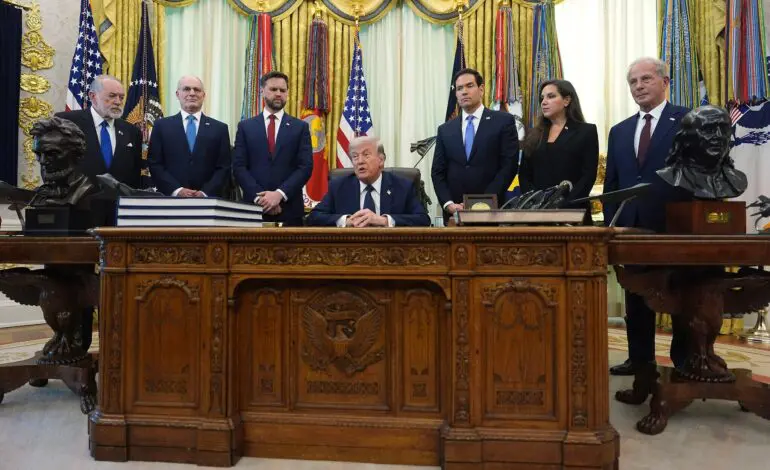
At the conclusion of the talks, which Trump described as having gone “very well”, the president announced the extension of the ceasefire between Lebanon and Israel for an additional three weeks, expressing hope of hosting Israeli Prime Minister Benjamin Netanyahu and Lebanese President Joseph Aoun at the White House “during this period.”
According to observers, the surge in U.S.-led direct negotiations reflects a race against time to undercut Iranian influence and its allies within Lebanon, particularly after Tehran made a ceasefire in Lebanon a key condition for engaging in talks with Washington.
Meanwhile, U.S.-Iran negotiations remain “stuck” in Islamabad, with Trump telling Fox News that “there is no timeline for the war and no need to rush”, adding that the blockade is more frightening to Iran than military strikes.
The White House also confirmed that Trump has presented a new proposal to Tehran, without revealing details, and renewed calls for Iran to hand over its enriched uranium stockpile.
In response, Iranian President Masoud Pezeshkian reiterated his country’s openness to dialogue, while stressing that ongoing sanctions and threats remain the primary obstacles to meaningful negotiations.
At the same time, the U.S. naval blockade continues. U.S. Central Command (CENTCOM) reported ordering 31 vessels to turn back or return to port as part of enforcement measures.
Ceasefire under strain amid Israeli violations
In a statement posted on his platform Truth Social, Trump said the White House meeting “went very well”, adding that the United States would continue working with Lebanon “to help it protect itself from Hezbollah.”
He framed the ceasefire extension as part of broader efforts to stabilize the situation and prevent escalation. In separate remarks, Trump suggested that achieving peace between Lebanon and Israel may be “easier” than other conflicts he is handling, expressing optimism about reaching an agreement within the year.
He also reiterated that the United States would cut off funding to Hezbollah, while affirming that “Israel has the right to defend itself”, though he cautioned that this must be done “carefully.”
U.S. Secretary of State Marco Rubio echoed this optimism, stating that a lasting peace between Lebanon and Israel could be reached “within weeks,” despite significant obstacles on the ground.
Washington hosted the second round of ambassador-level talks between Lebanon and Israel Tuesday, even as Israeli forces continued violating the ceasefire and escalating attacks in southern Lebanon. Among the most serious incidents was a direct strike targeting two journalists, followed by delays in allowing rescue teams access to the scene for more than four hours. One of the journalists, Amal Khalil, was later found dead.
The White House meeting included Trump, Vice President J.D. Vance and Secretary Rubio, as part of a broader U.S. push to secure a political breakthrough amid the complexities of the confrontation with Iran.
Lebanon, for its part, is seeking U.S. and Israeli commitment for a fully enforced ceasefire, including an end to violations across land, air and sea, a halt to targeted killings and destruction in occupied areas, in exchange for ensuring that Hezbollah resistance groups adhere to the truce as well.
Israeli soldiers have been looting civilian property on a large scale from homes and businesses in southern Lebanon with the knowledge of their commanders, Haaretz reported on Thursday.
Soldiers and officers described widespread, routine theft of belongings, including motorbikes, televisions, paintings, sofas and carpets.
Despite being aware of the practice, both senior and junior commanders have largely failed to take disciplinary action to curb it, according to testimonies.
As Israeli troops leave Lebanon, they openly load stolen goods onto their vehicles without attempting to conceal them.
“It’s on a crazy scale,” one soldier said. “Anyone who takes something – televisions, cigarettes, tools, whatever – immediately puts it in their vehicle or leaves it to the side. It’s not hidden. Everyone sees it and understands.”
Soldiers said commanders either turn a blind eye or voice opposition without enforcing consequences.
Ahead of the talks, the U.S. State Department urged American citizens to leave Lebanon while commercial flights remain available, amid rising concerns that the ceasefire could collapse. Continued Israeli violations have prompted Hezbollah fighters to resume limited military operations, emphasizing its commitment to defending Lebanese territory and civilians.
Despite renewed Saudi and Arab pressure to slow down direct negotiations with Israel, President Aoun confirmed that diplomatic efforts to halt escalation have entered a serious phase. Speaking at a Cabinet session at the Baabda Presidential Palace, he outlined a framework centered on solidifying the ceasefire, launching negotiations to end the state of war with Israel, securing Israeli withdrawal from occupied territories, ensuring the return of prisoners and deploying the Lebanese Army to the international border.
Aoun also dismissed reports of possible direct communication with Netanyahu.
“It was never under consideration,” he said.
Iran: Tactical pause or strategic shift?
Amid escalating tensions between Washington and Tehran, the extension of the ceasefire appears to be more of a tactical maneuver than a strategic shift, reflecting U.S. contradictions and firm Iranian responses.
Trump extended the ceasefire with Iran indefinitely just hours before its expiration, aiming to preserve diplomatic channels and prevent renewed military escalation.
According to Trump, the decision came in response to mediation efforts led by Pakistan, including Army Chief Field Marshal Asim Munir and Prime Minister Shehbaz Sharif, who urged a pause in hostilities until Iran presents a negotiating position.
As is often the case, Trump has pursued a dual-track approach: signaling openness to negotiations while simultaneously issuing threats of force if talks fail. Iran, however, has maintained its position that negotiations cannot resume unless the United States withdraws its conditions and stop the language of threats, while affirming its readiness to defend itself against any new military action.
In reality, the ceasefire extension appears to offer Trump a political exit from a costly and losing conflict, rather than a concession to mediators. By leveraging international mediation, particularly from Pakistan, the administration has sought to reposition itself diplomatically while minimizing the political costs of de-escalation.
At the same time, Trump’s return to aggressive rhetoric and enforcement of the naval blockade has once again strained the negotiation environment, widening the trust gap between Washington and Tehran.
Iran responded swiftly by closing the Strait of Hormuz again, signaling that the costs of the blockade will not be one-sided, but will directly impact global energy markets and maritime security.
A prolonged “maritime cold war”
With negotiations stalled, the U.S.-Iran confrontation is increasingly resembling a “maritime cold war”, likely to result in persistent disruptions to global shipping, volatility in energy prices and heightened security risks across the region.
The most sensitive dimension of this crisis extends beyond military and economic considerations to domestic political calculations on both sides. While Iran appears in no rush to reach a comprehensive agreement, preferring to manage the crisis on its own terms, both the United States and Israel face mounting electoral pressures that push them toward achieving a “clear victory”, rather than settling for ambiguous or interim solutions that are difficult to sell to their respective public.


Leave a Reply