



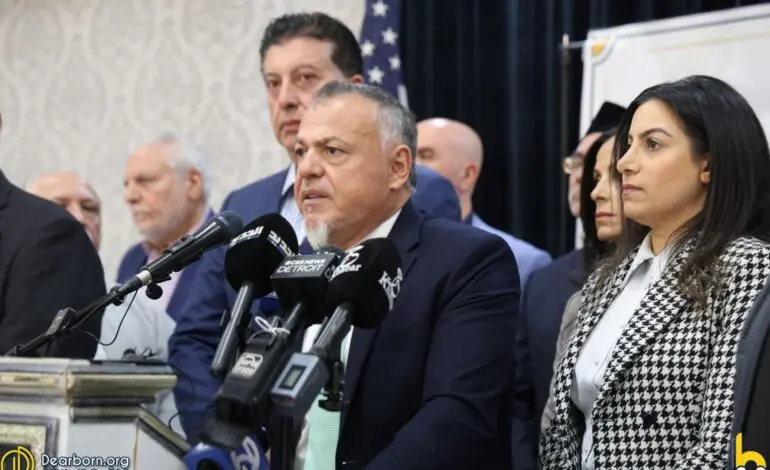

DEARBORN — In what organizers described as the first lawsuit of its kind in the United States, the Arab American Civil Rights League (ACRL) announced during a large press conference held Monday at the Bint Jebail Cultural Center in Dearborn its intention to file a federal class-action lawsuit against the U.S. government on behalf of American citizens of Lebanese descent whose properties and families have been harmed by Israel’s ongoing war on Lebanon.
The lawsuit aims to spotlight what the organization describes as the direct responsibility of the U.S. Departments of State and Defense, arguing that continued U.S. military aid — including advanced weapons and funding — has contributed to the destruction of civilian neighborhoods, including properties owned by American citizens.
The ACRL contends that such support may constitute legal negligence and complicity in violations, particularly under the framework of the Leahy Law, a key U.S. human rights statute governing foreign military assistance.
Legal foundation: The Leahy Law and U.S. obligations
At the center of the case is the Leahy Law, which strictly prohibits the United States from providing weapons, training or funding to any foreign military or police unit credibly implicated in serious human rights violations, including the killing of civilians, torture, enforced disappearances, extrajudicial executions or sexual violence.
Under the law, if a specific unit is found responsible for such violations, the United States is required to immediately cut off all support to that unit.
The law exists to ensure that:
- U.S. weapons are not used against civilians
- U.S. taxpayer money does not support human rights abuses
- Partner countries are pressured to investigate and hold violators accountable
There are two complementary versions of the Leahy Law:
- One administered by the U.S. Department of State, governing arms sales and security assistance and requiring human rights vetting before approval
- Another overseen by the Department of Defense, applying to training programs and military support
The ACRL’s lawsuit argues that the widespread destruction of civilian homes and infrastructure in Lebanon, including properties owned by American citizens, falls squarely within the types of violations that should trigger suspension of U.S. assistance under this law.
Extraterritorial rights: Extending constitutional protections
In addition to the Leahy Law, the lawsuit is built on the principle of “extraterritorial constitutional protection”, asserting that the rights of U.S. citizens — including the protection of private property — do not disappear simply because those properties are located outside U.S. territory.
The case seeks to compel the U.S. government to provide a full accounting of how its military aid is used abroad, while enforcing mechanisms that require cutting support to units involved in targeting civilian property.
If successful, the lawsuit could establish a major legal precedent, redefining the limits of U.S. foreign military assistance and strengthening protections for American citizens with assets overseas.
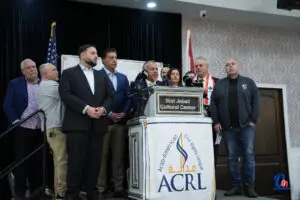
ACRL founder Nabih Ayad speaks during the press conference at the Bint Jebail Cultural Center in Dearborn on Monday, April 20. – Photo by Abbas Shehab
Context: Widespread destruction across Lebanon
The legal action comes amid extensive and systematic destruction across Lebanon as a result of Israel’s ongoing military campaign.
In recent months, large areas of southern Lebanon, the Bekaa Valley and Beirut’s southern suburbs have been devastated. Entire neighborhoods have been reduced to rubble, resulting in thousands of civilian casualties and injuries, along with the destruction of homes, businesses and public infrastructure.
The damage extends beyond property loss. More than one million people have been displaced, while essential infrastructure — including electricity, water systems and roads — has been severely damaged.
Historic sites and heritage villages have also been targeted, raising concerns about the erasure of cultural identity and long-term societal impact.
Conference testimonies: Personal loss and calls for accountability
ACRL Chairman Nasser Beydoun opened the press conference with a deeply personal account, emphasizing that the initiative is not only legal but rooted in lived experience and the demand for justice.
“I stand before you today not only as a civil rights advocate, but as someone personally affected by the ongoing war on Lebanon,” Beydoun said. “Two buildings owned by my parents in Bint Jbeil have been destroyed, along with both of my grandparents’ homes.”
He stressed that American citizens deserve protection — not neglect — from their government.
“Lebanese Americans have watched their homes destroyed, their land taken and their future erased — without accountability,” he said. “This must end today.”
Legal strategy: Expanding accountability
ACRL founder Nabih Ayad said the case reflects longstanding demands from the local community, particularly in southeast Michigan.
“Our legal team has studied this extensively, and we believe this will be one of the first cases of its kind — a class-action lawsuit against the U.S. government, specifically the State Department, for allowing this conduct,” Ayad, an attorney, said.
He argued that the indiscriminate destruction of civilian homes constitutes a clear violation of the Leahy Law, dismissing claims that such areas represent legitimate military targets.
Ayad also indicated that the legal effort may expand to include arms manufacturers, accusing them of knowingly supplying weapons used in violations of the Leahy Law.
“They are aware that their weapons are being used in ways that violate U.S. law and destroy civilian homes, yet they continue to supply them,” he said.
Political backing and legislative action
Wayne County Commissioner Sam Baydoun, who is originally from southern Lebanon, described the destruction as “catastrophic”, comparing the devastation of Bint Jbeil and surrounding villages to Hiroshima and calling it an “ethnic cleansing campaign.”
“These homes are not just structures — they are generational legacies,” he said, noting that even his own family home had been destroyed.
U.S. Rep. Rashida Tlaib (D-Detroit) expressed strong support for the lawsuit and outlined her introduction of the “Lebanon War Powers Resolution”, aimed at forcing a withdrawal of U.S. involvement in unauthorized hostilities.
“People are tired of the immunity we give to the Israeli government,” Tlaib said. “We will force a vote to end any U.S. assistance to these actions.”
State Rep. Alabas Farhat (D-Dearborn) also backed the lawsuit, emphasizing the need for moral clarity and enforcement of U.S. law.
“We are not asking for special treatment — we are asking for the law to be applied, for our citizens to be protected and for this destruction to stop,” Farhat said.
Community response and legal mobilization
The Arab American News Publisher Osama Siblani praised the initiative, noting that legal teams in Lebanon are already working to document evidence, including identifying the weapons used.
“We still believe in the rule of law and the Constitution,” Siblani said. “This is America — and change will only come when people speak up.”
Attorney Zena Makki Jarouski emphasized that the lawsuit seeks to defend the constitutional rights of all American citizens.
“These individuals invested their life savings in homes and businesses in Lebanon, only to see them destroyed by weapons funded by their own government,” she said.
She confirmed that the ACRL is collecting testimonies and legal documentation to build strong federal cases.
Meanwhile, Beirut Bar Association attorney Hassan Adel Makki said a large group of Lebanese lawyers will work to document crimes against civilians, homes and heritage sites to support the case and potential proceedings in international courts.
Next steps: Building the case
The ACRL is calling on affected individuals to submit their information via info@acrlmich.org
The organization will provide a formal intake form to document damages, including property details and the nature of destruction.
Ayad emphasized that the legal effort is being led entirely by volunteer attorneys, drawing on the ACRL’s experience in mobilizing large legal teams in past civil rights cases.
“We will take this fight to the end,” he said. “The era of impunity is coming to an end — we will see you in court.”


Leave a Reply