





LANSING — Three Democratic officials in Michigan, including Attorney General Dana Nessel, are calling for an independent audit of the results from the Michigan Democratic Party nomination convention held in Detroit on April 19, where thousands of delegates used a mobile phone application to vote on party nominees for various offices in the November election.
Both State Sen. Sylvia Santana, who represents Detroit and Dearborn, and Oakland Prosecutor Karen McDonald questioned the accuracy and integrity of the electronic voting and tabulation system operated through the Election Buddy app. Their concerns were later supported by Nessel, who joined calls Monday for an independent review of the convention vote.
Santana had sought the Democratic nomination for one of two seats on the Board of Trustees at Michigan State University, while McDonald was competing for the Democratic nomination for Michigan attorney general against Eli Savit, who ultimately secured the nomination to succeed Nessel, who is term-limited.
Santana challenges results
Over the weekend, Santana formally challenged her narrow loss in the race for the Michigan State University Board of Trustees, arguing that party leadership failed to enforce rules requiring delegates to be physically present at the convention venue in order to vote.
According to Santana’s 53-page filing, “significant errors” affected the vote-counting process, prompting demands for a full independent review of all election results from the convention.
Unofficial results published by the Detroit News showed Santana finishing third, only 15 votes behind incumbent trustees Brianna Scott and Kelly Tebay.
Santana’s filing highlighted concerns among party members over the use of personal smartphones for electronic voting during the convention. Her campaign stated that a review of geolocation data from devices used to vote showed that more than 200 votes were cast from outside Huntington Place convention center in downtown Detroit, where the convention was held.
According to the challenge, some delegates cast ballots from locations as far away as Montenegro in Europe and Antrim County in northern Michigan while the convention was in session.
Michigan Democratic Party member Cathy Albro said she attended the first day of the convention before returning home to Antrim County ahead of the April 19 vote. She said she was later asked to test the voting system remotely.
“You know, no intention of defrauding or anything like that. I just wanted to check the integrity of the vote,” Albro said. She added that her ballot was accepted despite not being physically present at the convention site.
Michigan Democratic Party member Liano Sharon argued that the incident violated the party’s own convention rules, which require delegates to be physically present at the convention in order to vote. Santana’s campaign contended that if the disputed votes had been excluded, she would have won the race by approximately 50 votes.
Unofficial results showed incumbent trustee Kelly Tebay defeating Santana by just 15 votes, while Brianna Scott finished first with approximately 38 percent of the vote. Tebay and Santana each received roughly 31 percent among more than 6,600 delegates.
Calls for broad audit
Santana’s challenge was referred to the Michigan Democratic Party’s appeals committee, requesting a fully audited recount not only of the Michigan State University trustee race but of all convention contests “to ensure voter confidence in the results.”
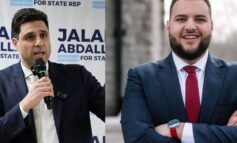
If approved, the review would also cover races for attorney general and secretary of state, along with other competitive contests, including the University of Michigan and Wayne State University Board of Governors races, which resulted in the nominations of Arab American attorneys Amir Makled and Sheref Akeel.
According to the results, Savit won the Democratic nomination for attorney general with about 59 percent of the vote, compared to 41 percent for McDonald.
In the race for secretary of state, Lt. Gov. Garlin Gilchrist II received about 58 percent of the vote, while Barb Byrum received about 22 percent and former state lottery commissioner Suzanna Shkreli received about 20 percent.
In a statement issued Monday, coinciding with the deadline for convention appeals, McDonald endorsed Santana’s request for an audit.
“I strongly support Senator Santana’s call for an independent audit and encourage fellow Democrats across the state to support it as well,” McDonald said. “It is critically important that every voter and every campaign have full confidence in the integrity of the voting process.
“After reviewing the results of the Michigan Democratic Party nominating convention, it became clear that votes were incorrectly recorded, that individuals voted despite not being physically present at the convention and that some votes were not recorded at all,” she added.
Santana’s challenge, filed by attorney Melvin “Butch” Hollowell, the former corporation counsel for the city of Detroit, alleged that the Michigan Democratic Party failed “to fulfill its responsibility to administer a convention with procedural integrity and transparency in accordance with its own rules and bylaws”, making adherence to the results “difficult, if not impossible.”
The challenge further alleged that 302 delegates who cast ballots were not listed on the official delegate roster and that 208 delegates shared a phone number with at least one other delegate, including six delegates linked to the same phone number.
“This means one individual had the ability to cast multiple votes,” Santana’s filing stated.
Nessel raises additional concerns
Nessel also voiced support Monday for an independent audit of the convention’s electronic voting process. According to a spokesperson for her office, the Election Buddy app incorrectly attributed her votes and congressional district information.
“I learned in the days immediately following the convention that the Election Buddy app did not correctly attribute my votes or my congressional district, and I immediately notified the impacted candidates and the state party chair,” Nessel said.
The state party chair is former State Sen. Curtis Hertel Jr. Aside from a statement issued by party spokesperson Alyssa Honeyman, Hertel had not publicly commented further on the controversy as of Monday.
Some Republicans mocked the Michigan Democratic Party in the days following the convention as reports of confusion and procedural irregularities continued to emerge. Several critics sarcastically questioned the party’s commitment to election integrity.
Nessel sought to draw a distinction between the convention’s internal voting process and Michigan’s official election system.
“There’s a substantial and documented difference between voting on a third-party mobile phone application at a partisan convention and the long-established, decentralized process utilized by Michigan’s over 1,600 bipartisan clerks each election,” Nessel wrote.
“Those drawing a false equivalency are also the same ones telling you not to trust Michigan’s election system, which includes paper ballots, audits and bipartisan certification at the local and state level,” she added. “Those who traffic in election conspiracies will seek any and every opportunity to undermine public confidence in our elections, and while an audit is warranted in this circumstance, these results have no bearing on the veracity of state-run elections.”

Leave a Reply