



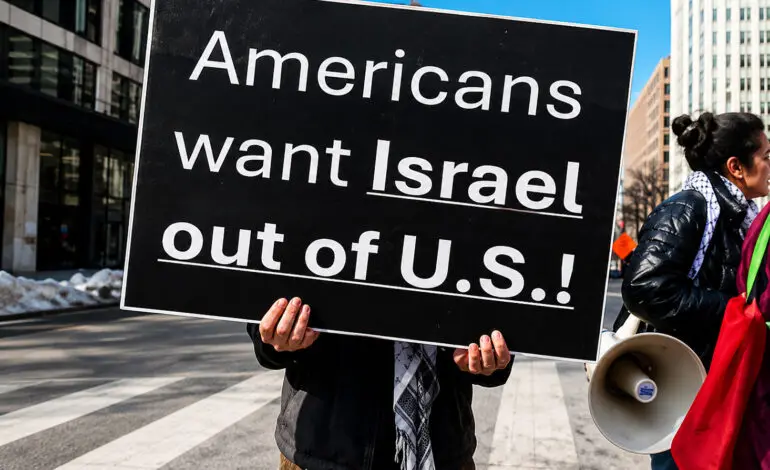

Recent polls of U.S. voters demonstrate a steep decline in overall support for Israel. For example, in February, when Gallup asked with whom they most sympathized, 41 percent of respondents said Palestinians, while only 36 percent named Israel. This markedly contrasts with results to Gallup’s same question in 2023 when 54 percent of respondents sympathized more with Israel and 36 percent more with Palestinians. Then, a few weeks ago, Pew released a poll in which 60 percent of respondents had an unfavorable view of Israel.
Voters’ alienation of affection from Israel, its leadership and policies is already impacting Congress and the upcoming elections.
To better understand these changes in voters’ opinions, the roles played by Israel’s wars with Lebanon and the Palestinians in shaping their views, and how voters want the U.S. government and members of Congress to respond, the Arab American Institute and Voters for Justice in Palestine, a North Carolina advocacy group, commissioned John Zogby Strategies to conduct a nationwide poll about these matters. In all, 1,001 likely U.S. voters were surveyed (yielding results with a margin of error of +/-3.2).
What’s clear is that Israeli behaviors have fallen into disfavor with a plurality of American voters. Overall, 41 percent of voters agree that Israeli actions against Palestinians are “excessive and tantamount to genocide.” Only 32 percent disagree with that proposition. The margin among Democrats is substantially greater, with 57 percent agreeing that “genocide” applies to Israel’s actions, while only 17 percent disagree. Responses about whether the U.S. should do more to pressure Israel to end its occupation of Palestinian lands yield similar results.
Forty-one percent of voters agree that Israeli actions against Palestinians are “excessive and tantamount to genocide.”
On these issues and others relating to Israeli behaviors consistent opposition to Israel policies is expressed — mainly by Democrats or Independents. The subgroups leading the opposition are younger or non-White voters. There’s a deep demographic split among voters who identify as Republicans, with younger Republicans (under 45-years-old) expressing negative attitudes toward Israeli actions that are more aligned with Democrats than with older Republicans. In fact, in response to almost every question in the poll, the only real support base on which Israel can depend are older, White Republican voters — a group that’s a dwindling minority in the overall electorate.
The poll also demonstrates the electoral consequences associated with voters’ changing attitudes. A plurality of all voters say they’d be more likely to support candidates who call for a reduction or an end to military aid to Israel (45 percent to 27 percent) or who reject funding or support from AIPAC-related sources (36 percent to 22 percent). Rejection is highest (substantially greater than two-to-one) among Democrats, Independents and non-White voters.
The only real support base on which Israel can depend are older, White Republican voters, a group that’s a dwindling minority in the overall electorate.
One area where majorities of Democrats, Republicans and Independents (and all major demographic subgroups) agree is that Israel should be held accountable and prosecuted for the killing of U.S. citizens. Fifty-eight percent of all likely voters believe Israel should be held accountable versus only 16 percent who don’t want them prosecuted.
Similar results emerge when voters turn to addressing Israel’s bombing and occupation of Lebanon. By a two-to-one margin, likely U.S. voters believe the administration should do more to pressure Israel to stop the bombing and leave southern Lebanon. By a similar margin, voters express the concern that Israel’s bombing and occupation of Lebanon is harming U.S. interests in the Middle East. And these margins hold for every major demographic group except Republicans, who are divided.
While voters are decidedly negative about Israeli behaviors and support U.S. policy to restrain Israel and hold it accountable for its actions, the poll also establishes that a sizable minority (between one-quarter and one-third of respondents) acknowledge that they’d need more information before making decisions about some of the policy issues at stake.
As the midterm elections approach, signs are emerging that voters’ alienation of affection from Israel, its leadership and policies are already having impacting Congress and the upcoming elections. This past month, 40 of 47 U.S. senators who are Democrats or caucus with the Democrats (including the majority of Jewish senators) voted to block some military supplies to Israel — an unprecedented number of elected officials to take such a stand in an election year. Scores of members of Congress have publicly pledged to reject the support of the powerful pro-Israel lobby in their reelection bids, including some who’d once been major recipients of funds from pro-Israel donors. These dramatic and consequential developments are important to note moving forward.
– Dr. James Zogby is the president and founder of the Washington based Arab American Institute (AAI)



Leave a Reply