



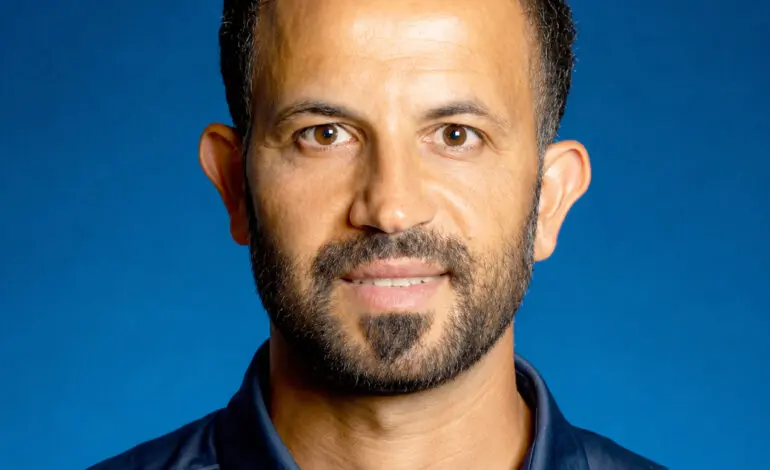

Lebanese American athlete Bilal Hussein to represent Team USA in FootGolf World Cup
ANN ARBOR — On a quiet summer morning at a public park, Bilal Hussein was simply looking for a way to clear his mind after years of pressure and emotional exhaustion in the world of soccer coaching.
He never imagined that one casual kick of a soccer ball would eventually lead him to the U.S. national team, and to the FootGolf World Cup, in a sport he had never even heard of before.
After spending years on the sidelines as a mentor and coach for young soccer players, the Lebanese-born coach now finds himself living the very experience he once helped others navigate: competition, travel, pressure and the pursuit of a dream that once seemed impossible.
Less than two years after discovering the sport of FootGolf, Hussein officially earned a place on Team USA as one of the country’s top-ranked players, qualifying to compete in the 2026 FootGolf World Cup in Acapulco, Mexico.
“Sometimes it still doesn’t feel real,” Hussein told The Arab American News. “From the very first time I played, I felt a deep passion for the sport. I immediately set one clear goal for myself: qualifying for the World Cup.”
A dream rooted in Lebanon
Hussein’s relationship with sports began years ago in Lebanon, where he grew up with a deep love for soccer and saw the game as both a passion and a pathway to belonging and ambition.
He played at the collegiate level before joining the Lebanese Army team, an experience that helped shape his competitive personality and reinforced the values of discipline and commitment.
Like many young athletes, Hussein dreamed of reaching the professional level and one day representing his homeland.
“I truly believed I had the ability to play professionally,” he said. “But the circumstances surrounding Lebanese sports at the time made that path extremely difficult.”
Eventually, life led him to the United States, where he began an entirely new chapter far from the soccer fields where his athletic journey first began.
Building a new life in America
After earning a master’s degree in business administration with concentrations in accounting and finance, Hussein moved to Michigan and began rebuilding both his professional and personal life.
Driven by a passion for mentorship, he entered the world of coaching and worked with several youth clubs while continuing to advance through U.S. Soccer coaching programs.
He quickly became known as a coach who cared as much about developing character as improving technical ability on the field.
“For me, coaching was never just about sports,” Hussein said. “I always believed my real role was helping young people become better human beings — more disciplined, respectful and confident.”
In 2017, Hussein achieved one of the defining milestones of his career when he earned the prestigious U.S. Soccer A – Senior coaching license, becoming, according to Hussein, the first Lebanese and first Arab coach to receive the certification.
Between 2017 and 2021, Hussein worked within the women’s soccer program at the University of Michigan, serving as both assistant coach and director of technical analysis.
“Women’s soccer in the United States is among the best in the world,” he said. “Working in that highly competitive environment was both an incredible learning experience and a daily challenge.”
From burnout to a new beginning
Despite his professional success, Hussein eventually began experiencing significant mental and emotional exhaustion after years of investing deeply in the lives and development of athletes.
“When you work with full passion for so many years, eventually you reach a point where you need to step away and reset mentally,” he said.
After leaving the collegiate coaching environment, Hussein focused on improving his physical and mental well-being. During that period, he unexpectedly discovered FootGolf while visiting a public park in Ann Arbor.
At first, the sport simply sparked his curiosity. Soon, however, that curiosity evolved into genuine passion.
What is FootGolf?
FootGolf is a hybrid sport that combines soccer and golf. Players attempt to kick a soccer ball into an oversized hole using the fewest possible shots, similar to traditional golf. The game is played on golf courses using standard soccer balls, while the holes measure roughly 21 inches in diameter.
The Federation for International FootGolf (FIFG) was established in 2012, and the sport has grown rapidly across the United States, Europe and South America in recent years. The most recent World Cup, held in Orlando in 2023, featured nearly 1,000 players representing 39 countries.
Hussein said the sport immediately attracted him because of its unique combination of technical skill, strategic thinking and mental focus.
“The more I played, the more I realized this sport is far more difficult than it appears,” he said.
He explained that FootGolf is not simply about kicking a ball toward a hole, but rather a sport built on precision, ball control, reading terrain and maintaining mental composure under pressure.
“In soccer, you usually have opportunities to recover from mistakes during a match,” Hussein said. “In FootGolf, sometimes a single bad shot can completely change the outcome of an entire round.”
Chasing goals that seemed impossible
In January 2025, Hussein officially entered professional FootGolf competition.
From the beginning, he set ambitious goals that many considered unrealistic: becoming one of the top players in the United States, breaking into the world’s top 100 rankings and qualifying for the 2026 World Cup.
To Hussein, those dreams were not impossible, they were motivation.
He traveled across the country, competing in tournaments in states that included California, Nevada and New Jersey in pursuit of ranking points that would elevate him in the national standings.
But the journey was far from easy.
Because FootGolf remains a relatively young sport, most players are responsible for covering their own travel, lodging and tournament expenses.
“Financial support and sponsorships in this sport are still very limited,” Hussein said. “Most players make major sacrifices simply because they love competing.”

Bilal Hussein practicing FootGolf
The moment he nearly walked away
One of the most difficult moments came after a disappointing performance at the U.S. Open in New Jersey, when Hussein seriously considered quitting.
The physical fatigue, constant travel and mental pressure had begun taking a visible toll.
But one thought prevented him from giving up.
“I asked myself, How can I tell kids not to quit if I’m going to quit myself?” he said.
After that moment, Hussein returned with a completely different mindset.
He began implementing structured training plans, carefully analyzing his strengths and weaknesses while preparing his body for the demands of elite competition.
“At first, my goal was simply to finish tournaments without my body breaking down,” he said with a laugh.
Over time, his body gradually adapted.
Following Ramadan in 2025, Hussein intensified his training significantly, spending long hours practicing under difficult conditions designed to simulate the climate he expects to face in Mexico.
Slowly, the results began reflecting the work.
Earning a place on Team USA
By the end of the season, Hussein finished ranked among the nation’s top American players, officially securing a place on Team USA’s roster for the 2026 FootGolf World Cup in Acapulco.
His name officially appeared on the qualified roster in the Senior Men’s division.
The fifth edition of the FootGolf World Cup is scheduled to begin May 27 in Mexico and continue through June 7.
For Hussein, the achievement represents far more than athletic success.
“When I was a child in Lebanon, my dream was to represent my country,” he said emotionally. “Today, I have the opportunity to represent the United States while still holding complete pride in my Lebanese roots.
“Before anything else,” he added, “I am proud to be a son of Lebanon.”
A story bigger than sports
Now, as the FootGolf World Cup approaches, Hussein sees his journey not merely as a personal accomplishment, but as a message of hope for anyone who believes it is too late to pursue their dreams.
After years spent coaching others, he now understands firsthand the realities athletes face at the highest levels: pressure, defeat, travel, sacrifice, resilience and starting over again.
“This journey will absolutely make me a better coach and a better human being,” he said.
His final message is simple and direct:
“It is never too late to challenge yourself. If you stay disciplined, continue learning and refuse to give up, incredible things can happen.”
From the soccer fields of Lebanon to Michigan and now the global stage in Mexico, Bilal Hussein’s story stands as proof that some dreams may be delayed, but they never truly die.
Leave a Reply