



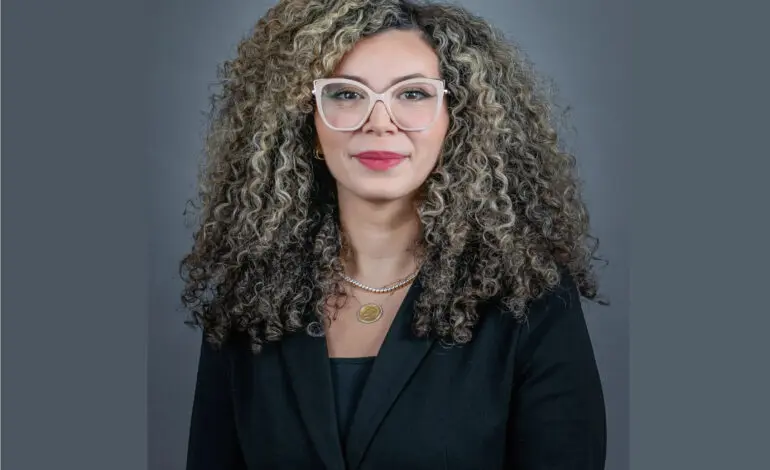

LANSING — Gov. Whitmer announced the appointment of Dearborn Magistrate Rula Aoun to the Wayne County Circuit Court on Wednesday, further expanding Arab American representation on the bench of Michigan’s largest trial court.
Aoun was appointed alongside attorneys Robbie Gaines, Jr. and Robyn Liddell to fill three vacancies on the Third Judicial Circuit Court of Michigan, commonly known as the Wayne County Circuit Court, which has 59 judges.
“I am proud to appoint Robbie, Robyn and Rula to the Wayne County Circuit Court,” Whitmer said in a statement. “They are skilled legal professionals with years of experience and dedication to serving their communities. I am confident they will uphold the rule of law and faithfully serve the people of Michigan.”
Aoun will officially begin her judicial duties on September 14, following the planned resignation of Judge Muriel Hughes. Her appointment covers a partial term ending January 1, 2029. Aoun would have to seek election in 2028 to remain on the bench beyond that date.
“I am deeply grateful to Governor Whitmer for this opportunity, and I am honored to serve the people of Wayne County,” Aoun said. “I am committed to ensuring that every person who enters the courtroom is heard and treated with respect and dignity.”
In written responses to questions from The Arab American News, Aoun described the appointment as the culmination of a legal career rooted in public service, advocacy and her upbringing in Dearborn.
“Professionally, it is the greatest honor of my career thus far,” she said. “Personally, it means even more. I understand the responsibility that comes with being entrusted to make decisions that can profoundly affect people’s lives.”
Aoun said her goal is to earn the public’s trust every day by approaching each case with preparation and fairness.
“I’m incredibly grateful for the opportunity because people have always been my passion and interest,” she said. “My goal is to earn the trust of the public every day by being prepared, fair and making sure everyone who enters my courtroom knows that they have been heard.”
A legal career rooted in service
Born in Illinois to Lebanese immigrant parents, Aoun has lived in Dearborn for nearly her entire life. Both of her parents were born in Lebanon and have lived in the United States for at least 40 years.
Aoun attended the University of Michigan-Dearborn, earning a bachelor’s degree in international affairs while also studying French. She received her Juris Doctor from Wayne State University Law School in 2014 and was admitted to the State Bar of Michigan that November.
Aoun said she was attracted to the legal profession because she viewed it as a means of advocating for others and making a tangible difference in their lives.
“I was drawn to law because I saw it as a way to advocate for people and make a meaningful difference in their lives,” she told The Arab American News. “Throughout my career, I’ve had the opportunity to represent people during some of the most difficult moments of their lives.”
My goal is to earn the trust of the public every day by being prepared, fair and making sure everyone who enters my courtroom knows that they have been heard.
– Rula Aoun
Those experiences, she said, taught her the importance of an attorney’s role and the extent to which clients depend on their lawyers to protect their rights and pursue justice.
“I practiced many areas of law to ensure that I could serve in any capacity where I was needed,” she said. “Each step in my career has reinforced for me that the law is ultimately about service.”
Aoun worked at several law firms before joining Cochran, Kroll & Associates in Livonia in 2017. Her legal experience has included personal injury, civil litigation, family law, immigration, intellectual property and business law.
She also served as legal director of the Arab American Civil Rights League (ACRL), overseeing the organization’s legal strategy and programs and providing pro bono representation, particularly in cases involving alleged civil rights violations. She continues to serve on the organization’s board of directors.
Experience on the Dearborn bench
Aoun has served as a magistrate in Dearborn’s 19th District Court since 2019, an experience she said prepared her for the practical and human responsibilities of serving as a Circuit Court judge.
“Serving as a magistrate at the 19th District Court gave me the opportunity to take those lessons from advocacy and apply them from the bench,” she said. “It taught me that being a good judicial officer involves much more than knowing the law.”
Aoun said judicial officers must listen carefully, exercise patience, make difficult decisions and explain those decisions in language that litigants and defendants can understand.
“It also taught me that, for many people, their interaction with you may be their only experience with the justice system,” she said. “How you treat them matters. I will carry that perspective with me to the Third Circuit.”
The new position also represents a homecoming for Aoun, who previously interned at the Wayne County Circuit Court while studying at Wayne State University Law School.
“I was a summer intern at Third Circuit when I was still in law school,” she said. “I could not have imagined then that I would one day return to serve on that bench.”
Aoun said returning to the court as a judge makes her legal journey feel as though it has come “full circle” and has given her an even greater appreciation for the responsibility she is assuming.
Pride in her Lebanese American roots
Aoun said she is deeply proud of her Lebanese heritage and her upbringing in Dearborn, adding that her appointment carries significance beyond her personal and professional accomplishments.
“I know there are young people in our community who may see this appointment and realize that opportunities like this are possible for them, too,” she said. “That means a great deal to me.”
Aoun said a judiciary that reflects the diversity of the community can strengthen public trust by assuring residents that their voices, experiences and perspectives are understood.
At the same time, she emphasized that her responsibility as a judge will extend equally to everyone who enters her courtroom.
“Everyone deserves the same fairness, dignity and respect, regardless of who they are or where they come from,” she said.
Aoun said she hopes to bring preparation, fairness, compassion and common sense to the bench while maintaining high expectations for attorneys appearing before her.
“I want to run a courtroom where lawyers are expected to be prepared and professional, but also one where every person is treated with dignity and respect,” she said.
Although litigants may not always agree with a judge’s ruling, Aoun said they should leave the courtroom knowing they received a fair hearing.
“They should leave the courtroom knowing that they were heard, that the judge understood the issues and that the decision was made fairly and according to the law and in the interest of serving the people of Wayne County,” she said.
Eight Arab American judges on Wayne County bench
Aoun’s appointment will bring the number of Arab American judges serving on the Wayne County Circuit Court to eight. The others are Judges Helal Farhat, David Allen, Charlene Elder, Adel Harb, Yvonna Abraham, Lawrence Elassal and Susan Dabaja. Judge Farhat is currently the chief judge pro-tem, and the presiding judge of the Family Court.
Aoun is the fifth Arab American judge appointed by Whitmer directly to the Wayne County Circuit Court, following Farhat, Abraham, Elassal and Dabaja.
Judge Mariam Saad Bazzi was initially appointed to the Wayne County Circuit Court by Republican Gov. Snyder in 2017. Whitmer elevated Bazzi to the Michigan Court of Appeals in 2025.
Judges Allen and Elder were appointed to the Wayne County Circuit Court by Democratic Gov. Granholm, while Harb was appointed by Snyder.
The appointments reflect the gradual growth of Arab American representation in Michigan’s judiciary, particularly in Wayne County, which is home to one of the country’s largest Arab American populations.



Leave a Reply