



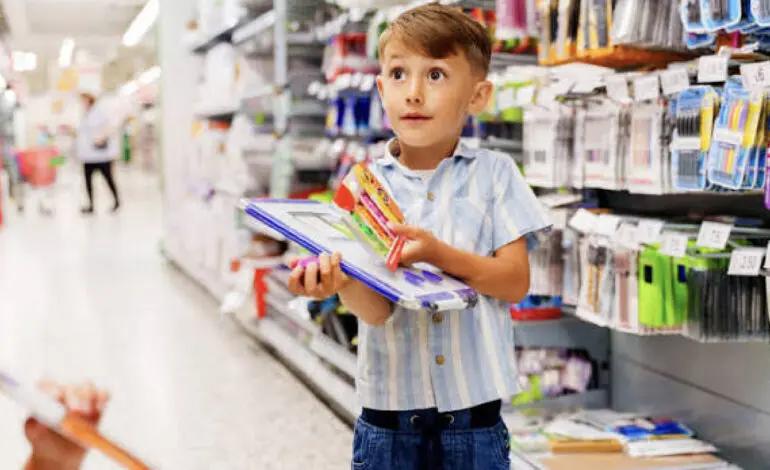

DEARBORN / DEARBORN HEIGHTS— With the new academic year approaching, backpacks, notebooks, pens, clothes and shoes are returning to family shopping lists. This year, however, preparations come amid rising living costs that are forcing many households to cut spending, particularly those with several children and mounting expenses.
Not every family faces the same circumstances. Some can comfortably absorb the additional costs, while others compare prices and wait for discounts. Still others need assistance.
Across those different economic circumstances, however, the rising cost of daily necessities — from food and clothing to school supplies and gasoline — remains a recurring concern as families await the first bell of the new school year.
According to the National Retail Federation’s latest figures, spending on back-to-school items for American students in kindergarten through 12th grade is expected to reach a record $43.3 billion this year, up from $39.4 billion in 2025.
Families plan to spend an average of approximately $864 on clothing, shoes, school supplies and electronics. Meanwhile, 78 percent of shoppers expect prices to be higher this year, making discounts and other opportunities to save increasingly important.
School will not wait
The academic year begins Monday, August 24, in Dearborn and Dearborn Heights. For Ali Jaber, a father of three children in Dearborn Public Schools, calculating the costs began days earlier.
Jaber told The Arab American News that he did not travel with his children to Lebanon this summer, initially because of security conditions there, but also because of rising prices and his desire to protect his savings amid concerns that he could lose his job in the coming months.
“I have children, school and expenses,” he said. “I would rather preserve the money for essential needs than spend it on travel.”
Jaber’s circumstances reflect those of many families who are not necessarily unable to purchase what their children need, but have become more cautious about allocating their income amid uncertainty about the future.
Travel and nonessential purchases can be postponed. School and its accompanying expenses cannot.
As the school year approaches, Dearborn and Dearborn Heights are also seeing a series of assistance initiatives involving schools, nonprofit organizations and local businesses.
Some organizations are distributing free backpacks and supplies. Barbers are offering complimentary haircuts to students, while businesses — including juice shops — are providing promotions, gifts and free beverages to celebrate students’ return to the classroom.
For a family with several children, such initiatives can cover part of a long list of expenses arriving simultaneously. They do not necessarily eliminate the need for additional purchases.
After families buy clothes, shoes, backpacks and basic supplies, teachers may distribute additional lists containing items that vary by grade level and subject.
Fatima Baydoun, whose children attend Crestwood Schools in Dearborn Heights, said the rising costs become especially noticeable when families receive multiple supply lists.
“We may buy everything we think the children need, and then, after school starts, each teacher sends a list,” she told The Arab American News. “Sometimes they request specific colors or types of notebooks, folders and other items for each subject. When you have more than one child, those things add up and the difference in prices becomes clear.”
The back-to-school bill does not end with supplies and clothing.
“The issue is not that people will not buy things for their children,” Mahmoud Mohammed Bazzi told The Arab American News. “Parents will ultimately provide what their children need, but everything has become more expensive. You fill the car with gas and buy clothes, shoes and school supplies, and in the end you feel the difference in the amount you have spent.”
Confidential assistance
In the Crestwood School District, which serves central and northern Dearborn Heights, Superintendent Dr. Youssef Mosallam said the district has not received direct complaints from parents about rising back-to-school costs. However, administrators recognize the pressure inflation and higher prices are placing on some families.
Mosallam, who has led the district since 2019, encouraged families having difficulty purchasing school supplies to contact their schools.
“We understand that with the current inflation, things have become difficult, and we know many people are struggling with higher costs,” he told The Arab American News. “We do not want anyone in our community to feel that help is not available.”
Mosallam said supply lists distributed by teachers contain “recommended” materials, not mandatory requirements.
“No child will be punished, and there will be no consequences for a child who cannot obtain these supplies,” he said.
Parents who cannot afford certain items should contact their school principal directly, Mosallam said. Any request for assistance will be handled confidentially, and the school will work to provide what the student needs without disclosing the family’s circumstances.
The district does not want parents to feel that they must carry the burden alone, he added.
Mosallam said confidentiality extends to the student, who would not be told that the family requested assistance unless the parents chose to share that information.
He noted that the overwhelming majority of parents in the Crestwood community work, making the beginning of the academic year particularly challenging for families trying to balance employment responsibilities with their children’s needs.
A support network beyond school supplies
Dearborn Public Schools, which serves approximately 20,000 students in Dearborn and parts of Dearborn Heights, also recognizes the financial pressure families face as the prices of supplies, clothing and gasoline rise, Superintendent Mike Esseily said.
Esseily became the district’s superintendent earlier this year following a long career with Dearborn Public Schools.
“We know families feel the pressure at this time of year, with the rising costs of supplies, clothing and gasoline,” he told The Arab American News.
The district’s efforts to ease those burdens extend beyond school supplies, Esseily said.
Dearborn Public Schools provides free breakfast and lunch to all students through Michigan’s universal school meals program. The district’s Food Services Department also works to ensure students continue receiving meals during exceptional circumstances.
When severe storm damage forced some summer programs to close temporarily, Esseily said, the Food Services team continued providing meals to students.
The district also partners with parent-teacher organizations, nonprofit groups and local businesses to provide backpacks, supplies, clothing and other resources before classes begin and throughout the academic year.
The Food Services Department also maintains a list of community organizations families can contact for additional help.
Regarding additional supply lists distributed by teachers, Esseily said backpacks and essential materials are provided annually with support from community partners.
Additional lists should be treated as “a guide, not a requirement,” he said. No student will be placed at a disadvantage because their family cannot purchase every listed item.
Esseily encouraged families experiencing financial hardship to contact their schools, which can provide needed supplies and connect them with other available resources.
Different families, different circumstances
Despite rising prices, no single description applies to every family.
Some households can purchase everything their children need without the cost imposing a significant burden. Others search for sales and attractive promotions. Some families accept free school supply kits or promotional haircuts to reduce part of the expense, while others need more extensive assistance.
Participating in a charitable or promotional initiative does not necessarily mean a family is experiencing serious financial hardship. With prices continuing to rise, finding ways to save has become a normal practice for households across different income levels.
Jaber chose to preserve his savings instead of traveling. Baydoun notices the rising costs as teacher requests multiply. Bazzi sees the effects of higher prices everywhere, from retail stores to gas stations.
Their circumstances differ, but schools, nonprofit organizations and local businesses are responding with a range of initiatives intended to ease at least some of the burden.
For many families, this year’s back-to-school season is ultimately a critical period requiring more careful calculations and a renewed ordering of household priorities.



Leave a Reply