



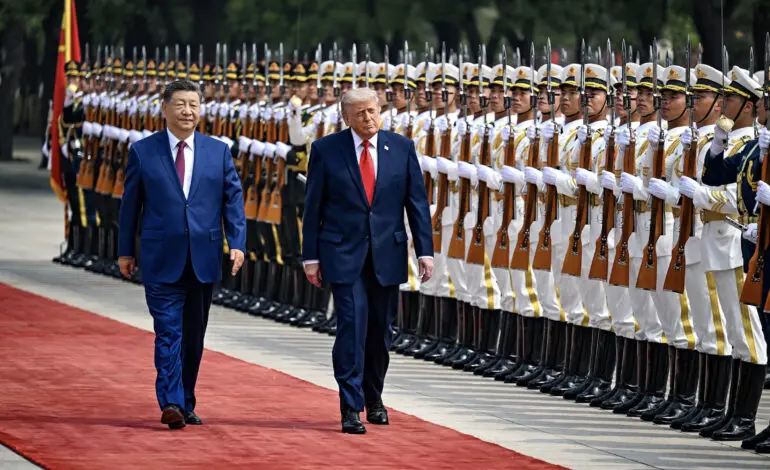

Against the backdrop of President Trump’s visit to China, the Middle East remained trapped in a temporary status quo, with Iran still caught in a state of neither war nor peace with the United States, while resistance forces in southern Lebanon continued targeting invading Israeli troops using fiber-optic drones, whose documented effectiveness has reportedly left the Israeli military unable to counter them.
Although Trump attempted to market his Beijing visit as a breakthrough on the Iranian file, the absence of any Chinese confirmation — coupled with continued naval coordination between Tehran and Beijing in the Strait of Hormuz — revealed a clear divergence between the narratives and objectives of both sides.
Following his meeting with Chinese President Xi Jinping in Beijing on Thursday, Trump sought to portray gains related to the war with Iran, claiming he had obtained a promise from Xi not to sell military equipment to Tehran and to help “ensure freedom of navigation in the Strait of Hormuz.” China itself, however, made no public statement on the matter, while Iran coincided with Trump’s visit by announcing the passage of Chinese vessels through the strait under Iranian arrangements.
Meanwhile, Reuters quoted sources saying that “Trump’s aides see China as one of the few actors capable of persuading decision-makers in Iran to reach an agreement”, adding that the urgent priority regarding Iran is “preventing a return to fighting by all means.”
Yet Xi made no mention of the war during remarks opening the official banquet with Trump and the U.S. delegation at the Great Hall of the People in Beijing, focusing instead on bilateral relations with the United States, which he described as “the most important bilateral relationship in the world.”
Xi described Trump’s visit as “historic”, arguing that “the great rejuvenation of the Chinese nation” and Trump’s slogan “Make America Great Again” could advance side by side.
The Washington Post previously revealed a classified U.S. intelligence assessment concluding that China is achieving broad strategic gains at the expense of the United States as a result of the ongoing war with Iran in military, economic, diplomatic and media spheres, while concern inside the Pentagon continues to grow over the geopolitical consequences of the conflict.
At the same time, several Chinese ships were documented crossing the Strait of Hormuz in coordination with Iran. Iranian state television quoted an official from the naval forces of the Islamic Revolutionary Guard Corps saying that 30 ships had successfully crossed Hormuz, while stressing that “Iran’s position toward hostile ships has not changed and they cannot pass through the strait.”
Iran has maintained effective control over the Strait of Hormuz since the Israeli assault launched in late February, even after the ceasefire declared on April 8.
Trump-Xi summit
Amid mutual efforts to contain tensions between the world’s two largest economic powers, Trump and Xi held an extended summit in Beijing addressing key disputes between the two countries, most notably Taiwan, the war with Iran, security in the Strait of Hormuz, trade cooperation and aviation deals.
While Trump had hoped his delayed visit to China would produce a dual victory in both Venezuela and Iran, the U.S. president ultimately found himself lacking sufficient leverage over China because of Iran’s resilience and the American predicament caused by the closure of Hormuz and rising global energy prices.
Aside from a civilian aircraft deal benefiting Boeing, Trump’s visit produced little of significance, effectively forcing him to return to Washington without achieving any meaningful breakthrough.
The summit came amid an active trade truce between the two nations after months of tariff escalation and geopolitical tensions that had dominated the first year of Trump’s second presidency.
The talks lasted more than two hours and addressed regional security, trade, energy and other highly sensitive bilateral issues.
Xi warned during the meeting that mismanaging the Taiwan issue could lead to direct conflict between the two powers, describing Taiwan as “the most important issue” in U.S.-China relations.
He said mishandling the matter could push bilateral relations into “a highly dangerous situation”, referring to ongoing disputes over Washington’s military support for Taiwan. The White House, in turn, described the meeting as “good” without directly addressing Taiwan.
The United States remains Taiwan’s primary security partner and is legally obligated to assist the island’s defense under the Taiwan Relations Act of 1979. Beijing considers Taiwan part of Chinese territory despite the island being self-governed under a democratically elected administration since 1949.
The summit also featured extensive discussions about the war with Iran and its implications for international navigation. The White House announced that both presidents agreed on the need to keep the Strait of Hormuz open after Iran had effectively closed it following the joint American-Israeli assault launched in late February.
Trump told Fox News that Xi informed him he “wanted” to help find a way to end the war with Iran, adding that the Chinese president had “already offered” assistance if possible.
Trump also claimed Xi pledged not to supply Iran with military equipment or goods, though Beijing has yet to officially confirm those statements.
By contrast, Secretary of State Marco Rubio said in an interview with NBC News that Trump did not ask China for direct assistance regarding Iran.
“We are not seeking China’s help, nor do we need it,” Rubio said. “We raised the issue to clarify our position and ensure they understood it.”
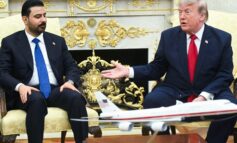
On the economic front, Trump announced that China had agreed to order around 200 civilian aircraft from Boeing in the first major American commercial aviation deal with China since 2017.
Trump said the agreement would create “many jobs”, though he provided no further details regarding aircraft models or the overall value of the transaction. Boeing shares declined following Trump’s comments due to market expectations for a larger agreement.
The American delegation included several leading business figures, among them Jensen Huang and Elon Musk, who participated in portions of the meetings.
Xi told the delegation that China’s doors “would open wider and wider” to American companies. Trump also announced that he had invited Xi and his wife, Peng Liyuan, to visit the White House on Sept. 24.
In a notable comment, Trump praised himself while attacking former President Biden in response to remarks by Xi concerning America’s decline.
Posting on Truth Social, Trump wrote that when Xi “eloquently suggested the United States may be a declining nation, he was referring to the immense damage inflicted on us during the four years of Biden and his administration, and in that respect, he was absolutely correct.”
Trump continued criticizing Biden’s policies, citing “open borders, high taxes, transgender equality, men competing in women’s sports, DEI policies, disastrous trade agreements, rampant crime and much more.”
He then praised his own presidency.
“Xi was not referring to the astonishing rise achieved by the United States during the magnificent 16 months of the Trump administration, which included unprecedented gains in stock markets and retirement accounts, military victory and flourishing relations in Venezuela, and a crushing military defeat for Iran.”
Iran has not conceded defeat.
“The strongest military in the world without question, a great economic power once again, with a record $18 trillion invested in the United States by outside actors, and the best American labor market in history,” Trump added.
Iran remains firm
Vice President JD Vance announced that negotiations with Iran are making progress despite Trump’s rejection of Tehran’s latest proposal to end the war and Iran’s insistence on its conditions regarding Hormuz and nuclear enrichment.
Vance referred to ongoing talks with Iranian officials and disclosed telephone discussions with Trump adviser Jared Kushner, special envoy Steve Witkoff and several unnamed “friends” in the Arab world.
“I think we are making progress,” Vance said. “The key question is whether we have made enough progress to satisfy the red line set by the president.”
Iranian parliamentarian Alaeddin Boroujerdi, a member of Iran’s National Security and Foreign Policy Committee, declared that “Iran will never relinquish the strategic gain represented by the Strait of Hormuz and will under no circumstances enter discussions regarding negotiations over nuclear enrichment.”
In remarks to the Iranian news agency ISNA, Boroujerdi added that the announced ceasefire is “fragile and unreliable”, stressing that “Iran will not accept anything less than achieving its demands.”
He further emphasized that Tehran is “in no way prepared to submit to American viewpoints”, warning that renewed clashes remain possible.
In the latest acknowledgment from Washington regarding losses suffered during the assault on Iran, the Congressional Research Service published estimates indicating that approximately 42 aircraft had been damaged, lost or destroyed, including F-35s, F-15s and drones.
The Pentagon has not yet issued a comprehensive assessment of losses, though it announced last week that total war spending is estimated at $29 billion, excluding losses sustained at U.S. bases throughout the Middle East.
Meanwhile, the Financial Times reported, citing diplomats, that Saudi Arabia is discussing with allies a proposed regional non-aggression pact with Iran as part of postwar regional planning following the American-Israeli conflict with Tehran.
Western diplomats said Riyadh is considering drawing lessons from the Helsinki Process launched during the Cold War in Europe as a potential regional model, amid expectations that Iran will remain an influential actor despite being weakened by the recent war.
In contrast to Saudi flexibility toward Iran, the United Arab Emirates appeared determined to escalate tensions with Tehran by insisting on blocking a solidarity statement with Iran within the BRICS framework.
Disagreements during the BRICS meeting in New Delhi last week — particularly regarding the war on Iran and the Hormuz crisis — exposed divisions among the rising powers and highlighted differing approaches toward Washington and regional security.
BRICS, long viewed as a symbol of multipolar cooperation, now faces a serious test in responding to an American assault against one of its own members, Iran.
Lebanon negotiations
A new round of negotiations between Lebanon and Israel took place Thursday at the U.S. State Department in Washington amid expectations of another extension of the fragile ceasefire under American pressure tied to ongoing talks with Iran.
The third round of discussions comes as Israeli forces continue carrying out intense airstrikes on southern Lebanese towns, resulting in casualties among civilians, including women and children.
The U.S. State Department is expected to issue a statement summarizing the results of the direct negotiations between Lebanon’s Aoun-Salam government and Israel, with expectations of an “outline agreement” centered on a gradual Israeli withdrawal in parallel with a comprehensive Lebanese process to disarm the resistance.
Voices within Lebanon’s governing camp — especially President Joseph Aoun, who is reportedly overseeing negotiations directly from Baabda Palace — are expected to describe any ceasefire extension as a “major achievement”, along with Israeli willingness to withdraw from Lebanon.
Aoun’s camp is also expected to reiterate that the government’s decision regarding the disarmament of Hezbollah is “final and irreversible.”
Israel, meanwhile, seeks practical guarantees ensuring Lebanon fulfills its commitments concerning disarmament.
According to the Lebanese newspaper Al Akhbar, Washington discussed with Israel what were described as “the presumed outlines of a realistic plan” intended for implementation in Lebanon.
Sources in Washington said the Lebanon file was discussed during a national security meeting convened by Trump before traveling to China and that Washington wants to separate the Lebanese track from the Iran file despite understanding Tehran’s insistence on including Lebanon in any final agreement related to ending the war.
U.S. Ambassador to Lebanon Michel Issa reportedly conveyed this atmosphere to Aoun, stressing repeatedly that Washington cannot guarantee a complete halt to Israeli military operations before Hezbollah is disarmed.
The sources added that both Aoun and Prime Minister Nawaf Salam understand they are not in a position to impose a comprehensive ceasefire at this stage, which is why they agreed to enter negotiations without preconditions.
Washington also fears Hezbollah may maintain its current pace of military operations in southern Lebanon, thereby obstructing efforts to reach a broader agreement.
For his part, Lebanese Parliament Speaker Nabih Berri reiterated to Al Akhbar that Lebanon’s position supports indirect negotiations aimed first at securing a genuine ceasefire.
“Is there even a ceasefire now?” Berri asked, noting that Israel has failed to respect any agreement since October 2024.
“I am cautiously pessimistic,” hu said, signaling limited optimism regarding the current negotiations in Washington. “I do not support direct negotiations, but I will not speak further now. When this is over, I will have more to say.”
He stressed that any future agreement must be backed by “Saudi-Iranian-American guarantees.”


Leave a Reply