


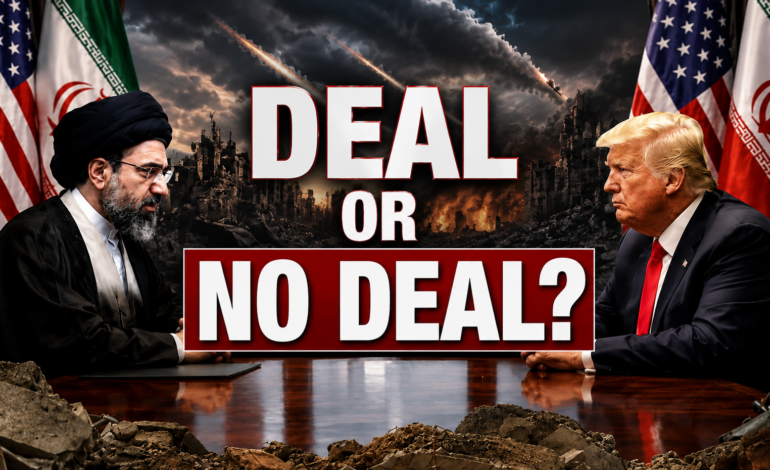

WASHINGTON, D.C. — Signs of a potential diplomatic breakthrough between the United States and Iran gained momentum over the past week, despite limited military exchanges between the two sides that remained below the threshold of a broader conflict and appeared designed to strengthen negotiating positions rather than derail ongoing talks.
According to reports from multiple international media outlets, U.S. and Iranian negotiators, working through Pakistani mediation, are nearing an agreement that would extend the current ceasefire for an additional 60 days while opening a new round of negotiations over the future of Iran’s nuclear program and the opening of the Strait of Hormuz.
Diplomacy advances amid continued military exchanges, Israeli opposition and uncertainty over Lebanon’s future
While officials in Washington have expressed optimism about a possible agreement awaiting President Trump’s approval, concerns remain that the negotiations could collapse under mounting political pressure, particularly from Israeli Prime Minister Benjamin Netanyahu, who continues to oppose arrangements that could strengthen and broaden Iran’s regional position.
The Lebanese front has emerged as a central point of contention, with Tehran reportedly insisting that any broader understanding with Washington include an end to hostilities involving Lebanon.
A proposed 60-day extension
The growing discussion surrounding a 60-day extension of the ceasefire reflects the difficult political position facing Trump, who is under pressure from domestic critics who accuse him of failing to achieve any of his stated objectives in Iran.
U.S. officials speaking to international media outlets, including the BBC and Axios, described negotiations as nearing completion.
Vice President J.D. Vance told reporters on Thursday that Washington and Tehran had made “substantial progress” toward extending the ceasefire, while cautioning that Trump had not yet made a final decision.
“We are exchanging views on some language issues, and we have made significant progress,” Vance said, expressing hope that negotiations would eventually produce an agreement acceptable to the president.
Iranian media, however, have offered a more cautious assessment. The semi-official Tasnim News Agency quoted a source close to the talks as saying that no final agreement has yet been completed or formally approved.
According to Axios, the emerging framework consists of a one-page memorandum of understanding that would serve as the basis for ending the conflict and launching broader nuclear negotiations.
Sources cited by the publication said the document would include an Iranian commitment not to pursue nuclear weapons, guarantees of unrestricted navigation through the Strait of Hormuz and an Iranian pledge to remove all naval mines from the strategic waterway within 30 days.
The proposal also reportedly includes mechanisms to facilitate humanitarian assistance to Iran and discussions regarding sanctions relief and the release of frozen Iranian assets.
Military pressure continues
Despite progress at the negotiating table, military tensions have not disappeared.
During the past week, U.S. forces reportedly struck targets in Bandar Abbas, while Iran responded with a ballistic missile launch toward a site in Kuwait.
Neither action resulted in a collapse of the ceasefire, which has remained in place since April 8.
Analysts suggest that both Washington and Tehran are using calibrated military pressure to strengthen their negotiating positions while avoiding a return to full-scale war.
For now, the ceasefire remains intact, but its future depends largely on political decisions still under consideration in Washington, amid domestic opposition and continuing Israeli objections.
Trump’s political dilemma
As prospects for a deal improve, questions are increasingly being raised about how a new agreement would differ from the 2015 nuclear accord negotiated under former President Obama.
Trump withdrew from that agreement during his first term, famously describing it as “the worst deal in history.”
Seeking to distinguish any future agreement from the Obama-era deal, Trump has suggested linking a potential understanding with Iran to an expansion of the Abraham Accords and broader normalization efforts involving additional Arab states, particularly Saudi Arabia.
Trump has repeatedly argued that any future agreement must prevent Iran from obtaining nuclear weapons while extending restrictions beyond those contained in the original 2015 accord.
The Obama agreement capped uranium enrichment at 3.67 percent for 15 years, sharply reduced Iran’s stockpile of enriched uranium and subjected the program to extensive international monitoring.
Many of the provisions currently being discussed, however, closely resemble elements already included in that earlier agreement.
One major difference involves Iran’s significantly expanded stockpile of enriched uranium, which has grown since Trump withdrew from the nuclear deal in 2018.
Trump has proposed several options for dealing with the material, including transferring it to the United States for destruction or eliminating it under international supervision either inside or outside Iran.
Strait of Hormuz remains a key pressure point
A major source of leverage for Tehran remains its influence over the Strait of Hormuz, through which roughly one-fifth of the world’s oil and natural gas supplies pass.
Iran’s ability to disrupt traffic through the waterway has complicated Washington’s efforts to pressure Tehran and strengthened Iran’s negotiating position.
Despite years of sanctions and threats of military action, Iran continues to reject U.S. demands for a complete end to uranium enrichment and is seeking broader concessions in return for any agreement.
Military preparations continue
Even as diplomatic efforts advance, both Washington and its regional allies continue preparing for the possibility of renewed conflict.
U.S. Treasury Secretary Scott Bessent warned against any attempt to impose transit fees in the Strait of Hormuz, threatening sanctions against countries or entities that facilitate such arrangements.
Meanwhile, Israeli media reported that military planners are preparing for the possibility of a future conflict involving Iran, Lebanon and Yemen.
According to Israeli officials, any future confrontation with Iran could begin suddenly and without warning, prompting extensive preparations by the country’s Home Front Command.
Israeli military officials have indicated that contingency plans assume a multi-front conflict and emphasize operational secrecy to preserve tactical surprise.
Lebanon’s future tied to regional negotiations
Developments in Lebanon remain closely linked to the outcome of U.S.-Iran negotiations.
Israeli forces expanded military operations in Lebanon this week, including strikes near Beirut after weeks in which the capital had largely been spared.
According to Lebanon’s Ministry of Public Health, the death toll from Israeli attacks since renewed hostilities began on March 2 has reached more than 3,300 people, with more than 10,000 wounded.
Iran has insisted that Lebanon be included within any broader regional arrangement, while Israel has sought to separate the Lebanese front from negotiations with Tehran.
The escalation comes as attention turns to Washington, where new talks involving Lebanese and Israeli representatives are expected.
Lebanese President Joseph Aoun and Prime Minister Nawaf Salam have continued to support direct negotiations despite opposition from many political factions.
In a sharply worded speech marking Resistance and Liberation Day, Hezbollah Secretary-General Naim Qassem warned that public pressure could be used to challenge and topple the Lebanese government if it continues pursuing direct negotiations with Israel.
Qassem argued that any lasting cessation of hostilities ultimately depends on a broader regional agreement between Washington and Tehran and reaffirmed Hezbollah’s commitment to maintaining its weapons until a national defense strategy is adopted.
His remarks sparked significant reactions both inside Lebanon and internationally, drawing criticism from political opponents and a formal rebuke from U.S. Secretary of State Marco Rubio.
Meanwhile, Hezbollah’s parliamentary bloc, Loyalty to the Resistance, accused Israel of seeking to impose surrender on Lebanon and reiterated its opposition to direct negotiations with Israel, while criticizing the Lebanese government for what it described as continued concessions under American pressure.


Leave a Reply