



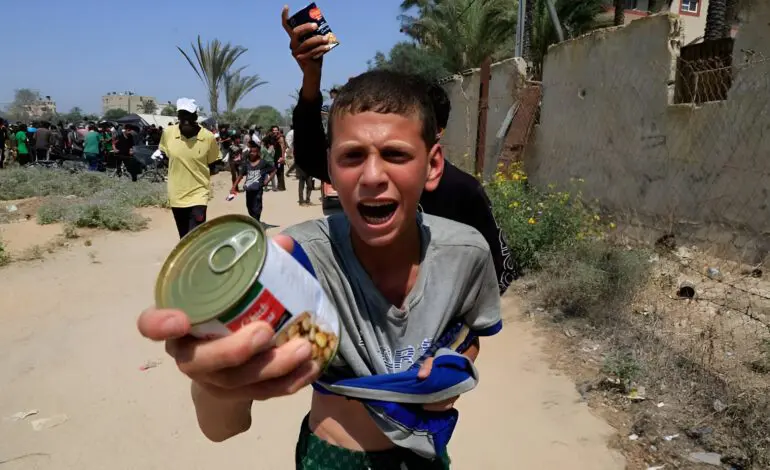

While the Israeli killing machine sharpens its swords to pounce on Gaza City with the declared goal of disarming Hamas, the Trump administration is undertaking a similar mission in Lebanon by exerting maximum pressure on the Lebanese government to disarm Hezbollah. The push is to force the Lebanese Army into confrontation with Hezbollah resistance forces without offering any reciprocal guarantees regarding Israeli occupation or ongoing daily aggressions — going as far as threatening to leave Lebanon to its fate should it refuse to comply with the demands of Netanyahu’s extreme right government. Meanwhile, the fate of Syria grows increasingly uncertain as Israel escalates its unchecked military attacks and destruction across its territory amid a rise in separatist movements rejecting the “one-color” regime in Damascus.
Prolonging the war on Gaza
The far-right coalition led by Benjamin Netanyahu shows no intention of halting its occupation of the Gaza City or the forced displacement of its remaining residents. The justification is that a “blitz” ground operation will be enough to subdue Hamas and compel it to accept Israeli conditions for a ceasefire — chief among them, the disarmament of Hamas.
Despite the occupation army’s warnings about the heavy human and material costs of occupying the devastated city — and expert estimates that the operation could last a full year — Netanyahu insists on prolonging the war. He and his cabinet extremists claim the operation will take only a few months, ignoring the concerns of the exhausted Israeli army and the mounting popular protests inside Israel, which accuse him of abandoning Israeli captives in Gaza for his own political survival.
Israeli Finance Minister Bezalel Smotrich was more explicit in revealing the war’s objectives. He predicted the operation would last until the end of this year at most, urging the government to begin annexing parts of Gaza if Hamas refuses to disarm.
During a press conference, Smotrich presented his plan for “victory in Gaza by year’s end”, which calls for evacuating civilians from Gaza City and from the northern and central Strip, pushing them south, and then exterminating Hamas fighters.
“Those who do not die by bullets will die of hunger,” he declared.
He added that if Hamas refuses, Israel should annex one part of the Strip each week for four weeks until most of Gaza is under full Israeli control. He demanded cutting off water, electricity and food as means to achieve this.
“This can be done in three to four months,” he said, calling on Netanyahu to adopt the plan immediately and in full.
Smotrich’s statements come as the occupation army intensifies its assault around Gaza City in preparation for occupying it, raising alarm among humanitarian groups about the fate of civilians.
Hamas denounced Smotrich’s remarks as an explicit admission of a policy of genocide.
“Smotrich’s comments represent a public call for the continued crimes of the occupation army until our people are exterminated and displaced. They are also an official admission of using starvation and siege against innocent civilians as a weapon, which constitutes a war crime under the Geneva Conventions and the Rome Statute.”
Hamas stressed that this is not an isolated extremist view, but an official government policy that has been implemented for nearly 23 months — by blocking food and medicine, bombing relief centers, destroying infrastructure and forcing displacement.
Meanwhile, Israel continues encircling Gaza City, expanding the bombardment as limited evacuations occur within the city’s corridors. On Wednesday, the Israeli government’s coordinator of activities called for the evacuation of Gaza City, saying, “There is no escape from evacuating the city” and claimed aid distribution would be more concentrated in the southern Strip.
Yet the Israeli army itself doubts the mission can be achieved within the time frame Netanyahu and his ministers proclaim — especially amid a recruitment crisis, reserve call-ups and ongoing refusal of the ultra-Orthodox (a core Netanyahu constituency) to serve in the depleted military. The army has admitted to 900 officers and soldiers killed and 6,210 wounded on the Gaza front since October 7, 2023.
Yedioth Ahronoth revealed a sharp division within the military’s top leadership between those advocating a “partial deal” now and others insisting on a comprehensive agreement involving the release of all hostages and the end of Hamas’ rule in Gaza. Chief of Staff Eyal Zamir seeks a hybrid approach — “combining military pressure with negotiations” through a phased plan: evacuating civilians from Gaza City, then escalating military operations in areas believed free of captives, while introducing limited humanitarian aid to reduce reserve fatigue and restore some international legitimacy.
Last week, the Israeli army once again committed a war crime by shelling the Nasser Medical Complex, killing at least 22 people, including health workers, emergency staff and five journalists. Israel faced international condemnation, but Netanyahu dismissed the massacre, caught on video, as a “tragic mistake.”
Netanyahu has also brushed aside army dissent and public protests against “Operation Gideon Chariots 2” in Gaza City. Nor does he appear concerned about Israel’s deteriorating global image or European threats to recognize the State of Palestine. Instead, he boasted of preventing Palestinian statehood as part of his “achievements”, showcasing his commitment to “Greater Israel” after Monday’s security cabinet meeting on Gaza — where the fate of hostages and Egyptian-Qatari mediation were not even discussed.
“I promised to prevent the establishment of a Palestinian state,” Netanyahu reiterated. “We are achieving this together. We are building and holding onto our land, our homeland.”
Israeli media confirmed the cabinet ended its meeting without addressing hostages or ceasefire negotiations, even though Hamas had just accepted a proposal days earlier.
Opposition leader Yair Lapid blasted the Netanyahu government.
“Meeting without discussing a hostage deal is another moral disgrace,” Lapid said. “There is a deal on the table to bring the hostages home and end the war, but the government ignores it. This is a national shame.”
Every week, hundreds of thousands of Israelis march nationwide demanding an end to the war on Gaza and the release of 50 hostages still held in Gaza (alive or dead). Former IDF chief and ex-cabinet member Gadi Eisenkot accused Netanyahu of dodging a deal.
“The majority of the public, the Knesset and even the government support a deal, but Netanyahu jumps from one initiative to another, ignoring public opinion out of fear of losing his coalition.”
Meanwhile, Israel’s killing and starvation machine continues devastating Gazans daily. Qatar and Egypt have stressed their ongoing mediation efforts, though Israel has yet to formally respond to the ceasefire proposal delivered by mediators on August 18, which Hamas has already accepted.
In Washington, President Trump has remained silently complicit. He briefly said he hoped the war would end within weeks — only to retract his statement the next day.
U.S. pressure on Lebanon
“Disarmament first… and without guarantees.” That was the message brought by a U.S. delegation to Beirut last week, just before Lebanese Prime Minister Nawaf Salam’s government was set to receive the army’s plan on Hezbollah disarmament. Netanyahu praised Lebanon’s government, expressing willingness to “support” Beirut’s efforts to disarm Hezbollah — but conditioned any Israeli reduction of forces in Lebanon on the success of those efforts.
Parliament Speaker Nabih Berri expressed frustration.
“The Americans came to us with the opposite of what they promised,” he told Asharq Al-Awsat.
He explained that U.S. envoy Tom Barrack, while publicly promoting a “step-by-step” approach, insisted privately (along with other delegation members, including Morgan Ortagus) that Hezbollah must disarm before any Israeli concessions such as withdrawal or halting daily attacks.
Berri said the delegation “brought nothing from Israel, complicating matters again.”
“Any issue that leads to internal strife is unacceptable,” he warned when asked about the cabinet’s upcoming September 2 session on the army’s disarmament plan
The U.S. delegation was forced to cancel a planned tour of southern Lebanon — including Tyre and Khiam — due to public protests. The tour was meant to promote promises of an “economic zone” on the ruins of southern villages to attract investment.
Barrack further fueled outrage the day before by telling Lebanese journalists during a Presidential Palace press conference to act “civilized, not animalistic.”
Hezbollah’s Deputy Secretary-General Sheikh Naim Qassem reaffirmed rejection of disarmament,
“Israel may occupy, destroy and kill, but we will confront it with defense and sacrifice so it cannot achieve its goals.”
He urged the government to “correct its sin” and retract its decision, presenting a roadmap:
-
Expel Israel from Lebanese land.
-
Halt aggression.
-
Release prisoners.
-
Begin reconstruction.
“Then come and discuss a defensive strategy,” Qassem said. “Sovereignty comes first, because the alternative to resistance is surrender.”
Meanwhile, Hezbollah and the Amal Movement continue exercising restraint, avoiding mobilization in the streets despite mounting pressure.
On Thursday, the U.N. Security Council unanimously extended UNIFIL’s mandate “for the last time” until December 31, 2026. The resolution calls on Israel to withdraw from areas north of the Blue Line and five Lebanese positions, while urging Lebanon to deploy in vacated areas with U.N. support.
Lebanese President Joseph Aoun said he hoped the extension would be “an opportunity to save Lebanon, stabilize our southern border and confirm sovereignty over all territory.”
Violations in Syria
Israel continues escalating militarily in southern Syria, even as U.S.-French mediation attempts to negotiate with Syria’s transitional authorities. At the same time, Sweida is consolidating its self-rule amid growing calls for secession extending to the Syrian coast.
Despite major territorial gains since December 2024, Israel is pressuring Damascus for further concessions through raids and threats to cement facts on the ground.
Most recently, Israeli forces established outposts in Rakhla, a strategic village in Mount Hermon overlooking three key roads linking Damascus to Baalbek and Beirut. With this, Israeli troops now sit only 20 km from Damascus, 50 km from Baalbek and 60 km from Beirut — within artillery range of vital highways such as Masnaa–Beirut and Zahle–Beirut.
On Tuesday, Israeli shelling killed seven Syrians, including six soldiers, near Damascus and in the south.
An Israeli military spokesman claimed these were “routine operations” prompted by security concerns since the fall of Bashar al-Assad’s government in December 2024, adding that Israel had a “commitment to protect the Druze minority” in Sweida, where separatist demands have grown after massacres by the regime forces and allied militias.
During a ceremony welcoming Mazid Khaddaj (Abu Diab), the new leader of the Men of Dignity Movement in Sweida (which recently merged with 40 local factions to form the “National Guard”), Druze religious leader Sheikh Hikmat al-Hijri called for international support for an autonomous Druze region.
“What happened in Sweida aimed to exterminate the Druze community. We need regional and global backing for a separate entity.”
Hijri thanked “the countries that stood with us, especially the U.S. and Israel”, vowing loyalty. He also highlighted strong ties between Sweida and both the Syrian Democratic Forces (SDF) and the Alawite groups on the coast.
Meanwhile, a new Political Council of Central and Western Syria issued its founding statement rejecting Ahmed al-Sharaa’s “one-color government.” The council includes Latakia, Tartus, Homs and parts of Hama, calling for secular, just governance modeled on Kurdish-administered zones like Sheikh Maqsoud in Aleppo.
The council demanded referral of “genocide, crimes against humanity and war crimes” to the International Criminal Court and called on the U.N. to declare central and western Syria disaster zones requiring urgent aid.
Economically, Syria’s interim government — formed after armed groups took Damascus — announced its first decisions: raising the price of subsidized bread by 900 percent and fully liberalizing fuel prices, ending more than 50 years of subsidies. U.N. figures warn of a food crisis threatening 3 million Syrians and more than half of the 25.6 million population suffering food insecurity.
The Yemen front
As part of its ongoing attacks on Yemen in retaliation for its support of Gaza, Israel bombed Sanaa on Thursday. Israel also claimed assassinations, which Ansarallah denied.
The strikes coincided with the weekly address of Abdul-Malik al-Houthi, who reaffirmed Yemen’s commitment to supporting Gaza and expanding Yemen military capacity.
“Our missile forces delivered the good news of a major achievement — the production of cluster warheads for the Palestine-2 missiles. This is a significant breakthrough that alarmed the Zionist enemy.”
He described Israeli attacks on fuel and power stations as “failed aggression” targeting civilian infrastructure.
“The Zionist enemy attacks services for the entire population to say, I am targeting all of you equally,” al-Houthi said.


Leave a Reply