


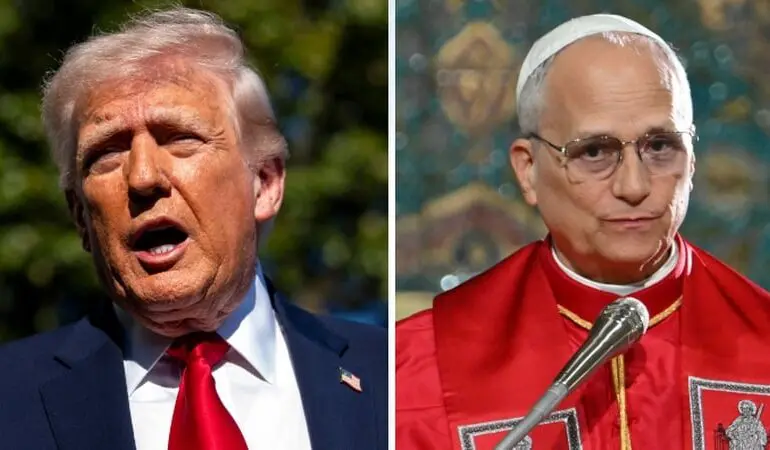

A rare and escalating confrontation between President Trump and Pope Leo XIV has exposed deep global divisions over the ongoing war on Iran, placing political power and moral authority on a direct collision course.
At the center of the dispute is a fundamental disagreement over war, diplomacy and the role of religion in global conflict, a clash that has quickly evolved into one of the most unusual and consequential public feuds between a U.S. president and a pope in modern history.
A war of words over U.S.-Israel war on Iran
The confrontation intensified after Pope Leo sharply criticized the U.S.-Israel war on Iran, warning against what he described as the dangerous logic of power and militarism.
In recent remarks, the Chicago-born pontiff condemned what he called a “delusion of omnipotence” driving global conflicts, cautioning leaders against invoking religion to justify war and urging a return to diplomacy and restraint.
Without naming Trump directly, the Pope warned that the world is being “ravaged by a handful of tyrants”, accusing political leaders of exploiting faith for military and economic gain rather than investing in human welfare.
The pope has repeatedly framed his position in moral and spiritual terms, emphasizing that the Church’s role is to promote peace, dialogue and reconciliation, not to align with political power or military campaigns.
Trump responds with sharp personal attacks
President Trump responded forcefully, turning the disagreement into a personal and political confrontation.
He publicly criticized Pope Leo as “very liberal” and “weak” and refused to apologize for his remarks, saying the pope had gone public with his criticism first.
Trump also dismissed the Vatican’s position on the war, insisting that Iran represents a major global threat and that strong action is necessary. In remarks outside the White House, he said it is “very important” for the pope to understand the realities of the situation.
The president’s rhetoric went even further, including a controversial social media post depicting himself in a Christ-like image — a move that drew widespread criticism and added a symbolic dimension to the dispute.
A deeper ideological divide
Beyond the personal exchanges, the clash reflects a much broader divide in worldviews.
Trump’s approach emphasizes national security, military deterrence and a willingness to use force to confront Iran. By contrast, Pope Leo has consistently advocated for diplomacy, de-escalation and moral restraint, arguing that war ultimately undermines human dignity and global stability.
Since assuming the papacy in 2025, Leo has made peace-building a central theme of his leadership, referencing conflicts in Iran, Gaza and Ukraine while calling for global solidarity over confrontation.
He has also warned that democratic systems risk losing their moral foundation when power is exercised without restraint, cautioning against what he described as the erosion of ethical leadership.
This divergence — between a nationalist, security-driven doctrine and a global, moral framework — has turned the dispute into more than a disagreement over policy. It has become a symbolic struggle over how power should be used in a time of war.
Tensions spill beyond rhetoric
The fallout from the feud has extended beyond words.
At the Vatican, visitors and Catholic observers have expressed concern over the president’s attacks, with some describing them as unprecedented and inappropriate toward the head of the Catholic Church.
At the same time, the dispute has played out against the backdrop of Pope Leo’s international tour, including visits to North and Central Africa where he has emphasized interfaith dialogue, peace-building and coexistence.
Even as the political tensions intensified, the pope has largely avoided direct escalation, choosing instead to reiterate his message of unity and spiritual responsibility.
A global moment with local implications
The clash comes at a critical moment in the broader Middle East conflict, as the U.S. expands its military and economic campaign against Iran and attempts to shape the regional balance of power.
For many observers, the dispute highlights a deeper question: Who defines legitimacy in times of war, political leaders or moral authorities?
The answer remains unresolved.
What is clear is that the Trump–Leo confrontation has moved beyond a simple policy disagreement. It has become a defining moment in the intersection of religion, politics and global conflict — one that underscores how deeply divided the international community remains over the path forward.
A rift unlikely to fade
Despite the intensity of the exchange, neither side appears willing to back down.
Trump has shown no indication of moderating his rhetoric, while Pope Leo has continued to speak out against the war, framing his position as a moral obligation rather than a political stance.
As the war on Iran continues and regional tensions escalate, the divide between Washington and the Vatican is likely to deepen, reflecting not only a disagreement between two leaders, but a broader struggle over the values shaping the global order.
Leave a Reply