



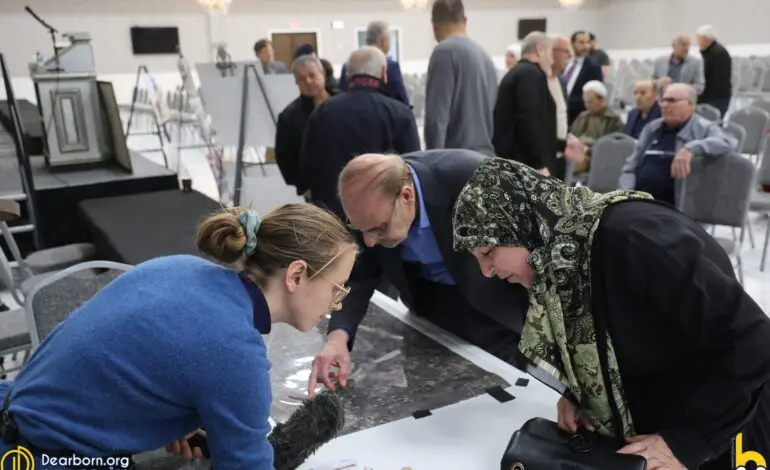

DEARBORN — The Bint Jebail Cultural Center hosted a large community gathering in Dearborn Tuesday evening with Belle Cushing, a reporter for the Wall Street Journal, as part of efforts to document the scale of suffering and losses endured by Lebanese Americans and their families in Lebanon as a result of ongoing Israeli attacks on villages and towns in southern Lebanon, the Bekaa Valley and Beirut’s southern suburbs.
During the gathering, which included the presentation of documentary photographs showing destroyed homes and businesses belonging to Lebanese Americans, Wayne County Commissioner Sam Baydoun highlighted the scale of the humanitarian catastrophe inflicted upon Lebanese civilians.
Baydoun noted that systematic Israeli attacks since the 1980s have been the primary reason behind the displacement of thousands of Lebanese immigrants who today make up one of the largest segments of the Arab American community in Metro Detroit.
Baydoun, who traces his roots to the southern Lebanese city of Bint Jbeil, said Lebanese Americans have formed an integral part of the American social fabric since the beginning of the last century, recalling sacrifices made by Lebanese immigrants over generations — from those who died aboard the RMS Titanic when it sank to the current tragedy involving the destruction of their towns, villages and neighborhoods by bombs “funded with our own tax dollars,” as he put it.
He pointed to the immense material and emotional losses suffered by Lebanese Americans, as well as the tragedies endured by their relatives and loved ones in Lebanon. However, he stressed that no matter how great the financial losses may be, they pale in comparison to the sanctity of human life lost during the heavy bombardment and repeated Israeli airstrikes targeting Lebanese cities and villages in recent years.
“No building or piece of land can ever compare to the value of human life,” Baydoun said.
He compared the devastation inflicted upon Bint Jbeil and neighboring villages to the destruction of the atomic bombings of Hiroshima and Nagasaki and described the systematic Israeli violations against Lebanese civilians as “a campaign of ethnic cleansing very similar to what we witnessed in Gaza.”
Baydoun also questioned the absence of legal and moral limits capable of restraining unlimited support for Israel.
“No country should be above international law, and no civilian should pay the price of geopolitical calculations,” he said.
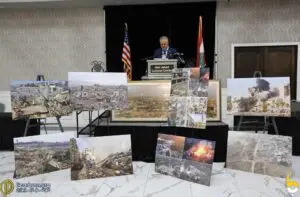
Wayne County Commissioner Sam Baydoun speaks at the gathering behind a display of pictures of some of the destroyed homes during the Israeli invasion of south Lebanon. – Photo by Dearborn.org
He urged the Wall Street Journal to uphold ethical and objective journalistic standards in its reporting.
“We respectfully ask reporter Belle Cushing to produce a fair, balanced and honest report,” Baydoun said. “We do not want our pain distorted into a different narrative or our grief politicized in a way that ignores the immense humanitarian suffering in Lebanon.”
He called on the prominent newspaper to convey “our story in the humane way we deserve.”
For her part, Cushing asked dozens of attendees to provide documentation and evidence related to the systematic destruction and demolition of residential neighborhoods in their towns and villages.
The gathering soon evolved beyond a formal meeting into an open platform filled with emotional testimony from community members sharing stories tied not only to physical destruction, but also to memories, homes and personal histories.
Attendees emphasized the deep emotional impact caused by the destruction of historical landmarks and social symbols in their communities. They argued that demolishing homes represents far more than the loss of buildings or property — describing it instead as a systematic attempt to erase the memory of an entire generation emotionally tied to its land and roots.
Participants also stressed that the destruction of these communities and their architectural and social heritage seeks to strip residents of their historical identity and sever their connection to the past, making reconstruction not merely a physical effort, but first and foremost a battle to reclaim memory itself.
In recent months, the Lebanese American community in Metro Detroit has also witnessed intensified legal advocacy efforts culminating in what organizers describe as the first federal legal action of its kind in the United States.
The Arab American Civil Rights League announced plans to launch a federal legal effort aimed at holding the U.S. administration accountable for the destruction of American-owned property in Lebanon during the ongoing Israeli war.
The organization intends to file a class-action lawsuit against the U.S. Department of State and the United States Department of Defense on behalf of hundreds of affected individuals.
The lawsuit will rely in part on the Leahy Law to argue that continuing to supply weapons and military funding to entities involved in the destruction of residential neighborhoods owned by Americans constitutes legal negligence amounting to participation in the violations themselves, thereby placing the U.S. government under direct responsibility for damages inflicted upon its own citizens.

Leave a Reply