



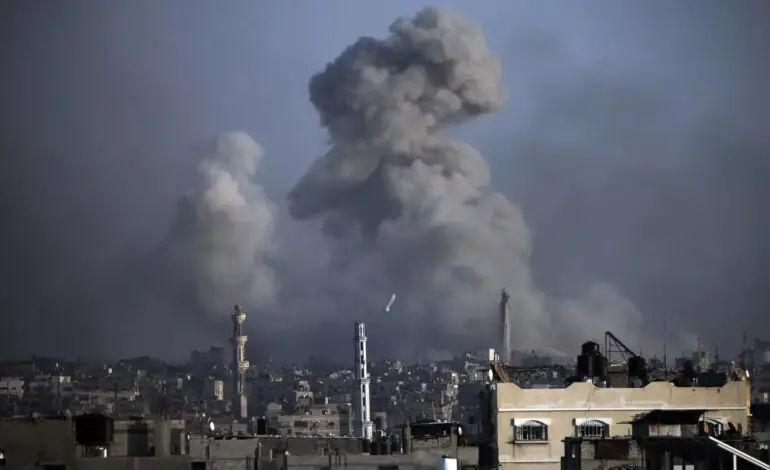

In the days after October 7, 2023, then-President Biden cautioned Israeli Prime Minister Benjamin Netanyahu not to make the same mistakes the U.S. made following 9/11. Biden never publicly spelled out his meaning, but it was understood as a warning to Netanyahu: Don’t overreact or overreach, as President George W. Bush had done by invading and occupying Iraq and proposing a U.S.-led democracy agenda to “transform” the Middle East. That war lasted more than a decade with tremendous cost in lives, treasure and U.S. prestige, emboldened Iran, and spawned extremist groups like ISIS.
It was sound advice — maybe the soundest Biden had to offer the Israelis during his tenure. The problem, of course, was that Netanyahu didn’t listen, and the U.S. did nothing to restrain the Israelis. In fact, the Biden administration did exactly the opposite, embracing Netanyahu’s goals in Israel’s assault on Gaza. It gave Israel tens of billions in military arms and defended its actions at the United Nations. As it became clear that the Israelis were committing war crimes and genocide, Biden and company threatened sanctions on the international jurists investigating these crimes.
When the U.S. administration did timidly challenge Netanyahu to think about “the day after” and offer a few ceasefire proposals, the Israelis never clarified their “day after” thinking, nor fully accepted the proposals’ terms. And the U.S. did nothing to rebuke them.
The Biden crowd should have known that neither Netanyahu nor his governing coalition wanted to end the war. They were driven by fantasies of Greater Israel: evicting Palestinians from Gaza, annexing the West Bank and expanding its “security perimeter” in parts of Lebanon and Syria.
As the war dragged on, it metastasized into a regional conflict. Lebanon’s Hezbollah and Yemen’s Houthi government entered the fray with disastrous consequences. Israel responded by assassinating Hezbollah’s leaders and cadre in a massive bombing campaign and a terrorist attack in Lebanon and extending the war into Syria and Iran.
A re-elected President Trump followed the Biden playbook, giving Israelis a free hand and political backing, while also floating grandiose and often contradictory ideas.
He cautioned Netanyahu against bombing Iran and then joined in the battle. He floated the now-infamous “Gaza Riveria” plan, and then embraced elements of the Arab peace plan — with Netanyahu’s amendments.
Announcing the plan, President Trump boasted that it was “the greatest day in human history.” Now, one month later, Israeli bombs continue falling on Lebanon and Gaza, though with less frequency and intensity, and there’s been an exchange of captives between Israel and Hamas. Otherwise, little has changed.
Palestinians in Gaza are still strangled by a constrictive Israeli occupation. Over one million souls are crammed into congested tent camps in the less than one-half of Gaza, from which Israelis have withdrawn, with little or no access to food, clean water, medical attention, electricity or sanitation facilities. Battles continue between Hamas and clan-led groups armed by Israel. And Israel shows little interest in surrendering its newly expanded Gaza “security perimeter” and moving to the “peace plan’s” next phase.
Israel has established five military outposts in southern Lebanon and continues to bomb Lebanese villages and U.N. teams there. And Israel has expanded its occupation of southern Syria and insists it will remain to “protect” Syria’s Druze population.
While withdrawing Knesset legislation to formally annex the West Bank, Israel’s military and organized settler movement continue to seize land, terrorize and evacuate villages, deny Palestinians the opportunity to harvest their olive crop — vital for survival — and detain and kill Palestinians protesting this oppression.
Biden’s 2023 cautionary note was clearly ignored. Like Bush’s disastrous war and occupation of Iraq to “transform the Middle East” only led to a decade of war and consequences still taking a toll in human suffering across the region, Netanyahu’s overreach, supported by the U.S., has indeed transformed the Middle East — but not for the better. Israel is more deeply enmeshed than ever in active conflict on multiple fronts, with no end in sight.
Israel’s problem is that its occupations and conflicts are costly and require U.S. support. With Democrats and a small but growing number of Republicans increasingly disinclined to financially underwrite these costs, the days of Israel’s deplorable behaviors may be numbered.
– Dr. James Zogby is the founder and president of the Washington based Arab American Institute



Leave a Reply