



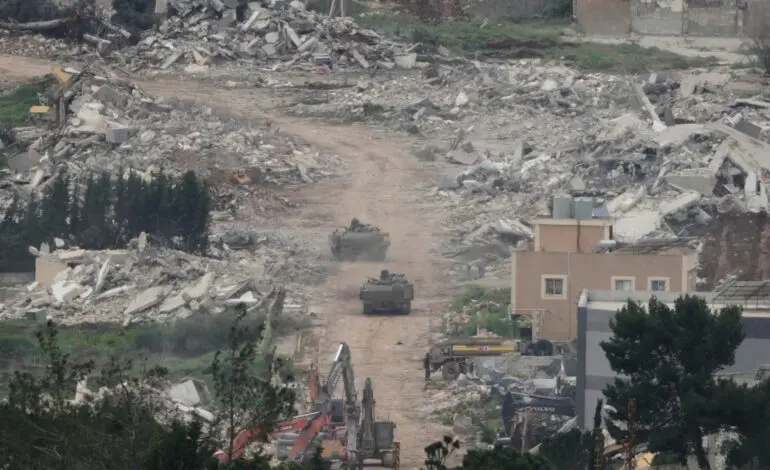

The Lebanese community in the Dearborn area — particularly those from southern Lebanon, who make up one of the largest segments of the diaspora in Michigan — is living in a constant state of anxiety and anticipation over the fate of their hometowns and villages amid long-standing Israeli ambitions they have witnessed for decades.
As news of killing, destruction, looting and bulldozing spreads across border villages and towns, one painful question dominates the minds of southern expatriates: Will we return and rebuild again?
In southern Lebanon, destruction is not measured only by the number of buildings reduced to rubble, but by the heavy void it leaves in people’s lives. Homes built over years, often decades of labor abroad, have collapsed in minutes. Lands passed down through generations have been burned or leveled. Public squares where they played, mosques where they prayed and even cemeteries where their loved ones are buried, there where they have lost their defining youth and hopes under bombardment.
From Tyre to Bint Jbeil, Marjayoun and Hasbaya, people are no longer speaking of another passing war, like those they have endured since the creation of the Israeli state, but of an existential battle to defend land, history and inherited identity.
For southerners, whether in Lebanon or in the diaspora, the current war is not merely another military confrontation. It is a moment of collective loss repeating itself in different forms: the loss of a home once meant for return to see loved ones, land that represented livelihood and belonging, memories built within walls and even the basic sense of safety and comfort. With every airstrike, it is not just stone that is destroyed, entire lives built over decades are erased in a relentless cycle of destruction and rebuilding.
Systematic destruction
In its latest plans of destruction and displacement, Israel drew a new line last week — the so-called “yellow line” — under the pretext of creating a security buffer zone. The move paves the way for the displacement of residents from dozens of border towns and villages, many of which are home to tens of thousands of Lebanese Americans in the Detroit area, and their relatives abroad, most notably Bint Jbeil.
Within the areas now falling inside this “yellow line”, extending between four and 10 kilometers into Lebanese territory, Israeli intentions appear increasingly clear. From Naqoura, Alma Al-Shaab, Al-Bayyada, Shamaa, Tayr Harfa and others in the Tyre district, to Aita Al-Shaab, Ramia, Debel, Ain Ebel, Yaroun, Maroun Al-Ras and Bint Jbeil, and further to the Marjayoun and Hasbaya villages — these names no longer refer to vibrant, inhabited communities, but have become, in the eyes of many, a list of targeted places — an erasure of history, roots and collective memory.
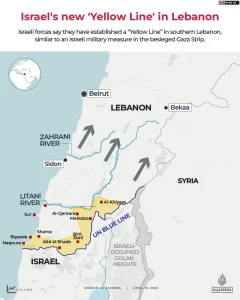
Israeli occupation forces have claimed a “buffer zone” spanning approximately 602 square kilometers, encompassing roughly 62 towns and villages, including key areas like Bint Jbeil and border towns in Marjayoun. As of April 21, Israeli occupation forces were reported to be occupying 47 of these villages.
There, the boundaries between streets and neighborhoods have disappeared. The rubble is one, the devastation continuous. From afar, expatriates wait for satellite images or brief video clips, trying to identify a landmark — any landmark — to determine the fate of a home, a building or even an orchard planted by their ancestors.
Hassan M. from Aitaroun said the neighborhood where he grew up “no longer exists”, explaining that he can no longer even pinpoint the exact location of his home after entire blocks were flattened.
Mohammad N. from Blida said the orchards that once separated homes and gave the village its character have turned into blackened, burned land. Trees planted by generations are gone.
In Yaroun, Ali J. said even the names of streets and neighborhoods, once tied to families, no longer mean anything after everything that connected name to place has vanished.
The family home
In Dearborn, Salma F. spoke about her family home in Barashit, built over many years of labor abroad.
“Room by room, floor by floor — after years of saving and hard work, the house was finally completed the way we wanted,” she said. “It wasn’t built overnight. It took years, with every money transfer. Today, nothing is left. We didn’t just lose a house — we lost a lifetime of effort.”
In Yaroun, Ali J. said his home was still under construction when bombardment destroyed the project in moments.
“It’s as if years were erased,” he said.
Abu Ali Nasser, originally from Bint Jbeil and now living in the United States, told a story repeated across the diaspora. After years of working day and night, sending money to his father in Lebanon to oversee construction, the house took nearly a decade to complete. He was only able to sit in it once before it was destroyed.
“Will we live long enough to return and rebuild? And will our children rebuild again?” he asked.
“But we will rebuild,” he added “…We always rebuild.”
Between the question and the answer lies the tension between despair and determination.
In Mais Al-Jabal, Maha Wahid said she had fully furnished her home after years of work, only for it to be completely destroyed.
“Not a single stone remains,” she said.
The home, for her, was not just a structure but a long-awaited project of stability and return.
Another woman from Yaroun, now in Michigan, scrolled silently through her phone between two images, one of her home full of life, and another reduced to rubble.
“This was my home… and this is what it became,” she said, her voice heavy. “It’s not the house… I lost my memories — with my siblings, the scent of my parents, every detail I lived.”
In another testimony, one expatriate wrote on Facebook, addressing his home:
“This is my house. Forgive me, my home — I built you three times and couldn’t protect you. Don’t tell me God will compensate me. My home is my soul, my family, my memories. It was a place where loved ones gathered. My home is not just stones.”
Bint Jbeil: A city erased
In Bint Jbeil — home to prominent Lebanese American families such as Bazzi, Baydoun, Saad and Hammoud — the marketplace was once the heart of daily life. Every Thursday, surrounding villages gathered there.
“Thursday was the day of the market — the day of the people,” one expatriate recalled.
Today, much of that market has been destroyed. Nearly half has become rubble.
“We didn’t just lose our shops, we lost the place that brought us together,” he said.
The deepest pain, however, is tied to “Hakourat Noss Al-Dayaa”, where the historic grand mosque once stood before being destroyed. Dating back to the Roman era, the mosque was not just a place of worship, but the cultural and social heart of the city.
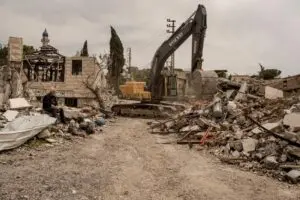
A man who lost two of his sons searches for the body of one of them in the rubble, the day after the cease-fire took effect, in Arnoun, Lebanon, on April 17. – Photo by
Total devastation
The destruction extends far beyond homes. Orchards have been burned entirely. Olive trees — which take decades to grow — have disappeared in days.
“This is not the loss of a season… it is the loss of a lifetime,” said a resident from Bint Jbeil.
Even cemeteries have not been spared. Salma said she no longer knows where her father is buried after all landmarks vanished. This loss transcends material damage, it severs the connection between people and their past.
Schools and hospitals, once symbols of stability, have also been destroyed or rendered inoperable.
Memory documented in exile
Social media have become an open archive of loss. People share images of their homes before and after destruction — proof that what once existed no longer does.
For expatriates, the pain takes a different but equally harsh form. Sitting in Michigan, they watch their homes collapse, their land burn and their villages disappear — unable to intervene.
“The hardest thing is watching everything fall apart… and being unable to do anything,” said Mohammad from Bint Jbeil.
“This war did not start today… it began in 1948,” said Mariam from Blida.
For her, today’s events are part of a long history — from the 1978 invasion to 1982, through occupation until 2000, and the wars of 1996 and 2006.
Each time, people returned and rebuilt.
“We will return… and rebuild”
But today feels different. For the first time, everything is being destroyed at once, homes, land, markets, schools, hospitals, cemeteries and memory itself.
Yet one answer remains constant among southerners when asked about the future.
We will return and rebuild.
“The invaders destroy, but the people of the land rebuild — with stone and memory,” Hadi D said. “They revive the place because they carry it within them. No matter how powerful Israel’s destruction machine is, it can erase form — but not meaning. We will return, clear the rubble and rebuild again.”


Leave a Reply