



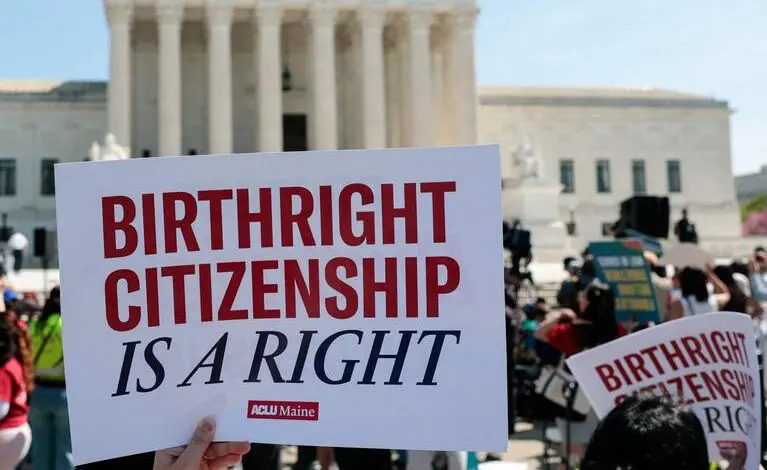

WASHINGTON, D.C. — The U.S. Supreme Court delivered a landmark victory for constitutional protections on June 30, rejecting President Trump’s attempt to restrict birthright citizenship through executive action and reaffirming that the right is guaranteed by the Fourteenth Amendment of the U.S. Constitution.
The Court ruled 6-3 that Trump’s executive order seeking to deny automatic U.S. citizenship to certain children born on American soil violates the Constitution and cannot stand. Legal scholars described the decision as one of the most consequential constitutional rulings in recent years, reaffirming that the president’s authority, no matter how broad, cannot override rights explicitly protected by the Constitution.
For millions of immigrant families across the United States, including Arab Americans, the ruling carried a broader message: constitutional rights do not change with changing administrations, and the future of children born in the United States cannot be subject to shifting political agendas.
From the White House to the Supreme Court
The legal battle began on the first day of Trump’s second term, when he signed an executive order directing federal agencies to deny automatic U.S. citizenship to certain children born in the United States if neither parent was a U.S. citizen or lawful permanent resident.
The administration argued that the order was intended to curb illegal immigration and eliminate what it called “birth tourism”, in which foreign nationals travel to the United States specifically to give birth so their children automatically receive U.S. citizenship.
Trump’s legal team contended that the phrase “subject to the jurisdiction thereof” in the Fourteenth Amendment does not apply to everyone born within the United States and argued that the constitutional provision had been interpreted too broadly over time.
The executive order immediately faced widespread legal challenges. A coalition of states, including Michigan, along with major civil rights organizations filed lawsuits in federal court, arguing that the president had exceeded his constitutional authority.
Michigan Attorney General Dana Nessel joined the legal challenge, maintaining that the executive order plainly violated the Constitution. Following the Court’s ruling, Nessel called the decision “a historic victory for the rule of law”, saying that birthright citizenship remains one of the nation’s fundamental constitutional guarantees.
After conflicting rulings in lower federal courts, the case reached the Supreme Court, which reaffirmed that birthright citizenship is constitutionally protected and cannot be redefined by executive order. The Court declared Trump’s order unconstitutional and invalid.
Civil rights organizations welcome the decision
Civil rights and immigrant advocacy organizations widely praised the ruling, which described it as a victory for the U.S. Constitution, the rule of law and immigrant communities.
The American Human Rights Council (AHRC-USA) said the decision reaffirmed that the Constitution remains the supreme law of the land and that the Fourteenth Amendment cannot be circumvented through executive action. The organization said the ruling preserves one of the cornerstones of American democracy for more than 150 years.
The American-Arab Anti-Discrimination Committee (ADC) also welcomed the decision, saying the Court rejected an attempt to reinterpret birthright citizenship through presidential authority. The organization emphasized that citizenship is not a privilege granted or revoked by governments, but a constitutional right.
Meanwhile, the Michigan Immigrant Rights Center (MIRC) called the ruling a major victory for Michigan families and all Americans, saying it confirms that the Constitution, not the president, determines who is an American citizen and prevents widespread legal uncertainty that could have affected millions of families.
A Constitutional principle dating back more than 150 years
Birthright citizenship traces its constitutional roots to 1868, when the Fourteenth Amendment was ratified following the Civil War to guarantee equal citizenship and prevent future governments from denying citizenship to entire classes of people.
The Supreme Court further cemented that principle in its landmark 1898 decision in United States v. Wong Kim Ark, ruling that a child born in the United States is an American citizen regardless of the parents’ citizenship status. That decision has remained the controlling constitutional precedent ever since.
The Court made clear that any future effort to alter birthright citizenship would require a constitutional amendment rather than unilateral executive action.
Nabih Ayad: Constitution remains the nation’s highest authority
In an interview with The Arab American News, Nabih Ayad, founder of the Arab American Civil Rights League (ACRL), said the significance of the ruling extends far beyond the Arab American community and protects all immigrant families living in the United States.
“The decision confirms that children born in the United States remain protected by the Constitution regardless of their parents’ immigration status,” Ayad, an attorney, said.
He added that the ruling provides stability for countless families because the concern was never limited to citizenship alone, but also to the possibility that weakening one constitutional protection could open the door to challenging others.
Ayad said the case quickly evolved beyond an immigration dispute into a broader constitutional test of executive power.
“The ruling sends a clear message that the Constitution remains the highest legal authority in the United States and that no administration can redefine constitutional rights through unilateral executive action,” he said.
Asked whether a future president could issue a similar executive order, Ayad said the Supreme Court’s decision effectively settled that question.
“After this ruling, no president will be able to restrict birthright citizenship through an executive order,” Ayad said. “Any future change would require amending the Constitution, a process that demands approval by two-thirds of both houses of Congress and ratification by three-fourths of the states, making any change extraordinarily difficult.”



Leave a Reply