



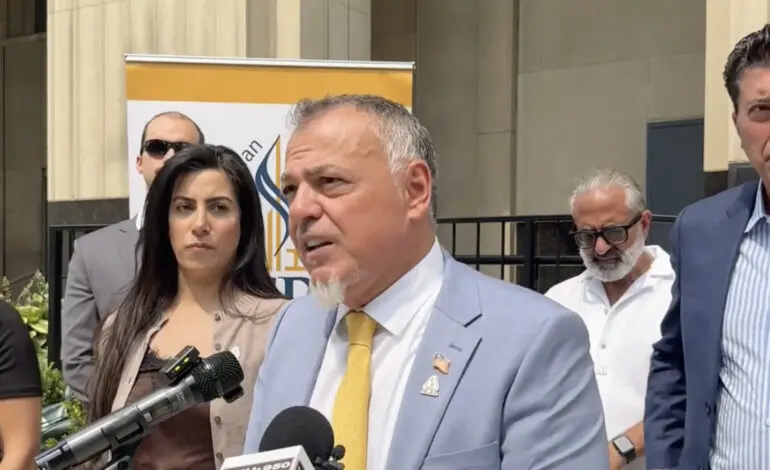

DETROIT — The Arab American Civil Rights League (ACRL) held a news conference outside the federal courthouse in Detroit on Tuesday to announce a proposed class-action lawsuit against U.S. Secretary of State Marco Rubio and three American companies accused of helping enable the Israeli military’s destruction of properties belonging to U.S. citizens and permanent residents in Lebanon.
The 85-page complaint, filed August 11 in the U.S. District Court for the Eastern District of Michigan, names Rubio in his official capacity, The Boeing Company, Lockheed Martin Corporation and Caterpillar Inc. as defendants.
The Arab American Civil Rights League, commonly known as the ACRL, and 17 Lebanese American plaintiffs allege the companies transferred weapons, machinery and related support to Israel despite knowing or having reason to know that the equipment would be used in ways posing an unreasonable risk of serious harm in Lebanon and elsewhere.
The complaint also accuses the State Department of maintaining a pattern of “Israeli exceptionalism” and preferential treatment by failing to enforce the Leahy Law against Israeli military units despite what the plaintiffs describe as extensive, credible evidence of gross human rights violations.
Federal lawsuit seeks damages for Lebanese American properties destroyed by Israel
The Leahy Law refers to federal provisions prohibiting the State and Defense Departments from providing certain assistance to foreign security force units when credible information indicates that those units have committed gross violations of human rights.
The lawsuit alleges that, despite hundreds of reports documenting Israeli violations, the State Department has fundamentally failed to apply the law.
The ACRL filed the case on behalf of U.S. citizens and lawful permanent residents who have owned homes, land or other property in Lebanon since at least April 1, 2024. The plaintiffs allege Israeli military operations destroyed their properties or deprived them of access to them.
The complaint states that the plaintiffs “continue to suffer the indefinitely prolonged threat of death and grievous bodily injury to themselves, their family and their communities, indefinitely prolonged property destruction and expropriation of their lawfully-held land, and acute mental and emotional suffering related to the same.”
Nasser Beydoun, chairman of the ACRL and a named plaintiff, said Israeli forces destroyed his family home in Bint Jbeil. His father built the house after working for Ford Motor Company for more than 30 years.
An estimated 20,000 to 25,000 Lebanese Americans living in Southeast Michigan trace their roots to Bint Jbeil.
The lawsuit asks the court to order a halt to certain transfers of weapons, equipment, technical assistance, software, parts and maintenance support to Israel. It also seeks financial damages for destroyed property, disrupted businesses and the plaintiffs’ alleged psychological and emotional suffering.
The claims against the corporate defendants include negligent entrustment, willful and wanton misconduct, intentional infliction of emotional distress and aiding and abetting trespass to land.
The lawsuit describes the devastation suffered by Lebanese Americans “who watched their homes, family property, businesses, villages and generations of history destroyed from thousands of miles away.”
About 13 pages of the complaint recount the experiences of individual plaintiffs, some identified by name and others by the pseudonyms “John Doe” and “Jane Doe” to protect their identities and privacy.
The plaintiffs have family or property connections to Bint Jbeil, Mays al-Jabal, Ainata, Taybeh, Ramieh, Debbine, Sarbine, Borj Rahal, Hanaway, Nabatieh, Beirut’s southern suburbs and other Lebanese communities.
The publicly identified plaintiffs include people from the Beydoun, Hammoud, Semhat, Harb, Ghandour, Hazimeh, Jammoul, Saleh, Shaito, Moughnieh, Hijazi and Ghaida families, among others.
The case, The Arab American Civil Rights League v. Rubio, was assigned to U.S. District Judge Terrence G. Berg, an appointee of President Obama. The case number is 2:26-cv-12793.
Challenging the “Israeli exception”
After months of gathering reports, records and accounts of property losses, Lebanese Americans have taken their campaign to federal court, relying on the ACRL to challenge what they describe as an “Israeli exception” to U.S. human rights laws and a failure to hold American companies accountable for the destruction of U.S.-owned property in Lebanon.
The ACRL announced in April that it was preparing a proposed class-action lawsuit on behalf of Americans harmed by Israeli military operations in Lebanon. At the time, the organization was recruiting plaintiffs and documenting their losses.
The ACRL takes “Israeli exception” challenge to federal court
“This lawsuit is about more than Lebanon,” Beydoun said during Tuesday’s news conference. “It’s more than Israel. It’s about more than any one administration. It’s about whether the rule of law still means something in America.”
“American citizens have watched their property that their families spent lifetimes building being destroyed in South Lebanon,” he added, calling on the federal judiciary to provide relief.
Nabih Ayad, the ACRL’s founder and lead attorney in the lawsuit, directly criticized Rubio and called on him to enforce the Leahy Law in light of hundreds of reports alleging gross human rights violations by Israeli military units.
“You’ve been handed hundreds in the last year of credible gross human rights violations,” Ayad said. “Do your job.”
Ayad urged the federal judiciary to stand with U.S. citizens affected by the continuing destruction.
“We’re asking the judiciary to stand up to do the right thing under these crises that we’re facing right now,” he said. “The world is watching.”
The complaint argues that the prohibition imposed by the Leahy Law is mandatory and that assistance may not be provided to an implicated unit unless the government of the country involved is taking effective steps to bring those responsible to justice.
The ACRL alleges that throughout the Leahy Law’s approximately 27-year history, the State Department has never declared an Israeli military unit ineligible to receive U.S. assistance.
“There cannot be one standard for the rest of the world and another standard of exceptionalism for the state of Israel,” ACRL Executive Director Houda Berri-Harajli said.
She said the case centers on a basic question: “Are the laws of the United States meant to be enforced equally — or does Israel receive an exception?”
The lawsuit alleges that the U.S. government possesses “credible and abundant information” that Israeli military units have committed gross human rights violations, including acts the plaintiffs characterize as genocide.
Despite that information, the complaint says, the United States has not suspended assistance to any Israeli unit and the State Department has continued approving arms transfers despite repeated reports from organizations including Human Rights Watch and Amnesty International.
Lockheed Martin told Bloomberg Law that it does not comment on pending litigation. The State Department also declined to comment. Boeing, Caterpillar and the Justice Department had not publicly responded to the lawsuit as of its announcement.
The allegations have not been adjudicated, and the defendants have not yet filed their formal responses in court.
The complaint also cites remarks President Trump made in June criticizing Israeli tactics in Lebanon.
“You don’t have to knock down an apartment building every time you’re looking for somebody,” Trump said, according to the complaint. “There are a lot of people in those apartment buildings, and they’re not all Hezbollah.”
Allegations against U.S. companies
The lawsuit accuses Boeing, Lockheed Martin and Caterpillar of negligence in connection with private sales or transfers of American military equipment and related support to Israel.
The complaint alleges that Israeli forces destroyed Lebanese towns and villages using industrial construction equipment, including heavy bulldozers, as well as guided explosives and modified mines.
It describes Boeing as Israel’s largest supplier of munitions by volume. It also alleges that Boeing and Lockheed Martin are contractors connected to a proposed $3.8 billion package involving Apache helicopters and related support for the Israeli forces.
Lawsuit accuses Rubio, Boeing, Lockheed Martin and Caterpillar of ignoring Israeli human rights violations.
According to the complaint, Lockheed Martin supplied a substantial portion of Israel’s aircraft platforms and provides mission support, software, training, maintenance and components for missile systems and joint platforms, including Apache-related systems.
The lawsuit alleges that Caterpillar supplied Israel with bulldozers, replacement parts and related support. It says the equipment has been used for tasks including closing tunnels, clearing roads and removing mines, but also for demolishing civilian homes and infrastructures.
The complaint cites reports from the United Nations, human rights organizations and news outlets concerning alleged Israeli violations in Lebanon. Those reports address the use of white phosphorus, attacks on paramedics and journalists, strikes on residential areas, the September 2024 pager explosions, the ground invasion, home demolitions and attacks that continued after the November 27, 2024 ceasefire agreement.
Demolitions are particularly important to the plaintiffs’ claims because some allege that their homes were not destroyed by airstrikes during active combat. Instead, they say Israeli troops entered and took control of their communities before planting explosives or using American-made bulldozers to demolish their properties.
The complaint alleges that Caterpillar D9 bulldozers are extensively used by the Israeli military, which also receives replacement parts and technical support related to the equipment.
The plaintiffs argue that Caterpillar’s continuing support makes the company legally responsible for contributing to property destruction in southern Lebanon. Caterpillar has not yet filed a response to those allegations.

On April 14, satellite imagery shows the center of Bint Jbeil in southern Lebanon severely damaged, with grey debris patterns suggesting burning consistent with demolitions. By April 23, the remaining buildings and structures had been completely flattened. (Airbus) from CNN
Accounts from the complaint
A sign bearing the name of his late father, Nassim, once stood at the entrance to Abbas Hammoud’s home in Bint Jbeil.
Hammoud built and dedicated the house to his father, who died at age 46. After his death, Hammoud’s mother spent years raising her children in a one-room apartment.
The Bint Jbeil house later became a home for Hammoud, his wife and their 9-year-old son, as well as a gathering place for their extended family.
According to the complaint, that ended on April 18, 2026, when Israeli troops entered the neighborhood on foot, surrounded the property, placed explosive charges around the house and demolished it.
No members of the family were inside at the time.
Two days later, the lawsuit alleges, the same sequence occurred at the home of another U.S. citizen in Bint Jbeil: Israeli troops entered the area, surrounded the residence, planted explosives and destroyed it.
In Aynata, the complaint recounts the experience of Jihad Kamal Semhat, a U.S. citizen who worked for more than 15 years clearing mines and unexploded ordnance with the United Nations.
Semhat and his siblings inherited two properties from their parents in Aynata’s al-Sanassel neighborhood.
One of those homes had previously been the site where his uncle, Mohammad Hammoud, also a U.S. citizen and a former federal employee, was killed in an Israeli strike during the July 2006 war. The house was later rebuilt.
In Ramiyah, the complaint alleges that Israeli forces used manually placed explosives, heavy equipment and bulldozers to demolish buildings in October 2024. The home of U.S. citizen Steve Saleh was allegedly among the structures destroyed.
One of the cases involving Hasbaya is especially significant to the lawsuit’s claims against the American companies.
Anoir Ghaida, a U.S. citizen, owns the Hasbaya Village Club Resort, which was struck by Israel on October 25, 2024, while journalists were staying there.
The strike killed three journalists and injured several others. The journalists killed were Ghassan Najjar and Mohammad Reda of Al Mayadeen and Wissam Qassem of Al Manar.
The complaint says Ghaida repaired the resort after the 2024 attack, only for it to be targeted and destroyed again this past March.
In that instance, the lawsuit relies not only on the plaintiff’s account but also on an investigation by Human Rights Watch.
Human Rights Watch visited the site, interviewed witnesses and examined photographs, videos, satellite imagery and munition remnants. It concluded that the weapon used in the October 2024 strike was equipped with a U.S.-made Joint Direct Attack Munition, or JDAM, guidance kit.
The organization said remnants recovered from the site were consistent with components used in Boeing-assembled JDAM systems.
Human Rights Watch reported that it found no evidence of fighting, military forces or military activity in the immediate area at the time of the attack. Israel initially said its forces had struck a building where “terrorists were operating” but later said the incident was under review.
The plaintiffs cite that investigation as evidence supporting their broader allegation that American-made weapons and equipment were used to destroy their homes, businesses, land and family property in Lebanon.



Leave a Reply